
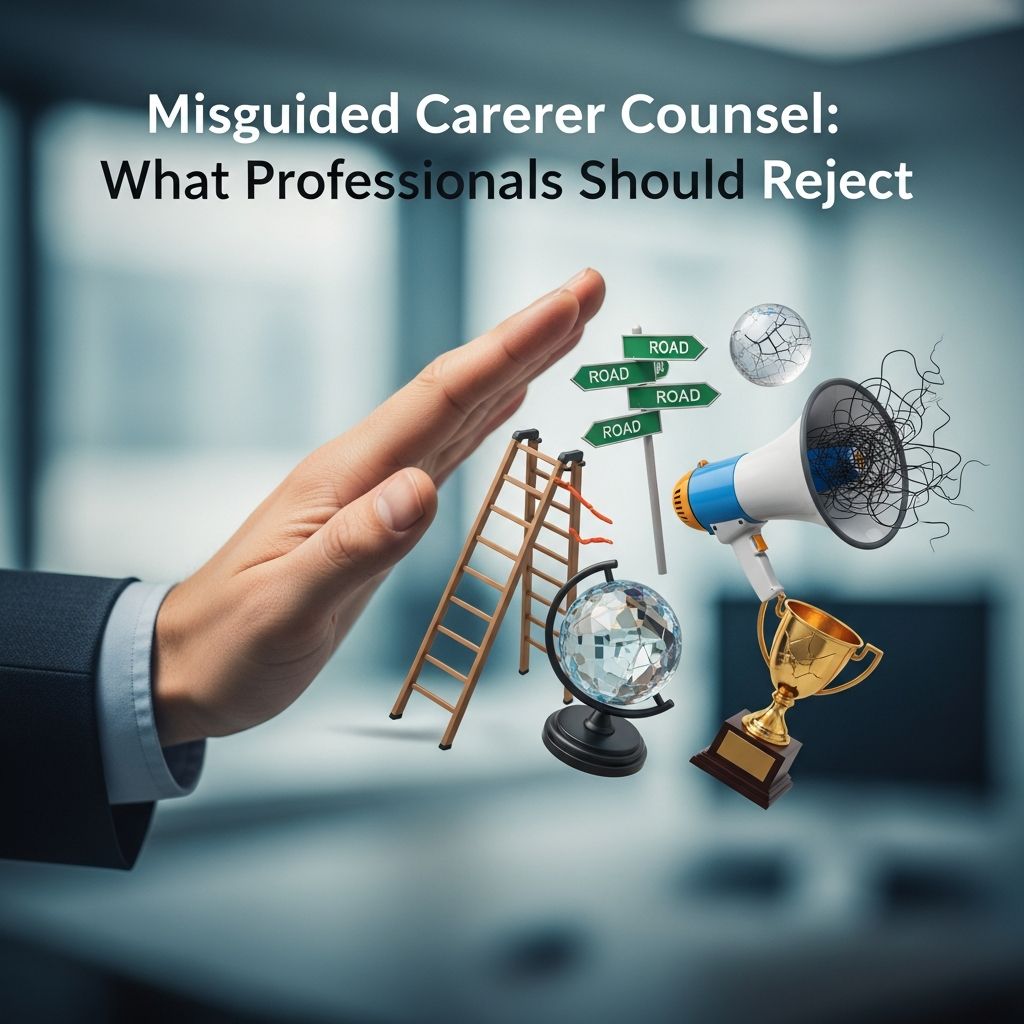
Why Career Advice Often Backfires
The career guidance landscape is filled with well-intentioned but fundamentally flawed recommendations that can derail your professional trajectory. Many professionals receive counsel that sounds compelling on the surface but fails to reflect modern workplace realities. These misleading suggestions often stem from outdated assumptions, survivorship bias, or one-size-fits-all thinking that ignores individual circumstances.
The consequences of following poor career advice extend beyond missed opportunities. Bad guidance can trap you in unsuitable roles, discourage you from exploring promising fields, or push you toward decisions misaligned with your values and strengths. Understanding which recommendations to discard is essential for building a career that genuinely serves your goals.
The Passion Prerequisite Trap
One of the most prevalent pieces of flawed career counsel tells you to “find your passion first, then build your career around it.” This advice creates unnecessary pressure and unrealistic expectations for career planning.
The reality is far more nuanced. Passion often develops through experience rather than preceding it. Most people don’t arrive at their early careers with a clearly defined passion waiting to be monetized. Instead, passion typically emerges as you develop competence, gain mastery, and accumulate experience in your field. By expecting passion to be your starting point, you unnecessarily limit yourself to only roles that feel immediately fulfilling—missing opportunities that could lead to genuine engagement and satisfaction over time.
Rather than pursuing this mythical pre-existing passion, focus on developing expertise in areas that interest you. As you build skills and contribute meaningfully to projects, you’ll often discover deeper engagement with your work. This approach is far more pragmatic and aligns with how most successful professionals actually build their careers.
The First Position Determinism Myth
Another damaging piece of advice suggests your initial role will define your entire career trajectory. This counsel creates anxiety for entry-level professionals and can discourage necessary job changes later in your career.
Today’s employment landscape is fundamentally different from the era when this advice originated. Careers are fluid, with professionals regularly transitioning between roles, industries, and organizational environments. Your first position serves as a learning laboratory, not a destiny marker. It provides valuable insights into your working preferences, reveals your genuine strengths, and clarifies what you want to avoid in future roles.
Consider your initial role as a temporary assignment with educational value rather than a permanent commitment. The skills you develop, relationships you build, and experiences you accumulate become transferable assets for your subsequent opportunities. Many highly successful professionals have had multiple career pivots, entirely different early roles compared to their ultimate positions, or even started in fields completely unrelated to their current expertise.
Compensation as the Ultimate Success Metric
Career advice frequently emphasizes salary maximization as the primary career objective. This counsel oversimplifies what actually contributes to long-term professional satisfaction and success.
Job satisfaction encompasses far more than compensation. Factors including work-life balance, opportunities for professional growth, supportive organizational culture, meaningful work, and alignment with personal values play equally critical roles in career fulfillment. High-paying positions without these elements frequently result in burnout, disengagement, and eventual career transitions—negating any financial advantage.
When evaluating career opportunities, adopt a holistic assessment framework. Consider roles that offer meaningful work, development opportunities, and cultural alignment alongside financial compensation. A position that sacrifices well-being for higher earnings often produces long-term regret. Conversely, roles that balance reasonable compensation with growth potential, purpose, and work-life integration typically yield greater sustained satisfaction and career longevity.
The Educational Credential Guarantee
Traditional career guidance presents formal education as a guaranteed pathway to professional success. This advice, while promoting education’s value, oversimplifies the modern employment equation.
While degrees open doors, they no longer guarantee career success in contemporary job markets. Employers increasingly prioritize practical experience, problem-solving capabilities, adaptability, and soft skills—competencies that frequently extend beyond classroom instruction. A candidate with minimal formal education but substantial relevant experience, demonstrated expertise, and strong interpersonal skills often outcompetes an academically credentialed but inexperienced professional.
Educational credentials provide a foundation, but they represent only one component of career competitiveness. Your professional development should emphasize building real-world experience through internships, project work, volunteer contributions, and continuous learning. Develop a well-rounded skill portfolio that combines formal education with practical capabilities, certifications, and demonstrated achievement. This balanced approach better reflects what employers actually seek and creates genuine competitive advantage.
The Linear Career Path Expectation
Traditional career advice often presents professional development as a linear progression up a predetermined ladder. This counsel fails to account for modern career dynamics and individual circumstances.
Contemporary careers are rarely linear. Professionals now routinely shift between industries, pursue entirely different fields, take career breaks for education or personal reasons, and even restart their careers multiple times. This isn’t career failure—it’s career evolution. Your professional journey is more accurately described as a portfolio approach, where you accumulate diverse experiences, develop varied competencies, and create opportunities by intentionally broadening your experience base.
Rather than rigidly adhering to a predefined career ladder within a single organization or field, embrace flexibility and exploration. Each role contributes unique value to your overall professional narrative. A position that seems like a “step backward” might provide essential skills, connections, or clarity that enables future advancement. Career resilience and optionality—having multiple potential paths forward—create far greater long-term opportunity than strict adherence to a predetermined trajectory.
The Experience Deficit Disqualification
Career advisors sometimes suggest that without directly relevant experience, you cannot transition into desired roles. This counsel unnecessarily restricts career mobility and discourages promising professionals from pursuing growth opportunities.
Transferable skills and demonstrated potential often matter more than identical prior experience. Employers recognize that adaptability, passion, and willingness to learn can outweigh the absence of identical job experience. Entry-level professionals successfully launch careers without prior industry experience. Career changers successfully transition into new fields despite lacking direct experience. Internships, volunteer work, relevant coursework, and demonstrated competencies provide legitimate pathways into roles without requiring identical prior experience.
When pursuing roles where your background isn’t a perfect match, emphasize transferable abilities, demonstrate your commitment to learning, and show how your diverse experiences position you to contribute. Everyone begins somewhere without complete experience requirements. Showcasing potential, dedication, and concrete skills can overcome experience gaps and open doors that rigid experience requirements would otherwise keep closed.
The Comprehensive Skill Requirement Fallacy
Job descriptions often include extensive requirement lists, and traditional advice suggests you must meet every qualification before applying. This counsel causes unnecessary self-elimination from viable opportunities.
Many job descriptions include aspirational qualifications rather than genuine requirements. Hiring managers understand that perfect candidates are rare and often build flexibility into their actual hiring criteria. Research indicates that people—particularly those from underrepresented groups—frequently eliminate themselves from consideration based on incomplete qualification matches, even when hiring teams would seriously consider their applications.
Evaluate job postings strategically. Identify core competencies essential to the role versus nice-to-have qualifications. If you demonstrate strength in fundamental requirements and can credibly communicate how your background positions you to develop missing skills, apply. Your potential employer will decide whether your profile merits consideration rather than you making that decision prematurely.
The Technical Supremacy Misconception
Career guidance sometimes overemphasizes technical skills as the exclusive differentiator in professional advancement. This counsel undervalues soft skills that often prove equally or more important for career progression.
Employers increasingly value soft skills—communication, leadership, teamwork, and emotional intelligence—alongside technical expertise. The most technically skilled candidate doesn’t automatically secure advancement or opportunities. Success requires integrating technical knowledge with interpersonal effectiveness, cultural alignment, and collaborative capability. Professionals who combine solid technical abilities with strong soft skills advance faster and contribute more effectively to organizational objectives.
Develop a balanced skill portfolio. Prioritize technical excellence in your domain while simultaneously cultivating communication capabilities, leadership potential, and emotional intelligence. Pursue opportunities for public speaking, cross-functional collaboration, and mentorship. These soft skill investments often produce greater career returns than additional technical specialization alone.
The Specialization-Only Strategy
Some career advice promotes extreme specialization—diving deeply into a narrow niche and staying there exclusively. While specialization has value, this singular focus can limit opportunity and create vulnerability.
Building professional resilience requires maintaining a portfolio approach. Develop genuine expertise in your primary domain while cultivating complementary skills and remaining aware of adjacent opportunities. This balanced approach provides multiple pathways forward, protects against field-specific disruption, and often generates innovative perspectives that narrow specialists miss. Your diverse experiences and varied competencies become competitive advantages rather than distractions.
The Perpetual Presence Performance Myth
Contemporary career advice sometimes suggests you must constantly demonstrate availability, responsiveness, and visible effort to advance. This counsel promotes unsustainable work cultures and often backfires professionally.
Sustainable career success requires boundaries, recovery time, and well-being protection. Professionals who maintain continuous high visibility and accessibility often experience burnout, reduced creativity, and eventual disengagement. Conversely, those who work effectively within reasonable hours, protect personal time, and prioritize recovery frequently demonstrate better performance, greater retention, and more consistent advancement.
Reject the notion that career success requires perpetual performance. Establish professional boundaries that protect your well-being. Demonstrate value through quality work completed during reasonable timeframes rather than through constant visibility. Your most effective career contributions emerge when you maintain adequate rest, personal renewal, and life balance.
The Cover Letter Irrelevance Assumption
Job application advice sometimes suggests that cover letters are ignored and unnecessary. This counsel causes candidates to miss valuable differentiation opportunities.
While hiring managers’ time is limited, well-crafted cover letters that address specific role requirements and organizational context still influence hiring decisions. Your resume provides credentials; your cover letter provides context, personality, and motivation. For competitive positions, a thoughtful cover letter can differentiate qualified candidates and establish initial impression before interviews occur. Rather than viewing cover letters as unnecessary obligations, use them as strategic communication tools.
FAQs
Q: What’s the most important factor in building a successful career?
A: Rather than any single factor, career success emerges from combining genuine interest in your work, commitment to continuous learning, strong interpersonal relationships, and alignment between your values and professional environment. This balanced approach proves more reliable than pursuing any single factor exclusively.
Q: Can I still succeed without a formal degree?
A: Yes. While degrees provide valuable foundation and opportunity access, success ultimately depends on demonstrated competence, relevant experience, and ongoing skill development. Many professionals have built thriving careers through alternative paths combining practical experience, certifications, and demonstrated expertise.
Q: How many career changes is too many?
A: Career changes are increasingly normal. What matters most is the narrative you construct about these transitions—demonstrating learning, progression, and intentional decision-making rather than erratic job-hopping. Each transition should reflect growth or strategic repositioning.
Q: Should I stay in an unsatisfying job if it pays well?
A: Not necessarily. While compensation matters, roles that severely compromise well-being or alignment often produce long-term costs exceeding short-term financial gains. Consider whether the position offers growth, meaning, or bridge value toward better opportunities before accepting permanent dissatisfaction for compensation.
Q: How do I transition careers without relevant experience?
A: Identify transferable skills, pursue targeted education or certifications, build practical experience through projects or volunteer work, network with professionals in your target field, and communicate how your diverse background contributes unique perspective. Your willingness to learn often outweighs perfect experience alignment.
References
- 5 Career Myths Debunked: Build a Career Path with Confidence — Astria Learning. 2026. https://astrialearning.com/blogs/blog/5-career-myths-debunked-build-a-career-path-with-confidence/
- Debunking Common Job Myths — Robert Walters Australia. 2026. https://www.robertwalters.com.au/insights/career-advice/blog/debunking-common-job-myths.html
- Career Myths and How to Debunk Them — U.S. Bureau of Labor Statistics. 2005. https://www.bls.gov/careeroutlook/2005/fall/art01.pdf
- The ‘Perfect’ First Job and Other Work Myths Debunked — EURES. 2026-01-09. https://eures.europa.eu/perfect-first-job-and-other-work-myths-debunked-2026-01-09_en
- Debunking Three Common Job Search Myths — City University of New York School of Public Health. 2021. https://sph.cuny.edu/wp-content/uploads/2021/10/Debunking-Three-Common-Job-Search-Myths.pdf

- Integrated M.A. in Applied Linguistics, University of Hyderabad
- 5+ years in editorial, instructional, SEO, and research-based writing
Sneha is a relationships and lifestyle writer with a strong foundation in applied linguistics and certified training in relationship coaching. She brings over five years of writing experience to theskillvault, crafting thoughtful, research-driven content that empowers readers to build healthier relationships, boost emotional well-being, and embrace holistic living. Her writing and insights reflect the belief that beauty, happiness, and wellness…