
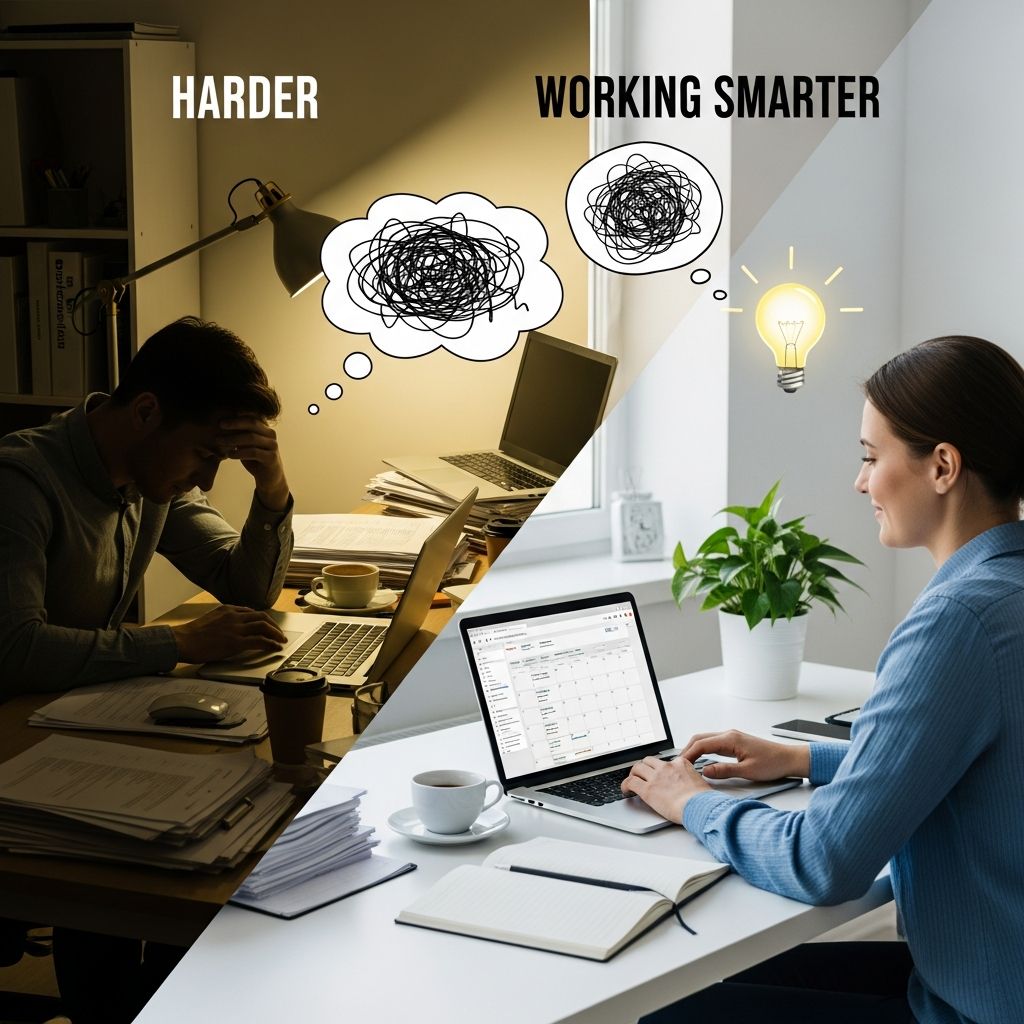
In today’s fast-paced world, the myth persists that longer hours equal greater success. Yet, evidence shows that strategic approaches to work—focusing on quality over quantity—yield superior results. By adopting techniques that prioritize deep focus, timely breaks, and ruthless prioritization, individuals can accomplish more while preserving energy and avoiding burnout.
Understanding the Productivity Paradox
The productivity paradox arises when increased effort leads to diminished returns. Prolonged work sessions often result in fatigue, reduced decision-making quality, and heightened stress levels. Research from cognitive science indicates that the human brain operates optimally in short, intense bursts rather than marathon sessions.
Consider the natural rhythms of attention: after about 25-50 minutes of concentrated effort, mental performance declines. Pushing through this wall doesn’t build resilience; it erodes it. Instead, embracing ‘strategic laziness’—intentionally doing less at key moments—recharges cognitive resources, fostering creativity and problem-solving.
Harnessing Focused Work Bursts
One of the most effective ways to maximize output is through structured work intervals. The Pomodoro Technique, developed by Francesco Cirillo in the late 1980s, divides tasks into 25-minute focused sprints followed by 5-minute breaks. This method combats procrastination by making tasks feel manageable and builds momentum through repeated cycles.
- Step 1: Select a single task and set a timer for 25 minutes.
- Step 2: Work exclusively on that task, eliminating all distractions.
- Step 3: Take a short break to stretch, hydrate, or step away.
- Step 4: After four cycles, take a longer 15-30 minute break.
Users report up to 25% gains in daily output, as this rhythm aligns with ultradian cycles—natural 90-minute waves of high and low energy. For best results, customize intervals: knowledge workers might extend to 50 minutes, while creative tasks suit shorter bursts.
The Power of Intentional Breaks
Counterintuitively, stepping away from work enhances productivity. A 20-minute walk during peak overwhelm clears mental fog, reduces cortisol, and sparks innovative ideas. This ‘diffuse mode’ thinking, as described by neuroscientists, allows subconscious processing of problems.
Environment matters: changing scenery—from desk to park or cafe—disrupts habitual patterns and boosts dopamine, improving mood and motivation. Schedule these micro-breaks daily, especially when stress peaks, to prevent decision fatigue.
| Break Type | Duration | Benefits | Ideal Timing |
|---|---|---|---|
| Movement Break | 5-10 min | Increases blood flow, reduces tension | Every 1-2 Pomodoros |
| Walk Outdoors | 20 min | Enhances creativity, stress relief | Mid-morning or overwhelm |
| Deep Rest | 15-30 min | Restores focus, consolidates learning | After 4 cycles |
Prioritizing High-Impact Tasks
Not all work creates equal value. Identify ‘leverage points’—tasks with outsized impact—and tackle them during peak energy windows, typically mornings for most. Block calendar time for these ‘big rocks,’ treating them as sacred appointments.
Use the Eisenhower Matrix to categorize tasks:
- Urgent and Important: Do immediately.
- Important but Not Urgent: Schedule.
- Urgent but Not Important: Delegate.
- Neither: Eliminate.
This framework, inspired by President Dwight D. Eisenhower, ensures 80% of results come from 20% of efforts (Pareto Principle). Weekly reviews refine priorities, adapting to shifting demands.
Mastering the Art of Single-Tasking
Multitasking is a productivity killer, fragmenting attention and increasing errors by up to 40%. Single-tasking—dedicating full cognitive resources to one activity—enhances speed and quality. Create ‘focus fortresses’ by closing doors, silencing notifications, and signaling unavailability.
Practical tips:
- Batch similar tasks (e.g., emails in dedicated slots).
- Use apps to block distracting sites during deep work.
- Start with a 2-minute rule: if a task takes under 2 minutes, complete it instantly to build momentum.
Delegation and Saying No
Effective leaders delegate to multiply their impact. Assess team strengths and assign accordingly, providing clear briefs and follow-up checkpoints. This frees bandwidth for strategic work while developing others.
Equally vital: mastering ‘no.’ Politely decline low-value requests to protect high-priority time. Phrases like ‘I’d love to, but my plate is full until next quarter’ preserve relationships without overcommitment.
Optimizing Your Environment and Routines
Productivity thrives in optimized settings. Alternate workspaces—a coffee shop for variety or quiet library for focus—combat habituation. Implement ‘no-meeting days’ or mornings to safeguard deep work.
Build rituals: start days with planning, end with reflection. Track energy patterns via journaling to align tasks with natural peaks. Quality sleep (7-9 hours) and exercise amplify all efforts, as per CDC guidelines.
Building Sustainable Habits for Long-Term Gains
Sustainable productivity requires systems, not willpower. Use Personal Kanban: visualize workflows on boards (physical or digital like Trello), limit work-in-progress to 3-5 items, and pull tasks as capacity allows. This prevents overload and ensures steady progress.
Measure success by outcomes, not hours logged. Quarterly audits reveal what’s working, allowing refinements. Over time, these habits compound, turning ‘work less’ into a lifestyle.
Frequently Asked Questions (FAQs)
What if I can’t take breaks during a busy workday?
Start small: even a 2-minute stretch or deep breathing counts. Build to 20-minute walks by communicating boundaries to colleagues.
Is the Pomodoro Technique suitable for all jobs?
Yes, adaptable for most. Creative fields may prefer 50/10 ratios; adapt based on task type and personal rhythm.
How do I convince my team about working less?
Lead by example: share results from your experiments. Frame it as efficiency for collective benefit.
What tools help with single-tasking?
Forest app for gamified focus, Freedom for site blocking, or simple timers. Prioritize analog methods first.
Can these strategies reduce burnout?
Absolutely; by emphasizing recovery and boundaries, they promote balance and resilience long-term.
References
- Do Less If You Want To Be More Productive — The Business Growth Agency. 2024. https://thebusinessgrowthagency.actioncoach.co.uk/less-to-be-more-productive/
- Work Less, Do More Podcast — Apple Podcasts. 2024-10-26. https://podcasts.apple.com/us/podcast/work-less-do-more-proven-productivity-hacks-to-save/id1776337638
- 3 Ways to Increase Your Productivity at Work — National Leadership Council. Accessed 2026. https://nlctb.org/tips/increase-your-productivity-at-work/
- Work Less, Get More Done – Cal Newport’s Slow Productivity — YouTube. 2024. https://www.youtube.com/watch?v=1M4DiPJzCpw

- Integrated M.A. in Applied Linguistics, University of Hyderabad
- 5+ years in editorial, instructional, SEO, and research-based writing
Sneha is a relationships and lifestyle writer with a strong foundation in applied linguistics and certified training in relationship coaching. She brings over five years of writing experience to theskillvault, crafting thoughtful, research-driven content that empowers readers to build healthier relationships, boost emotional well-being, and embrace holistic living. Her writing and insights reflect the belief that beauty, happiness, and wellness…