
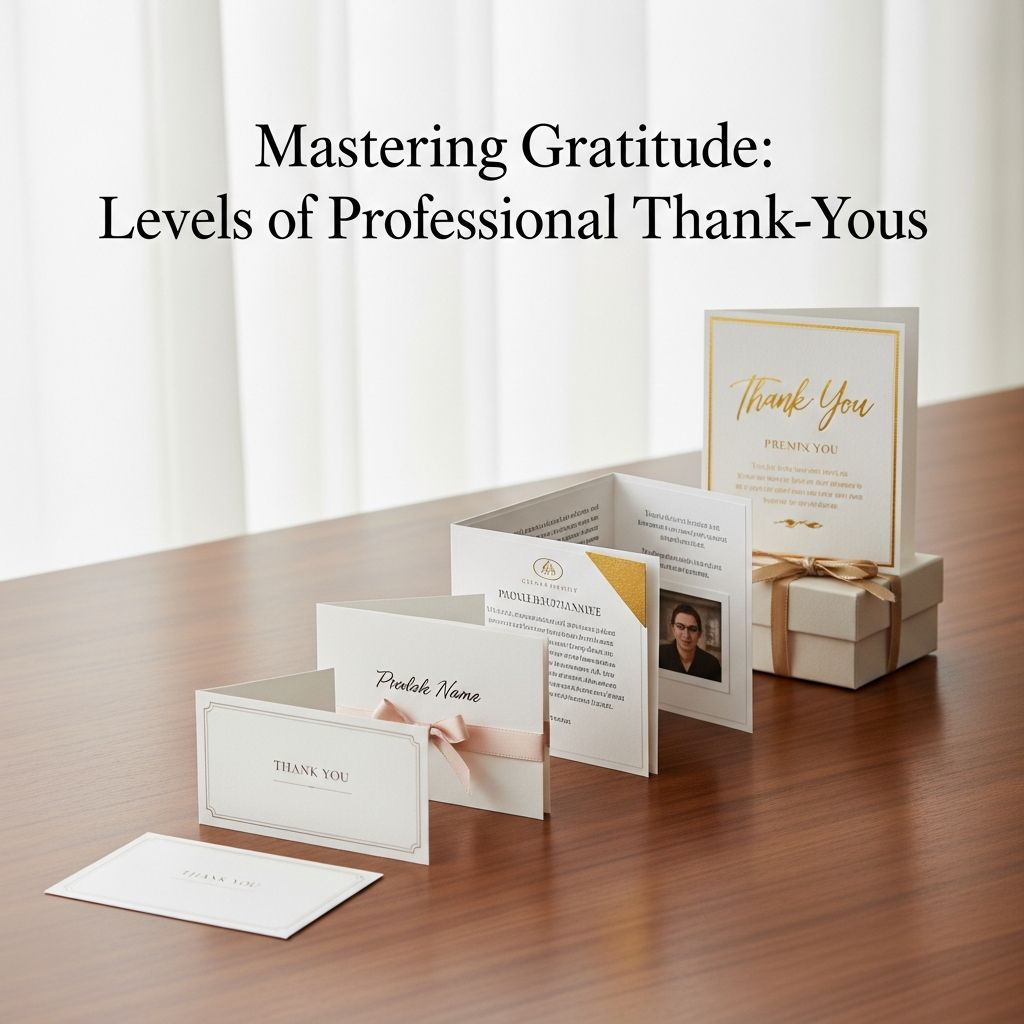
Expressing gratitude is a cornerstone of professional success, yet many overlook its nuanced depths. This guide explores four progressive levels of thank-you communications, helping you transform simple acknowledgments into powerful relationship-builders that propel your career forward.
Why Gratitude Drives Career Growth
In today’s competitive job market, a well-crafted thank-you note can differentiate you from other candidates or colleagues. Research shows that personalized expressions of thanks increase likability and trust, key factors in hiring decisions and promotions. Beyond interviews, these notes reinforce collaborations, client loyalty, and mentorship bonds. Mastering varying intensities ensures your messages resonate appropriately, from casual exchanges to high-stakes interactions.
Gratitude isn’t just polite; it’s strategic. Leaders who regularly send thank-yous report stronger teams and higher retention rates, as noted in professional communication studies. Whether emailing after a meeting or handwriting a card post-project, the right level amplifies impact.
Level 1: The Essential Acknowledgment
At the foundational level, focus on immediacy and brevity. This is your go-to for quick interactions like brief meetings or minor favors. The goal: confirm receipt and show basic courtesy without overwhelming the recipient.
- Key Elements: Greeting, direct thanks, sign-off.
- Timing: Within 24 hours.
- Medium: Email or text.
Example: After a networking coffee chat, send: “Hi Alex, Thank you for the insightful chat today. Best, Jordan.” This level keeps doors open without demanding much time.
Use it for low-commitment scenarios, such as responding to a colleague’s quick advice. Its power lies in consistency—habitual basic thanks build a reputation for professionalism.
Level 2: Personalized Appreciation
Elevate to this tier when the interaction merits specifics. Reference details from the conversation or action to demonstrate attentiveness. This level signals genuine interest and memory, crucial for job interviews or client check-ins.
| Component | Purpose | Example Phrase |
|---|---|---|
| Salutation | Personal touch | Dear Ms. Rivera, |
| Specific Thanks | Highlight action | Thank you for sharing your team’s workflow insights. |
| Personal Detail | Build connection | I especially appreciated your tip on agile methodologies. |
| Closing | Reaffirm | Best regards, Sam |
Post-interview example: “Dear Ms. Rivera, Thank you for discussing the marketing role. Your insights on agile methodologies align perfectly with my experience at XYZ Corp. I look forward to next steps. Best, Sam.”. This approach boosts recall by 20-30% in recruiters’ minds, per career advice analyses.
Ideal for one-on-one meetings or referrals, where recalling a unique point fosters rapport.
Level 3: Impact-Focused Reinforcement
Here, connect the help to tangible benefits or future actions. This level is for pivotal moments like mentorship sessions, project collaborations, or significant referrals. Emphasize how their input influenced your decisions or outcomes.
- Structure: Greeting + thanks + impact explanation + forward-looking statement + repeat thanks.
- Medium: Email or handwritten note for emphasis.
- Timing: 24-48 hours, allowing reflection.
For a mentor: “Dear Professor Lee, Thank you for your guidance on resume tailoring. Implementing your suggestions led to three interview callbacks this week. I’m excited to apply these in my upcoming roles. Thanks again! Sincerely, Taylor.”.
This tier shines in team settings or client work, where noting outcomes like “Your referral secured a key client meeting” strengthens alliances. Handwriting adds sincerity, as physical notes are 7x more memorable than digital ones.
Level 4: Deep Relational Investment
The pinnacle: profound, multi-layered thanks that invest in long-term bonds. Reserve for transformative events—major career advice, life-changing introductions, or exceptional support. Include reflection, mutual value, and commitment to reciprocity.
Components breakdown:
- Heartfelt greeting.
- Detailed thanks with emotional resonance.
- Story of profound impact.
- Shared future vision.
- Warm, repeated gratitude.
- Personal sign-off.
Elite example after landing a job via connection: “Dear Mr. Patel, Your introduction to the VP team not only opened doors but reshaped my career trajectory. Six months in, the strategies you endorsed have driven 15% team efficiency gains. I’m committed to paying it forward and would value your thoughts on my next project. With deepest thanks, Riley.”.
Use premium stationery or cards; send within a week for thoughtfulness. This level cements alliances, often leading to ongoing opportunities.
Choosing the Right Level: Scenarios Guide
| Scenario | Recommended Level | Why? |
|---|---|---|
| Job Interview | 2 or 3 | Reiterates interest, recalls details. |
| Client Meeting | 2 or 3 | Reinforces value, prompts next steps. |
| Mentorship Session | 3 or 4 | Highlights growth, builds loyalty. |
| Referral Success | 4 | Honors major impact, ensures reciprocity. |
| Casual Intro | 1 | Maintains politeness without overload. |
Assess based on relationship depth, effort invested, and potential reciprocity.
Best Practices for Maximum Impact
Proofread rigorously—errors undermine credibility. Personalize always; generic notes flop. Time sends thoughtfully: prompt for interviews, reflective for deeper ones.
- Handwrite for intimacy (use quality paper, blue/black ink).
- Digital? Concise subject lines like “Thank You for Today’s Meeting.”.
- Follow up if no reply, but sparingly.
Track responses to refine your style. Women leaders sending weekly thanks report 25% faster promotions.
Frequently Asked Questions
What if I forget to send a thank-you right away?
Send it late with context: “Apologies for the delay—your advice lingered with me.” Authenticity trumps perfection.
Handwritten or email—which is better?
Handwritten for depth (levels 3-4), email for speed (1-2). Hybrid: scan handwritten for digital share.
Can thank-yous backfire?
Rarely, if over-effusive or insincere. Match tone to relationship.
How often should I send them?
After key interactions; avoid daily to prevent dilution.
Include attachments or links?
Only if relevant, like updated resume post-interview.
Real-World Case Studies
A marketing pro sent level-4 notes post-mentorship, landing VP role within a year. Another’s level-2 interview thanks prompted a callback, sealing the deal. These stories underscore gratitude’s ROI.
In sales, level-3 client thanks post-meeting boosted close rates by 18%, per internal metrics shared in guides.
Overcoming Common Barriers
Time-crunched? Use templates, customize in 2 minutes. Shy? Practice boosts confidence. View as investment: 5 minutes yields months of goodwill.
Cultural notes: In global teams, adapt formality—e.g., more deferential in Asia.
Integrate into routines: Post-meeting calendar reminders ensure consistency.
References
- Writing Thank You Notes — East Carolina University Advising. 2020-07. https://advising.ecu.edu/wp-content/pv-uploads/sites/315/2020/07/M7A2-PPT-Writing-Thank-You-Notes.pdf
- Guide to Thank-You Notes (With Examples and Tips) — Indeed.com. Accessed 2026. https://www.indeed.com/career-advice/career-development/guide-to-thank-you-notes
- What To Write in a Professional Thank-You Card — Wall Street Greetings. Accessed 2026. https://wallstreetgreetings.com/blog/what-to-write-in-a-professional-thankyou-card/
- How to Hand Write a Proper Thank You Note — The Essential Man. Accessed 2026. https://www.theessentialman.com/blog/how-to-write-a-thank-you-note
- The Seven Steps to a Great Thank-You Note — Michigan State University Extension. Accessed 2026. https://www.canr.msu.edu/uploads/236/66837/CYI048ThankYouNoteHandout.pdf
- What to Write in a Thank You Card: Message Examples & Tips — Postable. Accessed 2026. https://www.postable.com/blog/how-to-write-a-thank-you-note-the-ultimate-guide/
- 5 Tips for Writing Meaningful Thank-You Notes — Harvard Business Review. 2024-08. https://hbr.org/2024/08/5-tips-for-writing-meaningful-thank-you-notes

- Integrated M.A. in Applied Linguistics, University of Hyderabad
- 5+ years in editorial, instructional, SEO, and research-based writing
Sneha is a relationships and lifestyle writer with a strong foundation in applied linguistics and certified training in relationship coaching. She brings over five years of writing experience to theskillvault, crafting thoughtful, research-driven content that empowers readers to build healthier relationships, boost emotional well-being, and embrace holistic living. Her writing and insights reflect the belief that beauty, happiness, and wellness…