
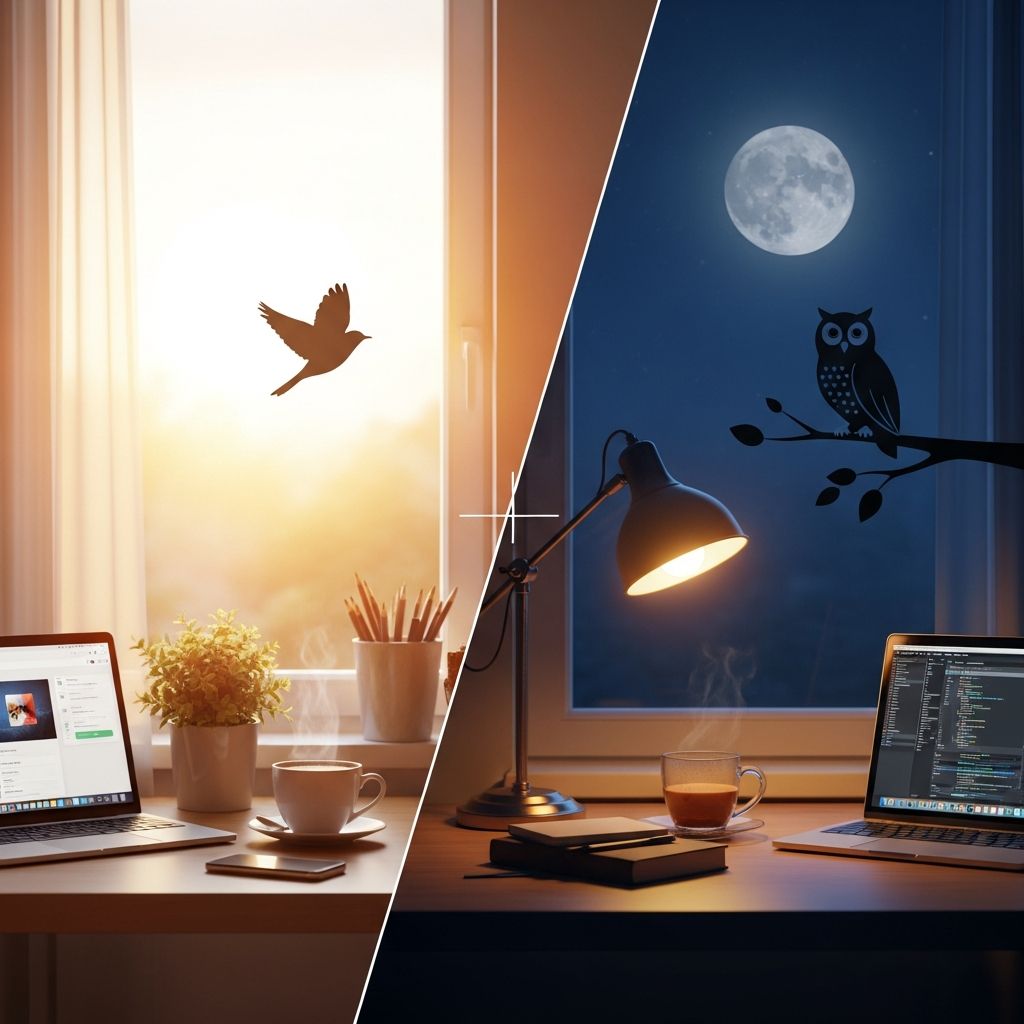
Your natural inclination toward mornings or evenings—known as your **chronotype**—plays a pivotal role in workplace productivity. Morning larks peak early, while night owls thrive after dark, and aligning tasks with these rhythms can boost output significantly.
Understanding Chronotypes: The Science Behind Larks and Owls
Chronotypes refer to individual preferences for activity and alertness dictated by circadian rhythms. Larks, or early birds, feel most energized from dawn through midday, tackling complex tasks with sharp focus. Night owls, conversely, experience delayed peaks, often hitting stride in the late afternoon or evening. Research from Imperial College London reveals that evening types outperform morning-oriented individuals in cognitive tests by 7.5% to 13.5%, suggesting owls may possess heightened mental sharpness.
Genetic factors underpin these differences. Studies indicate chronotypes are partly hardwired, with larks favoring daylight productivity akin to ancestral hunter-gatherers, while modern technology enables owls to extend into nights. A PubMed analysis confirms larks dominate traditional schedules, but owls correlate with advanced cognitive complexity.
Not everyone fits neatly into lark or owl categories. About 80% fall into ‘third bird’ or intermediate types, with moderate energy patterns peaking mid-morning or afternoon.
Energy Patterns: Mapping Your Daily Peaks and Troughs
Larks rise with the sun, channeling high energy into mornings for deep work like strategic planning or creative brainstorming. Energy wanes post-lunch, making evenings suitable for routine tasks.
- Morning Peak (5-11 AM): Optimal for analysis and decision-making.
- Midday Dip: Ideal for short breaks or administrative duties.
- Afternoon Slump: Light tasks only; avoid high-stakes meetings.
Night owls start slow, ramping up by late morning. Their true stride hits 4-9 PM, perfect for innovation when distractions fade. However, prolonged late nights risk sleep debt, impairing long-term performance.
| Chronotype | Peak Hours | Best Tasks | Challenges |
|---|---|---|---|
| Lark | 5 AM – 12 PM | Deep work, meetings | Evening fatigue |
| Owl | 4 PM – 9 PM+ | Creative projects | Morning grogginess |
| Third Bird | 10 AM – 4 PM | Balanced workload | Inconsistent peaks |
Third birds offer flexibility, maintaining steady output midday but needing protection from erratic scheduling.
Workplace Biases: Why Larks Have the Edge (For Now)
Standard 9-5 hours favor larks, who earn 4-5% more on average due to alignment with peak business times. This stems from historical norms glorifying early risers, embedding a cultural bias against owls despite their cognitive advantages.
Larks log more hours and sleep better within rigid structures, amplifying earnings gaps. Yet, as flexible work rises post-pandemic, owls gain ground by negotiating later starts or remote setups.
Strategies for Larks to Dominate Their Day
Morning enthusiasts should ruthlessly guard early hours:
- Rise consistently at 5 AM for 1-2 hours of uninterrupted focus before family or commutes intrude.
- Schedule meetings pre-noon; reserve afternoons for emails and reviews.
- Prioritize sleep hygiene—bed by 9 PM—to sustain peaks.
Avoid evening commitments that erode rest, opting for midday social breaks to recharge.
Empowering Night Owls in a Lark-Centric World
Owls must advocate for adaptations:
- Seek roles with flexible hours, like tech or creative fields, over rigid professions.
- Push later starts (e.g., 10 AM) for deep work from 4-7 PM, minimizing morning meetings.
- Set hard cutoffs (e.g., 1 AM) to prevent burnout; hydrate and eat well during late sessions.
Leverage quiet nights for breakthroughs—research links owl habits to higher intelligence evolutionarily.
Third Birds: Navigating the Middle Ground
Intermediates thrive with time blocking: mornings for prep, afternoons for collaboration. Protect mid-day peaks with calendar buffers against back-to-back calls.
Employer Tactics: Building Chronotype-Inclusive Teams
Leaders boost output by ditching one-size-fits-all schedules:
- Offer flex hours or four-day weeks to match personal rhythms.
- Assign tasks by chronotype—larks for AM crises, owls for PM innovation.
- Use async tools to reduce synchronous meetings, accommodating global teams.
Productivity soars when deep work aligns with peaks, even if just 1-2 hours daily.
Health Risks and Mitigation for Extreme Schedules
Night owls face attention lapses and slower reactions during forced early shifts. Larks risk overexertion if pushing evenings. Counter with naps, light exposure, and caffeine strategically—owls pair it with late fuel like Diet Coke.
Sleep deprivation hits owls harder long-term; enforce recovery days.
Real-World Success Stories
PhD candidates complete theses overnight, journalists file dawn stories via late shifts, and executives negotiate owl-friendly calendars. Flexible firms report higher retention as chronotypes align.
Frequently Asked Questions
Can I change my chronotype?
Partially—gradual shifts via light therapy and routines help, but genetics limit full reversal.
Do night owls underperform at work?
No; they excel cognitively but clash with standard hours. Flexibility equalizes outcomes.
What’s best for team productivity?
Chronotype-aware scheduling outperforms rigid 9-5 by 20-30% in peak alignment.
Are third birds less productive?
On the contrary, their steady energy suits collaborative roles without extremes.
How do I identify my chronotype?
Track energy over a week; tools like the Morningness-Eveningness Questionnaire provide precision.
Future of Work: Chronotypes in the Hybrid Era
As remote and async models dominate, chronotype barriers dissolve. Owls lead night-side innovations, larks own mornings, fostering diverse high-performers. Embrace your rhythm—productivity follows authenticity.
References
- Productive study habits exposed: Larks versus night owls — 100daystothedoctorate.wordpress.com. 2013-07-11. https://100daystothedoctorate.wordpress.com/2013/07/11/productive-study-habits-exposed-larks-versus-night-owls/
- The Case for Night Owls and Flexible Work Hours — Productivity Report. 2016-07-25. https://productivityreport.org/2016/07/25/the-case-for-night-owls-and-flexible-work-hours/
- Night Owls vs. Morning Larks: Who’s Really More Productive? — ContactZilla. N/A. https://contactzilla.com/night-owls-vs-morning-larks-whos-really-productive/
- The ideal week for Larks, Owls, and Third Birds — Morgen. N/A. https://www.morgen.so/blog-posts/the-ideal-week-for-larks-owls-and-third-birds
- Correlation of Chronotype (Lark versus Night Owl Status) with Mind… — PubMed (NCBI). 2021. https://pubmed.ncbi.nlm.nih.gov/34102094/
- Being a ‘night owl’ is associated with mental sharpness, study shows — Imperial College London. N/A. https://www.imperial.ac.uk/news/254738/being-night-associated-with-mental-sharpness/
- When You Do Things Matters — Ashley Janssen. N/A. https://ashleyjanssen.com/when-you-do-things-matters/

Medha Deb is an editor with a master's degree in Applied Linguistics from the University of Hyderabad. She believes that her qualification has helped her develop a deep understanding of language and its application in various contexts. Medha specializes in the areas of beauty, health, sports, and wellness and is committed to ensuring that the content on the website is…