
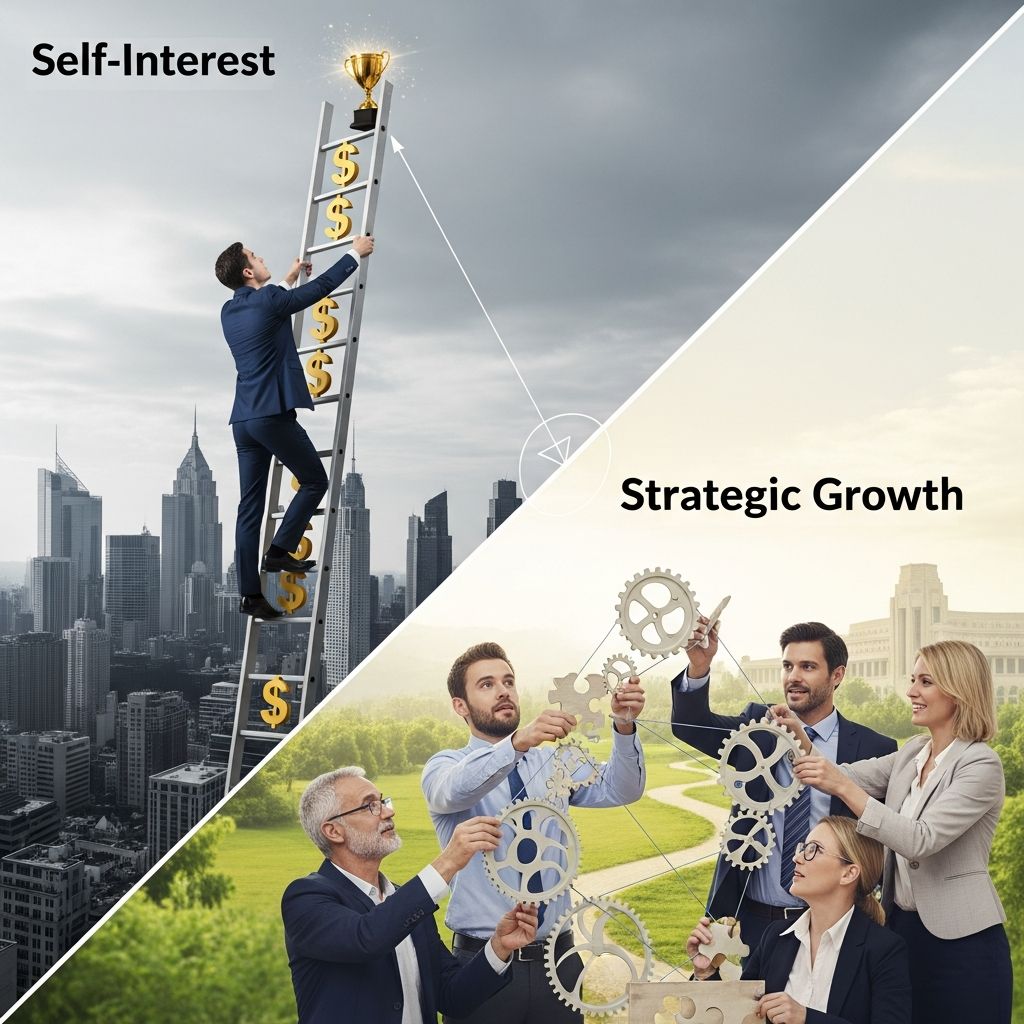
Every career milestone presents a critical juncture where the way you approach decision-making determines your trajectory. Whether you’re evaluating a job offer, considering a career pivot, or deciding which opportunities to pursue, the quality of your choices shapes your professional future. Yet many professionals fail to recognize that their own psychological biases—particularly the tendency to prioritize immediate gratification and personal status—quietly undermine their decision-making processes. This cognitive blind spot often goes undetected because it feels natural and justified from the inside.
The Silent Saboteur: How Self-Centered Thinking Derails Careers
When facing a significant career decision, most people believe they’re being rational and strategic. In reality, self-interest operates as a powerful undercurrent that distorts perception and clouds judgment. This isn’t about deliberate deception; rather, it’s a fundamental psychological tendency where the ego filters information through a self-serving lens. You interpret data differently when your status or financial gain hangs in the balance compared to when you’re advising someone else on an identical situation.
The mechanisms of self-interest in career decisions manifest in several recognizable patterns:
- Pattern recognition bias: Experienced professionals often rely on what they’ve seen before, assuming past outcomes predict future results. This shortcut feels efficient but prevents genuine consideration of novel approaches or changing market conditions.
- Confirmation filtering: You naturally seek information that supports the decision you’re already leaning toward while dismissing contradictory evidence as irrelevant or flawed.
- Status preservation: Decisions that protect your current position, title, or peer perception receive disproportionate weight compared to options that might offer greater long-term value but require admitting uncertainty or making a lateral move.
- Immediate reward preference: The tangible benefits visible today (higher salary, prestigious title, familiar environment) outweigh abstract future benefits that require patience and delayed gratification.
The Expertise Paradox: When Knowledge Breeds Overconfidence
There exists a troubling correlation between career experience and inflated confidence in one’s judgment. Early in your professional life, you operate with appropriate humility. You ask questions, verify assumptions, and actively seek feedback because you’re acutely aware of knowledge gaps. This openness is an asset.
However, as you advance and accumulate successes, a psychological shift occurs. You begin to trust your instincts more heavily. You think, “I’ve navigated similar situations successfully before, so I understand how this will unfold.” What feels like wisdom is often just overconfidence disguised as experience.
This paradox becomes especially problematic in strategic roles where the stakes are highest. Leaders responsible for major decisions carry both extensive expertise—which organizations rightfully value—and the subtle arrogance that expertise can cultivate. The very credentials that qualified you for the role can become liabilities if they feed an assumption that you’ve already learned everything critical to your success.
Recognizing the Mental Echo Chamber
One of the most insidious consequences of self-interested decision-making is the creation of an internal echo chamber. When your ego shapes your thinking, you become resistant to genuine challenges to your viewpoints. This doesn’t necessarily manifest as outward defensiveness or hostility; instead, it appears as a subtle unwillingness to seriously consider alternative perspectives.
Someone might present data contradicting your intended direction, yet you find yourself dismissing it with reasons that feel logical in the moment: “The sample size is too small,” “That doesn’t apply to our situation,” or “I’ve tried something similar before.” What you’re actually doing is protecting a decision you’ve already emotionally invested in rather than objectively evaluating the evidence.
For your career specifically, this mental narrowing means:
- You reject feedback from colleagues who could offer valuable perspective on how your decisions affect others
- You dismiss alternative career paths without genuinely exploring their potential
- You rationalize staying in situations that no longer serve your growth because leaving would require acknowledging the original decision was imperfect
- You fail to adapt when market conditions shift because admitting you need to change feels like admitting failure
The Organizational Costs of Ego-Driven Selection
While the personal costs of self-interested career decisions are significant, the ripple effects extend outward. When individuals in positions of influence make choices primarily to protect their status or image, entire teams and organizations suffer. High-performing talent becomes repelled by environments where credit flows upward but blame distributes downward. Promising initiatives get rejected because someone with authority has already publicly committed to a different direction. Adaptation slows because admitting past decisions weren’t optimal becomes impossible without losing face.
The accumulation of ego-driven decisions creates organizational drag—a persistent friction that slows progress and reduces competitive advantage. This isn’t always visible as dramatic failure; more often it appears as chronic underperformance, missed market opportunities, and the gradual departure of talented people who decide to pursue careers elsewhere.
Constructing an Objective Decision Framework
Recognizing the problem is necessary but insufficient. The real challenge lies in building systems and practices that counteract your natural self-interest during moments when decisions matter most.
Invite and Reward Dissenting Views
Establish a deliberate practice of seeking out disagreement. This requires more than passive openness; you must actively reward people for challenging your thinking. In your career decisions, this means explicitly asking trusted colleagues or mentors: “What concerns do you have about this choice? What am I not seeing?” The key is demonstrating through your responses that you genuinely value critical feedback. When someone offers a contrarian perspective and you dismiss it, you’ve just trained everyone in your network to withhold valuable insights in the future.
Conduct a Pre-Decision Analysis
Before committing to a significant career move, conduct what might be called a “failure simulation.” Imagine yourself one year into this decision, and the outcome has been disappointing. What went wrong? What warnings did you ignore? What assumptions proved false? By deliberately imagining negative scenarios before they occur, you accomplish two things: you identify risks that optimism bias had hidden, and you inoculate yourself against the shock of unexpected criticism. When you’ve already mentally rehearsed objections, your ego is less likely to activate defensive responses when those objections materialize.
Separate Decisions from Identity
Much of the ego’s power in career decisions stems from a fundamental confusion: treating a choice as a reflection of your worth as a professional. A rejected job application feels like personal rejection. Changing directions feels like admitting past choices were mistakes. Accepting feedback feels like conceding you’re not as competent as you believed.
Break this linkage explicitly. Your decision is not your identity. A poor career choice doesn’t make you a poor professional any more than a excellent choice makes you excellent. Decisions are tools you use to move forward; they’re not measures of your inherent capability. This psychological separation is liberating because it allows you to evaluate choices on their actual merits rather than on what they seem to say about you.
The Alignment Between Personal Purpose and Career Direction
One of the most effective antidotes to ego-driven career decisions is connecting your choices to a purpose larger than yourself. When a leader is genuinely motivated by a mission that transcends personal advancement—serving customers meaningfully, developing people around them, solving a substantive problem—their personal ego naturally takes a subordinate role.
This doesn’t mean ignoring practical considerations like compensation or stability. Rather, it means ensuring these factors support rather than define your career trajectory. If your primary metric for success is how quickly you accumulate titles or financial rewards, you’re vulnerable to the distortions that self-interest creates. If your primary metric is how effectively you execute your mission and whether you’re growing in capability, you have a stabilizing reference point for decisions.
Ask yourself genuinely: What problem am I trying to solve through my career? Who am I trying to serve? What capability am I committed to developing? When facing a choice, evaluate options against these anchors rather than against how impressive each option makes you appear.
Practical Mechanisms for Accountability
Understanding these principles intellectually and implementing them behaviorally are different challenges. Consider establishing concrete mechanisms that force more objective thinking:
- Written documentation: Before making a significant decision, write down your reasoning, your assumptions, and your predicted outcomes. Return to this document annually to see what you got right and wrong. This creates feedback loops that gradually improve your judgment.
- External review: For major decisions, present your thinking to someone you respect who has no stake in your choice. Their external perspective naturally counterbalances your internal bias.
- Decision criteria established beforehand: Before searching for opportunities, write down what criteria matter most: compensation range, growth potential, mission alignment, location, team culture. When you later evaluate specific opportunities, measure them against this predetermined rubric rather than letting each opportunity redefine what success looks like.
- Scheduled reflection: Create regular opportunities to assess whether current career direction still aligns with your broader purpose. Without these scheduled moments, momentum and routine can masquerade as deliberate choice.
Building a Career Legacy Rather Than a Career Image
The distinction between ego-driven and legacy-driven career decisions is fundamental. Ego-driven choices prioritize how you appear: securing impressive titles, working for prestigious organizations, acquiring visible recognition. Legacy-driven choices prioritize what you actually build: the capabilities you develop, the people you help advance, the problems you solve, the organizations you strengthen.
These don’t always conflict. Sometimes the prestigious opportunity also offers genuine growth. But when they diverge—when the impressive-looking choice conflicts with actual development—legacy thinking provides clarity. A lateral move to develop a critical skill might feel less prestigious than a promotion into a familiar domain. Taking time to deeply master your craft might look less impressive than rapidly accumulating titles. But which actually builds the foundation for sustained career success?
The Path Forward
Your ego will continue to operate in the background of your career decisions; that’s unavoidable. What’s avoidable is allowing it to operate without oversight. By building awareness of how self-interest distorts thinking, establishing systems that force more objective evaluation, connecting decisions to purpose beyond personal advancement, and creating accountability mechanisms, you dramatically improve the quality of your career choices.
The professionals who create genuine, sustained success in their careers aren’t those with the most impressive resumes or the highest salaries. They’re those who learned to distinguish between feeling right and being right, between protecting their image and advancing their capability, between decisions that serve today’s ego and decisions that serve tomorrow’s professional life.
References
- Ego and Decision-Making Never Belong Together — The Corporate Governance Institute. 2024. https://www.thecorporategovernanceinstitute.com/insights/thought-leadership/ego-and-decision-making/
- After So Many Ego-Driven Career Decisions, I Think I’m Finally Done — Substack. 2024. https://substack.com/home/post/p-127849773
- Ego Depletion: The More Decisions You Make, the Worse They Become — Welcome to the Jungle. 2023. https://www.welcometothejungle.com/en/articles/ego-depletion-decision-fatigue
- Ego in Leadership: How to Tame It for the Greater Good — ITD World. 2024. https://itdworld.com/blog/leadership/ego-in-leadership/
- Ego Decisions vs. Legacy Decisions — TeamBuildr Blog. 2023. https://blog.teambuildr.com/ego-decisions-vs.-legacy-decisions

Medha Deb is an editor with a master's degree in Applied Linguistics from the University of Hyderabad. She believes that her qualification has helped her develop a deep understanding of language and its application in various contexts. Medha specializes in the areas of beauty, health, sports, and wellness and is committed to ensuring that the content on the website is…