
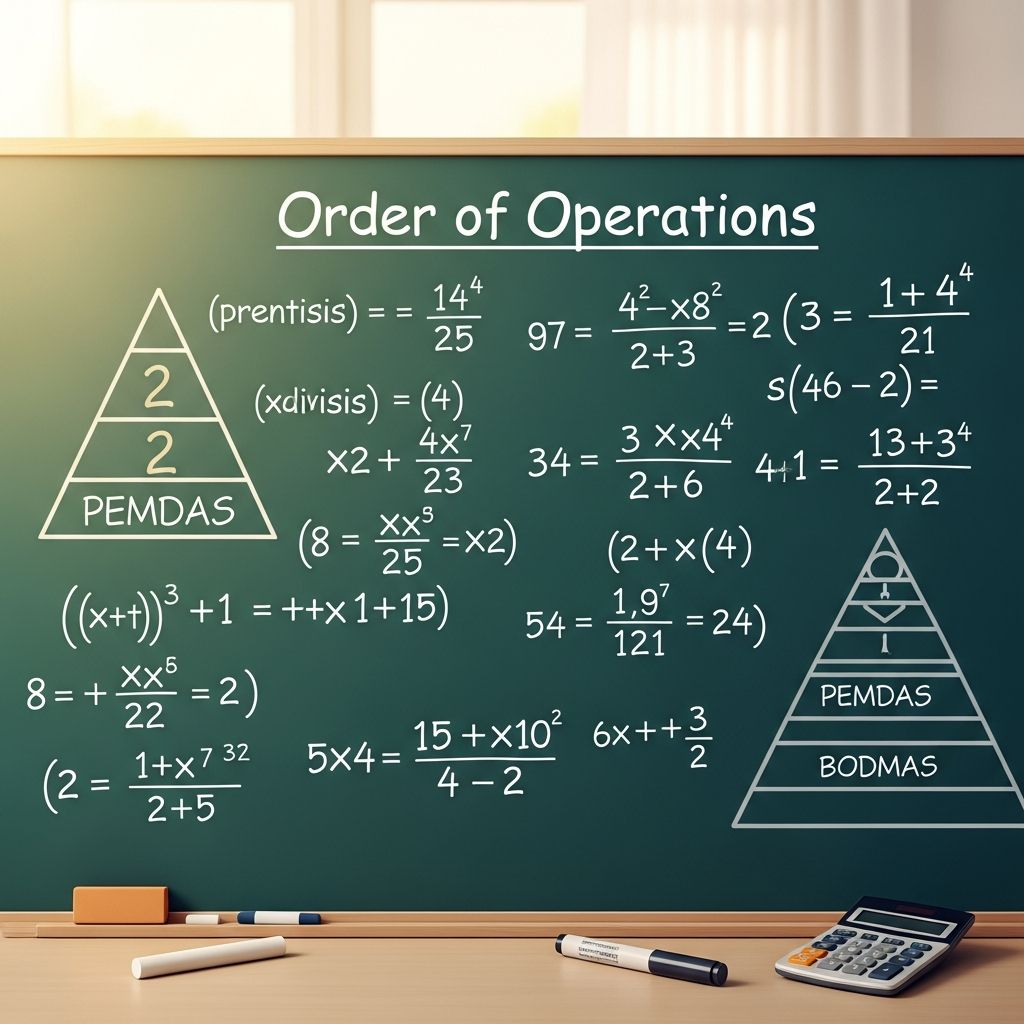
The order of operations serves as the foundational framework for evaluating mathematical expressions accurately. Without it, simple calculations could yield wildly different results depending on personal interpretation. This guide delves into the principles, applications, and nuances of this critical concept, empowering learners at all levels to compute with confidence.
Understanding the Core Principle
At its heart, the order of operations dictates a specific sequence for performing arithmetic tasks within an expression. This sequence prevents ambiguity, ensuring that 2 + 3 × 4 always equals 14, not 20. The standard acronym used in many regions is BODMAS, representing Brackets, Orders (or Of, for exponents), Division, Multiplication, Addition, and Subtraction. Each letter signals a priority level, with brackets holding the highest precedence.
This rule applies universally to expressions involving multiple operators. By following it systematically, mathematicians worldwide achieve consistent outcomes, much like a universal language for numbers.
Breaking Down Each Component
Let’s examine the hierarchy step by step to build a solid understanding.
1. Brackets: The Starting Point
Brackets, including parentheses (), square brackets [], and curly braces {}, command immediate attention. They group terms that must be resolved first, isolating sub-expressions for priority calculation. Begin with the innermost brackets and progress outward.
For instance, consider 10 × (5 + 3). First, compute inside the brackets: 5 + 3 = 8. Then multiply: 10 × 8 = 80. Nested brackets add layers; solve sequentially from inside out.
2. Orders: Powers and Roots
Next come orders, encompassing exponents, powers, square roots, and similar operations. These represent repeated multiplication, like 2³ meaning 2 × 2 × 2 = 8. Roots, such as √16 = 4, follow suit.
In 4 + 2³ – 1, calculate 2³ = 8 first, yielding 4 + 8 – 1 = 11. Remember, exponents precede multiplication or division.
3. Division and Multiplication: Equal Partners
Division (÷) and multiplication (×) share the same precedence level. Perform them from left to right, regardless of which appears first. This left-to-right rule is crucial to avoid errors.
Take 12 ÷ 3 × 2. Divide first: 12 ÷ 3 = 4, then multiply: 4 × 2 = 8. Reversing order would incorrectly give 8.
4. Addition and Subtraction: The Final Layer
Last are addition (+) and subtraction (-), also equal in precedence and evaluated left to right. They form the base after higher operations clear.
In 10 – 4 + 2, subtract first: 10 – 4 = 6, then add: 6 + 2 = 8.
Visual Hierarchy Table
| Level | Operation | Symbol | Direction |
|---|---|---|---|
| 1 | Brackets | ( ), [ ], { } | Innermost to outermost |
| 2 | Orders | ^, √ | Left to right |
| 3 | Division & Multiplication | ÷, × | Left to right |
| 4 | Addition & Subtraction | +, – | Left to right |
This table summarizes the sequence for quick reference, mirroring the BODMAS flow.
Practical Examples Across Difficulty Levels
Applying the rule to varied problems reinforces mastery. Here are progressively complex cases.
Basic Expression
Solve 6 + 4 × 3 – 2.
- Multiplication first: 4 × 3 = 12
- Then: 6 + 12 – 2
- Addition: 6 + 12 = 18
- Subtraction: 18 – 2 = 16
Result: 16.
With Brackets and Exponents
Evaluate (8 – 2)² ÷ 3 + 1.
- Brackets: 8 – 2 = 6
- Exponent: 6² = 36
- Division: 36 ÷ 3 = 12
- Addition: 12 + 1 = 13
Result: 13.
Advanced Nested Case
Compute 20 ÷ [4 + {2² – (3 × 1)}] × 5.
- Innermost: 3 × 1 = 3
- Then: 2² – 3 = 4 – 3 = 1
- Curly braces: 4 + 1 = 5
- Square brackets: 20 ÷ 5 = 4
- Multiplication: 4 × 5 = 20
Result: 20.
Common Mistakes and How to Avoid Them
Even experienced solvers falter. Awareness of pitfalls is key.
- Ignoring Left-to-Right for Same-Level Ops: In 10 × 2 ÷ 5, always left to right: 20 ÷ 5 = 4, not 10 × (2 ÷ 5).
- Misordering Brackets: Start innermost; outer ones wait.
- Forgetting Exponents: Powers before multiply/divide.
- Assuming D Before M Always: No—left to right trumps acronym letter order.
Avoid these by verbalizing steps aloud or writing them sequentially.
Real-World Applications
Beyond classroom, order of operations underpins engineering, finance, and programming. In budgeting, (income – expenses) × savings_rate calculates correctly only with brackets. Spreadsheets and coding languages like Python enforce PEMDAS/BODMAS equivalents to prevent errors.
In physics formulas, such as kinetic energy = ½ m v², the exponent on velocity precedes multiplication, yielding precise results.
Variations Across Regions
While BODMAS dominates in the UK and Commonwealth, the US uses PEMDAS (Parentheses, Exponents, Multiplication/Division, Addition/Subtraction). BEDMAS or BIDMAS appear elsewhere, but the logic remains identical: brackets/parentheses first, etc. Core sequence is universal.
Practice Exercises
Test your skills with these:
- 15 – 3 × 2 + 4 = ?
- (9 ÷ 3)² – 5 = ?
- 2 + 8 ÷ 4 × (6 – 4) = ?
Solutions: 1. 7; 2. 9; 3. 6. Work them out before checking.
Interactive Worksheet Ideas
For educators or self-learners:
- Create 10 expressions mixing all operations.
- Time yourself solving without a calculator.
- Pair with a partner to verify answers.
Progress to word problems: “If 5 apples cost $2 each and you buy 3 more than twice the cost in oranges at $1 each, total cost?” (Brackets needed for clarity.)
Frequently Asked Questions
What does BODMAS stand for?
BODMAS means Brackets, Orders, Division, Multiplication, Addition, Subtraction—a mnemonic for operation priority.
Does division always come before multiplication?
No. Both have equal precedence; go left to right.
How do I handle multiple bracket types?
Solve innermost first, regardless of type, moving outward.
Is PEMDAS different from BODMAS?
Only in wording; sequence is the same.
What if no brackets are present?
Proceed to orders, then DM left-to-right, then AS left-to-right.
Advanced Tips for Mastery
Memorize via mnemonics or flashcards. Use calculators that respect order (most do). In exams, show steps for partial credit. For algebra, apply to variables similarly: solve exponents before coefficients.
Explore extensions like vinculum (overlines) as bracket equivalents or fractional exponents. Practice daily to internalize.
References
- BODMAS Rule Examples — Cuemath. 2023. https://www.cuemath.com/numbers/bodmas-rule/
- BODMAS Explained – Order Of Mathematical Operations — The Calculator Site. 2023. https://www.thecalculatorsite.com/articles/math/bodmas-order-of-operations.php
- Order of Operations – BODMAS Rule — BYJU’S. 2023. https://byjus.com/maths/bodmas-rule/
- What is the Order of Operations in Maths (BODMAS)? — Doodle Learning. 2023. https://doodlelearning.com/maths/skills/numbers/order-of-operations
- Order of Operations – BODMAS — Maths Is Fun. 2023. https://www.mathsisfun.com/operation-order-bodmas.html

Medha Deb is an editor with a master's degree in Applied Linguistics from the University of Hyderabad. She believes that her qualification has helped her develop a deep understanding of language and its application in various contexts. Medha specializes in the areas of beauty, health, sports, and wellness and is committed to ensuring that the content on the website is…