
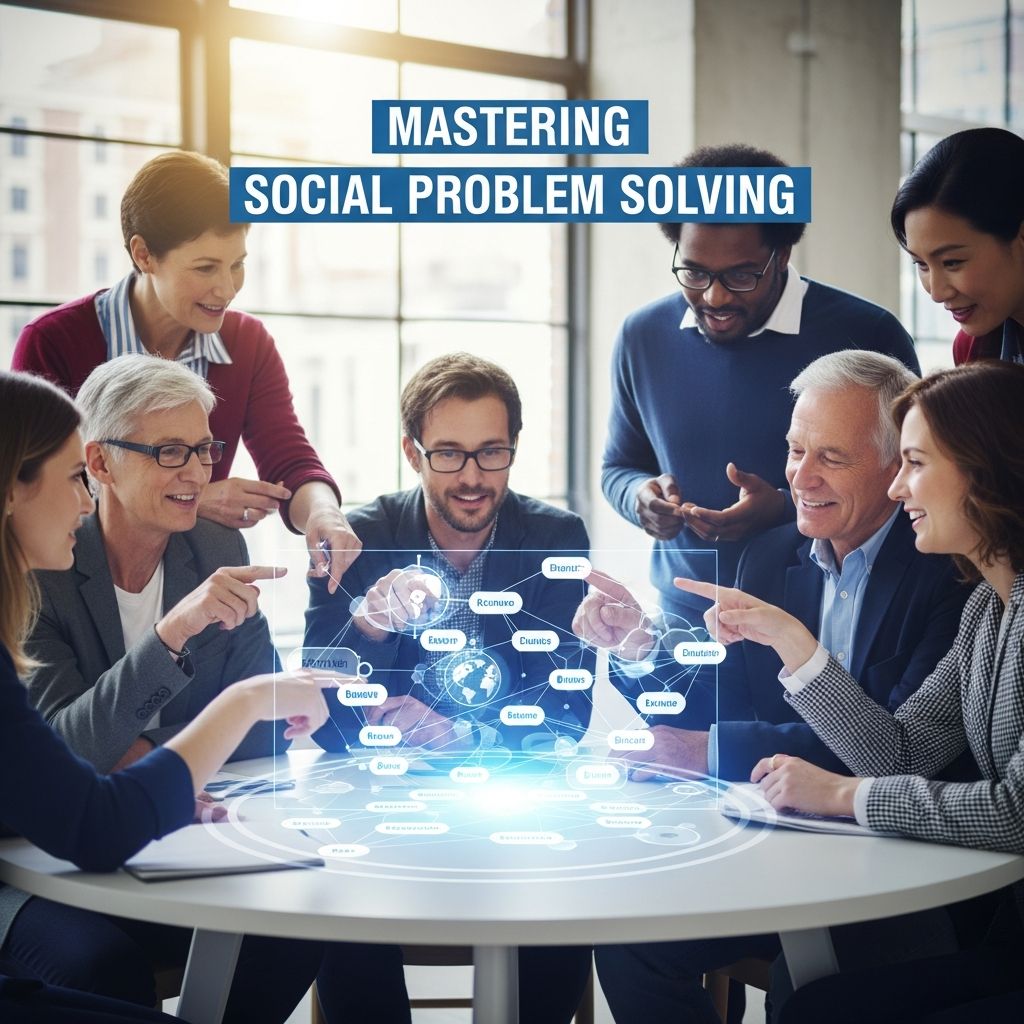
Social problem solving refers to the cognitive and behavioral processes individuals or groups use to address real-world challenges effectively. This skill set enables people to navigate personal dilemmas, relational tensions, financial hurdles, and broader community issues with confidence and clarity.
Understanding the Scope of Social Challenges
Everyday life presents a variety of obstacles that demand thoughtful responses. These range from internal struggles like managing stress or health concerns to external pressures such as budget constraints or neighborhood disputes. Unlike abstract puzzles, social problems involve human elements, emotions, and unpredictable outcomes, making them uniquely demanding.
Key categories include:
- Personal issues: Emotional distress, health setbacks, or self-doubt that affect individual well-being.
- Interpersonal conflicts: Miscommunications or disagreements with family, friends, or colleagues.
- Impersonal hurdles: Practical matters like financial shortages or logistical barriers.
- Community concerns: Larger-scale problems such as local safety issues or environmental neglect.
Recognizing these distinctions helps tailor approaches, ensuring solutions fit the context.
Core Components of Effective Problem Resolution
At its heart, social problem solving breaks down into identifying the issue, exploring options, selecting a path forward, and executing it. A foundational model outlines this as a self-guided effort where no external directive exists, emphasizing personal agency.
| Component | Description | Example |
|---|---|---|
| Problem Identification | Pinpointing the exact nature of the challenge without preconceptions. | Noticing persistent arguments with a roommate over chores. |
| Solution Generation | Brainstorming multiple viable ideas creatively. | Listing schedules, shared apps, or hired help. |
| Decision Making | Evaluating pros, cons, and feasibility. | Choosing a shared calendar for its low cost and ease. |
| Implementation | Putting the plan into action and monitoring results. | Setting up the app and reviewing after a week. |
This structured breakdown, drawn from established frameworks, promotes rational outcomes over impulsive reactions.
Building a Positive Mindset for Challenges
A constructive attitude forms the bedrock of successful resolution. This involves viewing obstacles as surmountable rather than overwhelming, fostering self-efficacy and optimism. Individuals with this orientation approach issues methodically, believing in their capacity to adapt.
Negative mindsets, conversely, amplify avoidance or defeatism, hindering progress. Cultivating positivity includes:
- Reframing problems as opportunities for growth.
- Acknowledging emotions without letting them dominate.
- Drawing on past successes to build confidence.
Research links this mindset to reduced anxiety and better coping in diverse scenarios.
Step-by-Step Guide to Resolving Social Issues
Navigating challenges systematically boosts efficacy. Here’s a proven sequence adaptable to most situations.
- Acknowledge the Issue: Pause to confirm a problem exists. Signs include recurring frustration or stalled progress.
- Define Clearly: Articulate what’s wrong, who’s involved, and desired changes. Use specifics: “I feel overlooked in meetings” versus vague complaints.
- Generate Options: List ideas freely, including unconventional ones. Collaborate if interpersonal.
- Evaluate Choices: Weigh benefits, risks, resources needed, and alignment with values.
- Act Decisively: Commit to one option and outline steps.
- Review Outcomes: Assess effectiveness post-implementation; adjust as needed.
Repeating this cycle refines skills over time, turning novices into adept solvers.
Practical Techniques for Everyday Application
Beyond theory, hands-on methods embed these skills. For immediate fixes, observe surroundings or seek quick advice. For complex matters, employ brainstorming sessions—solo or group—to spark innovation.
Flexible thinking shines when standard solutions falter. Prompt questions like “What’s another way to achieve this?” or “What worked before in a similar spot?” encourage adaptability. In child development, educators guide youth through such exercises, fostering independence from early ages.
Navigating Interpersonal Dynamics
Conflicts with others demand empathy alongside logic. Start by understanding perspectives: active listening reveals unspoken needs. Then, propose mutual gains, framing solutions collaboratively.
Example: In a team dispute over project roles, define each person’s contributions, brainstorm equitable divisions, and trial the arrangement. This preserves relationships while resolving tensions.
Enhancing Skills in Children and Youth
Early training yields lifelong benefits. Programs teach kids to self-regulate emotions first, creating space for clear thinking. Activities like role-playing peer squabbles build empathy and strategy.
For instance, when a child faces playground exclusion, guide them to identify feelings, consider alternatives like inviting others, and evaluate results. Digital tools and games further reinforce these through interactive scenarios.
Applications in Professional and Community Arenas
In workplaces, these skills drive teamwork and innovation. Leaders model calm analysis during crises, inspiring teams. Community efforts, like addressing litter, involve collective brainstorming and sustained action.
Therapeutic contexts leverage this for mental health: structured sessions reduce depressive symptoms by empowering problem-focused coping. Offender rehabilitation programs similarly enhance social competencies.
Common Roadblocks and How to Overcome Them
Barriers like emotional overwhelm or overthinking derail efforts. Counter with mindfulness to regain focus. Perfectionism blocks action—embrace iterative trials instead.
When group dynamics stall, assign roles: one for ideas, another for critique. Persistence separates success from stagnation.
Measuring Progress in Problem-Solving Prowess
Track growth via journals noting resolved issues and strategies used. Scales assess orientation (optimism levels) and execution (solution quality). Improvements manifest in faster resolutions and lower stress.
Frequently Asked Questions (FAQs)
What distinguishes social problem solving from general problem solving?
It focuses on real-life, human-centered scenarios involving emotions and relationships, unlike purely technical puzzles.
Can these skills be taught to children?
Yes, through guided practice, role-play, and emotional regulation activities, yielding better peer interactions.
How does mindset impact outcomes?
Positive views promote methodical approaches and success; negative ones foster avoidance.
Is implementation as crucial as planning?
Absolutely—plans fail without committed action and review.
Where can adults practice these skills?
Daily life, workplaces, volunteering, or therapy groups provide ample opportunities.
Advanced Strategies for Complex Scenarios
For multifaceted issues like career shifts amid family obligations, integrate stakeholder input. Use decision matrices to quantify options:
| Option | Feasibility (1-10) | Impact (1-10) | Total Score |
|---|---|---|---|
| Job switch | 7 | 9 | 16 |
| Promotion pursuit | 8 | 7 | 15 |
| Side gig | 9 | 6 | 15 |
Such tools objectify choices, reducing bias.
In societal contexts, like reducing community crime, rally groups for sustained campaigns: awareness drives, policy advocacy, and evaluation loops.
Word count: 1678 (excluding metadata and references).
References
- Social Problem Solving | SkillsYouNeed — SkillsYouNeed. 2023. https://www.skillsyouneed.com/ips/social-problem-solving.html
- Social Problems – ENG 210: Advanced Composition — Pressbooks NVCC. 2023. https://pressbooks.nvcc.edu/eng210/chapter/social-problems/
- Social problem-solving – Wikipedia — Wikipedia. 2024-02-01. https://en.wikipedia.org/wiki/Social_problem-solving
- Problem Solving – Socially Skilled Kids — Socially Skilled Kids. 2023. https://www.sociallyskilledkids.com/social-problem-solving
- Conceptual and Methodological Issues in Social Problem-Solving — University of Barcelona. 1986. https://www.ub.edu/gdne/documents/SPSassess_concept&method.pdf

- Integrated M.A. in Applied Linguistics, University of Hyderabad
- 5+ years in editorial, instructional, SEO, and research-based writing
Sneha is a relationships and lifestyle writer with a strong foundation in applied linguistics and certified training in relationship coaching. She brings over five years of writing experience to theskillvault, crafting thoughtful, research-driven content that empowers readers to build healthier relationships, boost emotional well-being, and embrace holistic living. Her writing and insights reflect the belief that beauty, happiness, and wellness…