
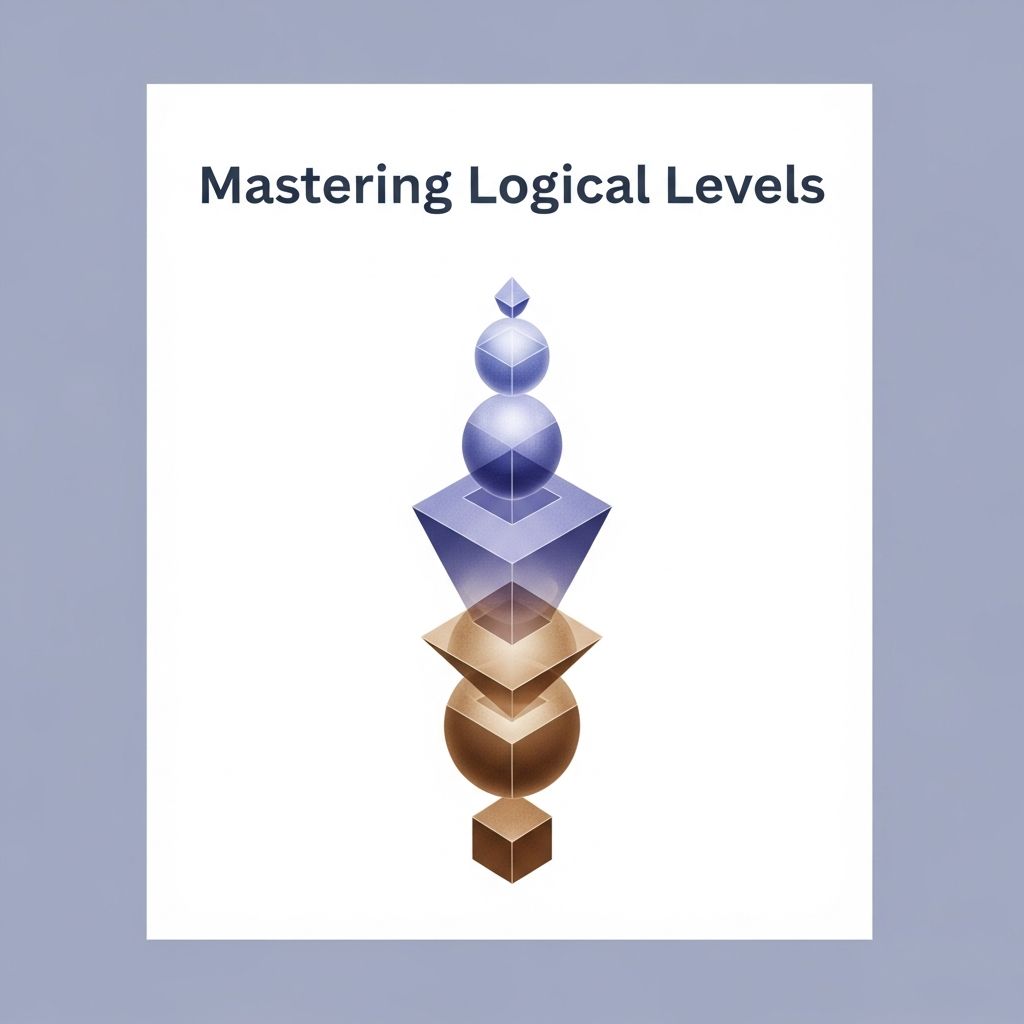
The logical levels model offers a structured approach to understanding human behavior and facilitating deep, sustainable change. Developed within neuro-linguistic programming (NLP), this framework organizes experience into hierarchical layers, from immediate surroundings to overarching purpose. By addressing these levels systematically, individuals, leaders, and coaches can resolve internal conflicts, enhance performance, and achieve alignment across personal and professional domains.
Understanding the Hierarchical Structure of Logical Levels
At its core, the logical levels concept posits that human functioning operates on multiple interconnected planes. Changes at higher levels influence those below, creating ripple effects, while lower-level adjustments rarely impact superior strata without broader support. This hierarchy ensures that interventions are targeted and effective.
- Environment: The foundational level, encompassing external conditions like physical spaces, people, and resources.
- Behavior: Observable actions and reactions within those environments.
- Capabilities: The skills and strategies enabling behaviors.
- Beliefs and Values: Convictions and principles that motivate capabilities.
- Identity: Sense of self that shapes beliefs.
- Vision: Long-term aspirations beyond the individual.
- Systems: Broader connections to communities and structures.
- Spiritual: Ultimate purpose or connection to something greater.
This eight-tier model expands on foundational NLP ideas, providing a comprehensive map for diagnosis and growth. Research on cognitive abilities underscores how logical reasoning at these levels supports academic and life success, with studies showing strong correlations between reasoning skills and achievement in subjects like math and science.
Navigating the Environment Level: Your External Foundation
The environment level addresses ‘where, when, and with whom’ questions. It involves adapting to physical settings, social interactions, and available tools. For instance, a remote worker might struggle due to poor lighting or distractions, not inherent ability. Adjusting this level yields quick wins but requires higher-level buy-in for permanence.
Leaders often overlook environmental mismatches. A team in a noisy office may underperform regardless of talent. Practical steps include workspace audits: assess ergonomics, lighting, and noise. Data from cognitive development studies highlight how optimized environments boost information processing and logical reasoning, essential for executive functions like planning.
| Environmental Factor | Impact on Performance | Optimization Strategies |
|---|---|---|
| Physical Space | Distractions reduce focus | Declutter, improve lighting |
| Social Dynamics | Conflicts hinder collaboration | Foster clear communication norms |
| Resources | Lack limits output | Inventory and procure essentials |
Shaping Behavior: Actions That Drive Results
Moving upward, behavior focuses on ‘what do you do?’ This level targets habits and reactions. Changing behavior without addressing capabilities often leads to relapse, as new actions feel unnatural.
Consider procrastination: swapping it for time-blocking works if skills support it. Behavioral interventions, like habit stacking, build momentum. Neuroscience links logical thinking here to executive functions, aiding impulse control and problem-solving in children and adults alike. In leadership, modeling desired behaviors cascades through teams.
Building Capabilities: The Power of Skills and Strategies
Capabilities answer ‘how?’—the competencies and methods underpinning actions. This level is pivotal for growth, as enhanced skills amplify behaviors across environments.
Training programs excel here: public speaking courses build confidence through practice. Cognitive research confirms that abilities like logical reasoning and information processing directly predict academic success, with structural models showing significant effects on math and English performance. For professionals, capability audits reveal gaps; targeted learning closes them.
- Assess current skills via self-evaluations or 360 feedback.
- Prioritize high-impact areas like decision-making.
- Employ deliberate practice for mastery.
Beliefs and Values: The Motivational Core
Beliefs and values address ‘why?’—the internal permissions and priorities fueling capabilities. Misaligned beliefs sabotage efforts; for example, ‘I’m not a leader’ blocks skill application.
Reframing occurs through evidence challenging limiting beliefs. Values clarification exercises align actions with core principles. Studies on cognitive skills emphasize how beliefs influence thinking transformation and reasoning, key to overall achievement. Leaders instill organizational values to unify teams.
Identity: Who You Are at Your Essence
Identity explores ‘who?’—self-concept dictating beliefs. A ‘victim’ identity perpetuates helplessness; shifting to ‘survivor’ empowers change.
Identity work uses affirmations and role immersion. In development, this level fosters resilience, as logical thinkers form stronger self-perceptions tied to executive functions. Corporate coaching often targets executive identity for authentic leadership.
Vision and Beyond: Purpose and Connection
Higher levels include vision (‘what for others?’), systems (interconnections), and spiritual (ultimate why). Vision inspires legacy; systems embed in networks; spiritual provides transcendence.
These drive profound shifts. Visionary leaders like those in STEM fields leverage them for innovation, backed by long-term benefits in career success.
Applying Logical Levels in Leadership and Coaching
In leadership, diagnose team issues by level: environmental fixes for logistics, identity work for culture. Coaching sequences interventions bottom-up for symptoms, top-down for roots.
Case: A manager’s sales slump. Environment: poor leads. Behavior: inconsistent calls. Capabilities: weak closing. Beliefs: sales unethical. Identity: not a salesperson. Vision: contribute meaningfully. Aligning upward transformed results.
Practical Tools and Exercises for Each Level
Implement via worksheets:
- Environment Map: List influences; adjust one weekly.
- Behavior Tracker: Log actions; replace negatives.
- Capability Matrix: Rate skills 1-10; plan development.
- Belief Audit: Challenge with evidence.
- Identity Statement: Craft ‘I am…’ declarations.
- Vision Board: Visualize purpose.
Group sessions amplify via peer insights. Cognitive training enhances this, promoting analytical thinking and independence.
Overcoming Common Challenges in Level Alignment
Resistance arises from level mismatches. Solution: chunk up to root cause. Track progress longitudinally, as skills build over time.
Long-Term Benefits and Real-World Impact
Mastery yields resilience, innovation, and fulfillment. In education, it boosts outcomes; professionally, it advances careers.
Frequently Asked Questions (FAQs)
What are logical levels used for?
They diagnose and catalyze change in personal development, therapy, business, and education.
How do I start applying this model?
Begin with self-assessment across levels, targeting the highest misaligned one.
Can logical levels help in team settings?
Yes, by aligning group environment, shared values, and collective identity.
Is this framework scientifically validated?
It draws from NLP and cognitive science, with supporting evidence on reasoning’s role in achievement.
How long does change take?
Varies; lower levels shift quickly, higher ones require sustained effort.
References
- Importance of Logical Reasoning and Critical Thinking Skills — 98thpercentile.com. 2023. https://www.98thpercentile.com/blog/importance-of-logical-reasoning-cognitive-ability-critical-thinking/
- How Logical Thinking Shapes Child Development — Neuro.now. 2024. https://neuro.now/lived_experience/logical-thinking-in-child-development/
- The effect of cognitive ability on academic achievement — PMC (National Library of Medicine). 2022-10-13. https://pmc.ncbi.nlm.nih.gov/articles/PMC9583534/
- Cognitive skill — Wikipedia. Accessed 2026. https://en.wikipedia.org/wiki/Cognitive_skill
- Cognitive Development in the Teen Years — Stanford Children’s Health. Accessed 2026. https://www.stanfordchildrens.org/en/topic/default?id=cognitive-development-in-the-teen-years-90-P01594

- Integrated M.A. in Applied Linguistics, University of Hyderabad
- 5+ years in editorial, instructional, SEO, and research-based writing
Sneha is a relationships and lifestyle writer with a strong foundation in applied linguistics and certified training in relationship coaching. She brings over five years of writing experience to theskillvault, crafting thoughtful, research-driven content that empowers readers to build healthier relationships, boost emotional well-being, and embrace holistic living. Her writing and insights reflect the belief that beauty, happiness, and wellness…