
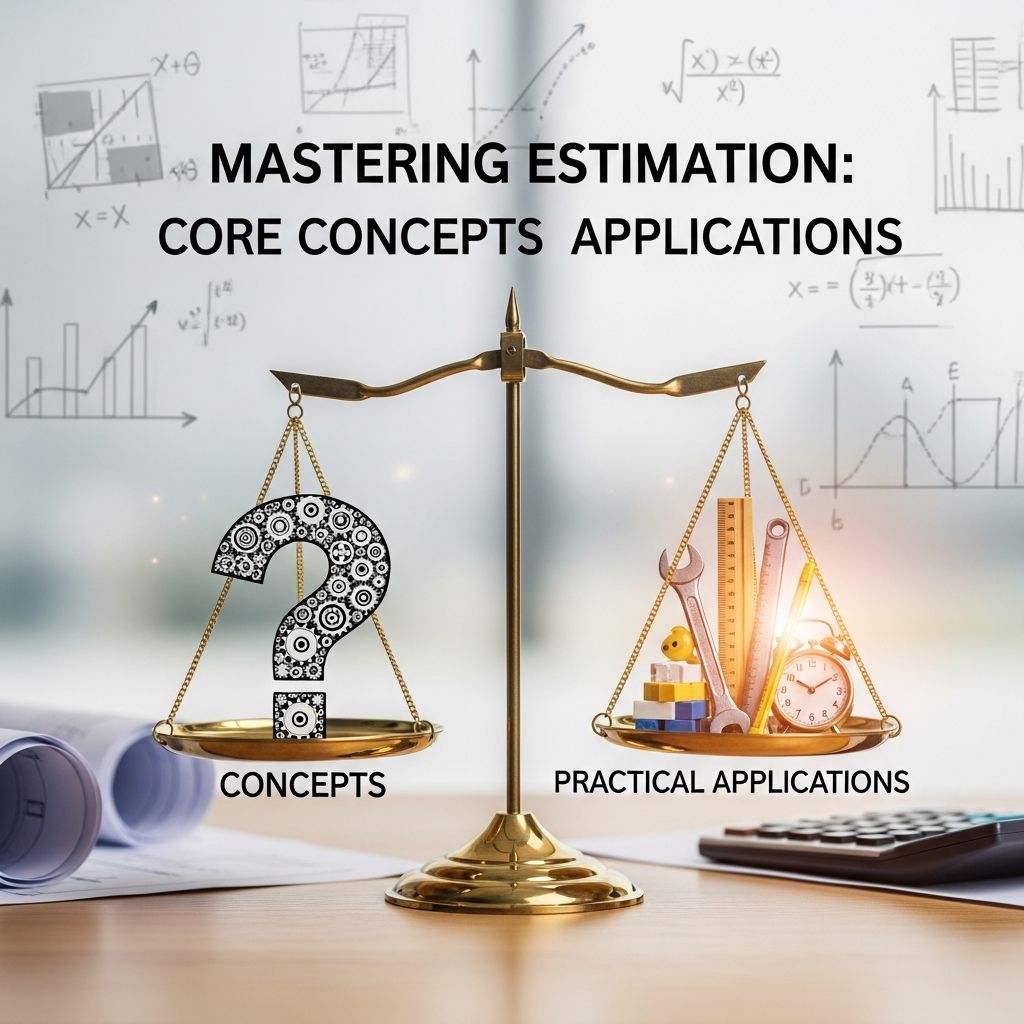
Estimation represents a critical competency across numerous professional and personal contexts. Whether calculating project timelines, budgeting resources, or predicting outcomes, the ability to make informed approximations significantly influences success rates and operational efficiency. This skill extends beyond simple guesswork—it combines analytical thinking, historical knowledge, and structured methodologies to produce reliable forecasts that guide decision-making processes.
Understanding the Foundation of Estimation
At its core, estimation involves making informed judgments about quantities, timelines, or costs when precise data remains unavailable or impractical to obtain. The distinction between estimation and calculation lies in the acknowledgment of uncertainty; estimation explicitly accounts for incomplete information while maintaining usefulness for planning purposes. This fundamental characteristic makes estimation invaluable in dynamic environments where perfect information never exists.
Developing strong estimation capabilities requires understanding that accuracy improves through systematic approaches rather than intuitive guessing. The most effective estimators combine domain expertise with structured methodologies, creating predictions that balance optimism with realism. This foundation supports everything from individual task assessment to large-scale organizational planning.
Key Attributes of Skilled Estimators
Individuals who excel at estimation typically demonstrate several consistent characteristics that distinguish their work quality. Recognizing these attributes helps identify areas for personal development and establishes benchmarks for improvement.
- Attention to Detail: Successful estimators maintain meticulous focus on project components, recognizing that overlooked elements compound estimation errors. This detail-oriented approach prevents the accumulation of minor miscalculations into significant deviations.
- Organizational Capability: Structured thinking and systematic documentation enable estimators to track information, identify patterns, and maintain consistency across multiple assessments. Organized professionals leverage checklists and standardized formats to ensure completeness.
- Technical Knowledge: Deep understanding of relevant domains—whether construction, software development, or project management—provides the context necessary for realistic assessments. This expertise helps identify dependencies, resource requirements, and potential complications.
- Research Orientation: Estimators who invest time investigating industry trends, examining historical data, and studying comparable projects develop more sophisticated understanding of variables affecting their estimates.
- Ethical Commitment: Maintaining honesty about uncertainties and avoiding systematic bias toward optimism or pessimism ensures estimates remain trustworthy and useful for organizational decision-making.
Foundational Estimation Techniques
Multiple established methodologies exist for approaching estimation challenges, each suited to different contexts and information availability levels. Understanding when to apply specific techniques significantly enhances prediction quality.
Bottom-Up Assessment Method
This approach begins with granular components and aggregates them into comprehensive estimates. By breaking projects into discrete, manageable tasks, estimators can assess each element with greater precision. This method proves particularly effective when detailed project scope exists and individual task characteristics are well-understood. The accumulation of individual estimates creates a foundation for overall project assessment, though this technique requires substantial time investment and detailed knowledge.
Top-Down Perspective Method
Conversely, top-down estimation starts with overall project scope and proportionally distributes estimates across components. This technique works well for rapid assessments when comprehensive project details remain undefined. While quicker than bottom-up approaches, top-down methods depend heavily on historical parallels and professional judgment, introducing greater variability in accuracy.
Historical Comparison Approach
Examining past projects with similar characteristics provides valuable reference points for current assessments. This analogous technique leverages organizational memory to inform predictions, becoming increasingly reliable as historical databases expand. The method assumes sufficient similarity between past and present contexts, requiring careful evaluation of meaningful parallels and differences.
Mathematical Modeling Technique
Parametric estimation establishes mathematical relationships between project characteristics and resource requirements. By identifying key variables and their correlations with outcomes, estimators create formulas applicable across comparable projects. This systematic approach reduces subjective judgment while requiring sufficient historical data to establish reliable correlations.
Risk-Adjusted Estimation Method
Rather than predicting single values, this technique explicitly incorporates uncertainty through multiple scenarios. Estimators identify optimistic, pessimistic, and most-likely outcomes, then apply weighted formulas to calculate expected values. This approach acknowledges variability inherent in many situations, producing more realistic expectations about potential ranges than single-point estimates.
Enhancing Estimation Accuracy Through Systematic Practices
Beyond selecting appropriate techniques, implementing consistent practices significantly improves estimation quality over time. These foundational approaches create environments where estimators can perform optimally.
Documenting and Analyzing Historical Performance
Creating searchable databases of past projects establishes benchmarks for current work. By recording actual performance against estimates, organizations identify systematic patterns—such as consistent underestimation of particular task types or overlooked activity categories. This comparative analysis transforms estimation from subjective assessment into evidence-based practice, continuously refining predictions through accumulated experience.
Effective documentation captures both successes and shortcomings. When estimates proved accurate, understanding the contributing factors allows replication of successful approaches. When significant variances occurred, identifying root causes prevents recurring errors. Over time, this deliberate reflection builds organizational wisdom that substantially improves forecast reliability.
Engaging Relevant Expertise
Consulting individuals with direct experience in similar work leverages specialized knowledge that general estimators may lack. Subject matter experts provide context-specific insights about complications, resource requirements, and realistic timelines. This collaborative approach reduces blind spots while building team consensus around estimates, improving acceptance and commitment to established targets.
Decomposing Complex Work
Breaking larger projects into increasingly specific components enables more precise assessment of individual elements. This systematic decomposition reveals dependencies, identifies overlooked activities, and surfaces hidden complexity. The granular approach also distributes estimation burden across team members with relevant expertise, combining specialized knowledge into comprehensive assessments.
Comprehensive Requirement Definition
Clarity about project scope, deliverables, and success criteria directly impacts estimation accuracy. Vague or incomplete requirements force estimators to make assumptions, introducing systematic bias. Investing time in detailed specification reduces downstream surprises and corrections that inflate actual costs beyond estimates.
Validation and Completeness Verification
Dedicated review of estimation documents identifies missing elements before commitment to deadlines. Systematic checklists ensure that all anticipated activities—client feedback cycles, quality assurance processes, administrative overhead—receive explicit consideration. This verification step prevents the false economy of low estimates that exclude necessary work.
Navigating Common Estimation Challenges
Even experienced estimators encounter recurring obstacles that distort predictions. Recognizing these patterns enables conscious correction.
| Challenge | Manifestation | Mitigation Approach |
|---|---|---|
| Excessive Optimism | Planning assumes ideal conditions without accounting for realistic delays, interruptions, or complications | Apply risk-adjusted methods explicitly incorporating pessimistic scenarios; compare current estimates against historical performance on similar work |
| Resource Availability Gaps | Estimates assume continuous, full-capacity work despite actual interruptions from competing priorities, leave, or fluctuating workload | Conduct capacity reviews accounting for vacations, split assignments, and organizational interruptions; adjust timelines based on realistic available hours |
| Overlooked Task Relationships | Sequential or dependent tasks create critical paths that cascade delays; estimates ignore interaction effects between activities | Map task dependencies explicitly; identify critical path activities most sensitive to delays; reserve buffer time for dependent work |
| Scope Creep | Initial estimates exclude changes, refinements, or additional features requested during execution | Establish clear scope boundaries; document assumptions explicitly; define change management processes; track requests separate from original estimates |
| Knowledge Gaps | Estimators unfamiliar with specific domains or technologies make uninformed assumptions, missing realistic requirements | Engage subject matter experts; invest in learning before estimating unfamiliar work; leverage historical data from previous similar projects |
Advanced Approaches and Emerging Practices
Beyond traditional techniques, contemporary approaches leverage enhanced tools and collaborative methods.
Collaborative Estimation Frameworks
Team-based estimation methods, such as relative sizing approaches using comparative scales, engage multiple perspectives simultaneously. Rather than predicting absolute hours, teams assess complexity and effort relative to reference work they’ve completed previously. This calibrated approach reduces individual bias while building shared understanding across contributors. Regular velocity tracking—measuring how much work teams actually complete—enables continuous refinement of estimation accuracy.
Technology-Enabled Analysis
Modern estimation tools consolidate historical project data, resource information, and cost variables into integrated platforms. These systems facilitate rapid analysis while reducing manual data compilation. Automated tracking of estimated versus actual performance provides continuous feedback loops, enabling systematic improvement in forecasting approaches. Visualization capabilities help teams understand estimation patterns and identify systematic bias.
Predictive Analytics Integration
Machine learning applications analyze organizational project histories to identify patterns humans might miss. These systems recognize which task characteristics correlate with underestimation, which team combinations produce reliable estimates, and how external factors influence outcomes. Predictive models adapt continuously as new project data accumulates, improving forecast accuracy over time while reducing the cognitive burden on individual estimators.
Developing Personal Estimation Capability
Improving individual estimation ability requires deliberate practice and reflective analysis.
Building Domain Expertise
Invest in deepening knowledge of your specific field—whether construction, software development, marketing, or other domains. Understand typical resource requirements, common complications, and industry benchmarks. This foundational knowledge provides context for realistic assessment.
Maintaining Estimate Logs
Document your estimates alongside actual outcomes. Review these logs regularly, analyzing where predictions proved accurate and where significant variances occurred. This personal feedback loop accelerates learning faster than passive observation.
Studying Analogous Work
Examine projects similar to work you’re estimating. Understand what factors influenced their costs and timelines. Look for patterns about which elements typically consume more resources than initially apparent.
Seeking Calibration Feedback
Discuss your estimates with colleagues and supervisors, explaining your reasoning and assumptions. External perspectives often identify unstated assumptions or overlooked factors. This dialogue improves your mental models and estimation logic.
Practicing Multiple Estimation Methods
Apply different techniques to the same scenario, comparing results. Understanding why methods produce different estimates deepens your appreciation for each approach’s strengths and limitations.
FAQ Section
What distinguishes estimation from simple guessing?
Estimation employs systematic methodologies, incorporates historical data, and explicitly acknowledges uncertainty. Guessing relies on intuition without structured analysis. Skilled estimation provides defensible reasoning for predictions, while guessing cannot justify its basis.
When should organizations use top-down versus bottom-up approaches?
Top-down methods work well for rapid assessments when projects lack detailed definition or when establishing ballpark figures for planning purposes. Bottom-up techniques suit situations where project scope is well-understood and precision significantly impacts decisions. Many organizations use top-down initially for feasibility assessment, then transition to bottom-up methods as project details become available.
How can teams improve estimation when historical data is limited?
Engage subject matter experts who’ve completed similar work in other organizations; research industry standards and benchmarks; break work into smaller components to reduce estimation uncertainty; apply risk-adjusted methods explicitly accounting for uncertainty; document current project performance thoroughly to establish foundations for future estimates.
What role does uncertainty play in effective estimation?
Acknowledging uncertainty produces more realistic expectations and enables better contingency planning. Estimates that ignore variability appear precise but prove unreliable. Methods explicitly incorporating uncertainty ranges provide decision-makers appropriate confidence levels about predictions.
How frequently should organizations revisit estimates during project execution?
Regular review—typically weekly or at defined project milestones—incorporates emerging information and progress data into revised forecasts. This continuous updating prevents estimates from growing increasingly inaccurate as circumstances change. However, excessive revision can undermine original planning; balance frequent updates with commitment to established targets unless significant changes warrant substantial adjustments.
References
- Top 6 Project Estimation Techniques in 2026 + Best Practices — Productive.io. 2026. https://productive.io/blog/project-estimation-techniques/
- 5 Ways to Improve Your Estimating Skills — Simpro. 2024. https://www.simprogroup.com/blog/5-ways-to-improve-your-estimating-skills
- Estimation Strategies and Tricks — Exponent. 2025. https://www.tryexponent.com/courses/estimation/estimation-strategies-tricks
- Estimating Techniques: A Beginner’s Guide — Parallel Project Training. 2024. https://www.parallelprojecttraining.com/blog/estimating-techniques-a-beginners-guide/
- FREE WEBINAR: Estimation Skills and Approaches — AgileLeanHouse. 2025. https://agileleanhouse.com/en/estimation-skills-and-approaches.html

- Integrated M.A. in Applied Linguistics, University of Hyderabad
- 5+ years in editorial, instructional, SEO, and research-based writing
Sneha is a relationships and lifestyle writer with a strong foundation in applied linguistics and certified training in relationship coaching. She brings over five years of writing experience to theskillvault, crafting thoughtful, research-driven content that empowers readers to build healthier relationships, boost emotional well-being, and embrace holistic living. Her writing and insights reflect the belief that beauty, happiness, and wellness…