
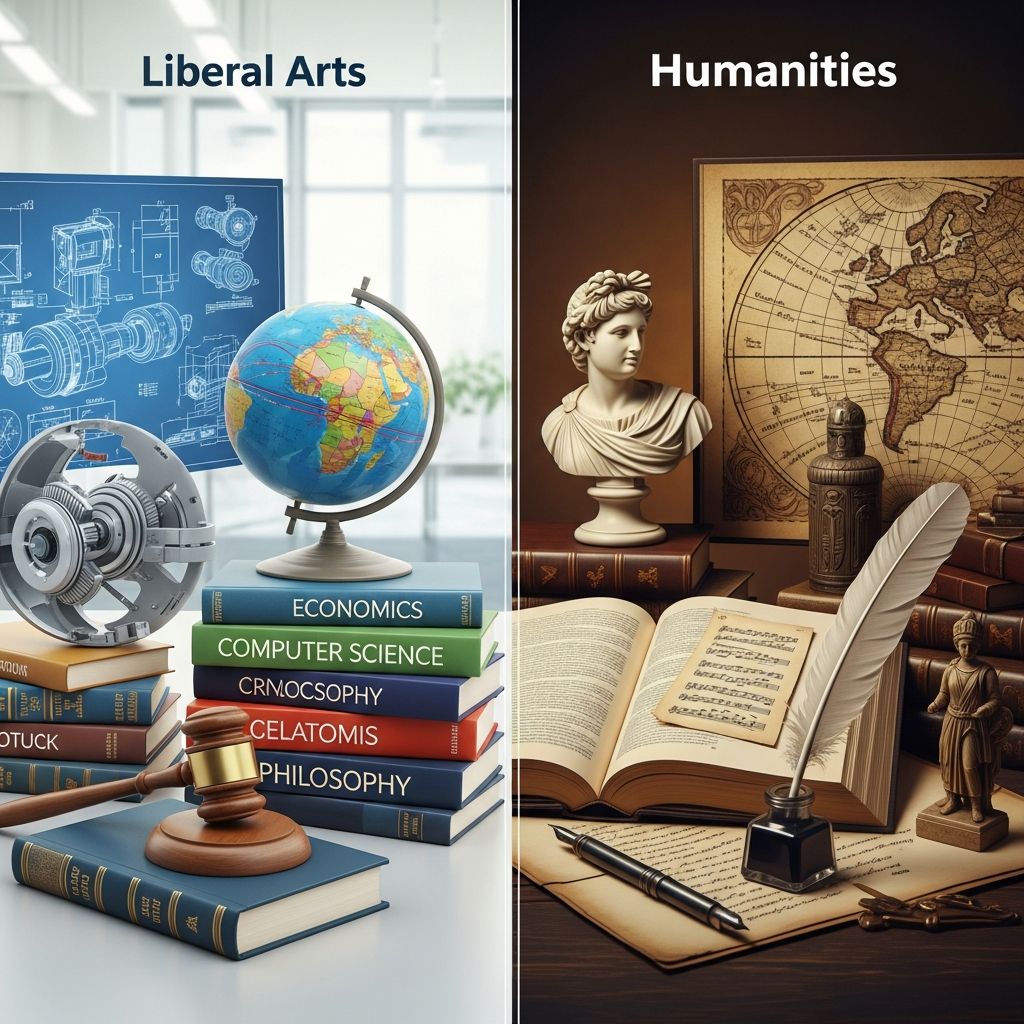
Liberal arts represent a comprehensive educational framework that includes humanities as one component alongside sciences and mathematics, fostering versatile skills for diverse careers. Humanities, in contrast, specifically examine human culture, behavior, and expression through disciplines like literature and history.
Understanding the Scope of Liberal Arts Education
The liberal arts tradition dates back centuries, emphasizing a well-rounded development of the mind. This approach trains students to think critically across multiple domains, preparing them for adaptability in a changing world. Unlike narrow vocational programs, liberal arts curricula integrate knowledge from various fields to build intellectual flexibility.
Core to liberal arts is the idea of learning how to learn. Students engage with diverse subjects, honing abilities in analysis, synthesis, and application. This broad foundation equips graduates to pivot between industries, from business to public policy.
- Broad disciplinary coverage: Includes natural sciences, social sciences, humanities, and quantitative areas.
- Skill-building focus: Emphasizes reasoning, research, communication, and problem-solving.
- Degree options: Available as Bachelor of Arts (BA) or Bachelor of Science (BS), depending on emphasis.
Delving into the Essence of Humanities Studies
Humanities form a vital subset within liberal arts, zeroing in on what defines human experience. These studies probe questions of identity, society, creativity, and ethics through interpretive lenses. Subjects explore the ‘why’ behind human actions and creations, fostering deep empathy and cultural awareness.
Typical humanities disciplines encourage close reading, debate, and contextual analysis. For instance, philosophy challenges ethical frameworks, while linguistics uncovers language’s role in thought. This focus cultivates nuanced perspectives essential for leadership and innovation.
| Discipline | Focus Area | Key Skills Gained |
|---|---|---|
| Literature | Narrative and themes in texts | Interpretation, empathy |
| History | Past events and societies | Contextual analysis, evidence evaluation |
| Philosophy | Ideas of existence and morality | Logical argumentation, ethics |
| Arts (visual, performing) | Creative expression | Aesthetic appreciation, critique |
Core Differences: A Side-by-Side Comparison
While overlapping, liberal arts and humanities diverge in breadth, methodology, and outcomes. Liberal arts casts a wide net, incorporating empirical sciences for a holistic view of human existence. Humanities narrows to cultural and expressive realms, prioritizing qualitative depth over quantitative breadth.
- Breadth vs. Depth: Liberal arts spans sciences (e.g., biology, physics) and math; humanities sticks to human-centric fields.
- Approach: Liberal arts balances theory and practice; humanities leans theoretical, exploring values and behaviors.
- Degree Structure: Liberal arts often allows interdisciplinary majors; humanities typically aligns with BA programs.
These distinctions matter for students choosing paths. Liberal arts suits those seeking versatility, while humanities appeals to cultural explorers.
Overlaps and Shared Foundations
Both domains champion critical thinking and communication, skills prized by employers. Liberal arts curricula frequently incorporate humanities courses, creating natural synergies. For example, a social science class might draw on historical humanities insights to analyze modern societies.
Shared benefits include enhanced adaptability and lifelong learning. Graduates from either path excel in roles requiring interpersonal savvy and innovative problem-solving.
Practical Skills Developed in Each Path
Liberal arts programs build a toolkit for real-world challenges. Students master data interpretation from stats courses alongside narrative crafting from writing classes. This blend yields professionals who communicate complex ideas accessibly.
Humanities sharpen subjective analysis, teaching students to navigate ambiguity. Skills like ethical reasoning and cultural sensitivity transfer seamlessly to globalized workplaces.
- Critical evaluation of evidence
- Effective written and oral expression
- Creative adaptation to scenarios
- Empathetic leadership
Career Trajectories and Opportunities
Liberal arts alumni thrive in dynamic fields. Their broad knowledge opens doors to tech, finance, and nonprofits. Common roles include analysts, managers, and entrepreneurs who leverage interdisciplinary insights.
Humanities graduates shine in creative and people-oriented sectors. From journalism to education, they apply interpretive prowess to storytelling and advocacy. Many pursue graduate studies in law or business, building on foundational strengths.
| Field | Liberal Arts Fit | Humanities Fit |
|---|---|---|
| Business/Marketing | High (analytical skills) | Medium (communication) |
| Education | High | High |
| Tech/Policy | High (versatility) | Medium |
| Arts/Media | Medium | High (creativity) |
Addressing Common Misconceptions
A frequent critique labels these fields ‘impractical.’ Yet, data shows liberal arts and humanities grads enjoy strong employability, often outpacing specialized peers in adaptability. Employers value their soft skills amid automation trends.
Another myth: Humanities lack rigor. In truth, these programs demand intense textual analysis and debate, rivaling STEM demands in intellectual challenge.
Choosing the Right Path for Your Goals
Prospective students should align choices with interests and aspirations. Self-assess: Do you crave broad exploration or cultural immersion? Consider hybrid programs blending both for maximum flexibility.
Campus visits and course audits help. Many institutions offer liberal studies degrees as customizable gateways.
Future Trends in These Disciplines
Digital humanities emerge, merging tech with traditional study—think AI analyzing literature. Liberal arts evolve too, incorporating data science for modern relevance. These shifts promise even greater career edge.
Frequently Asked Questions (FAQs)
What is the main difference between liberal arts and humanities?
Liberal arts is broader, including sciences and math, while humanities focuses solely on human culture and expression.
Can I get a good job with a humanities degree?
Yes, skills like critical thinking lead to roles in business, media, and education.
Are liberal arts degrees versatile?
Absolutely, they prepare for diverse careers through interdisciplinary training.
Is there overlap between the two?
Yes, humanities are a core part of liberal arts curricula.
What skills do these programs teach?
Analysis, communication, empathy, and problem-solving.
Navigating higher education choices involves weighing these educational pillars. Both paths cultivate enduring competencies for personal and professional growth.
References
- Liberal Arts and Sciences Education — Hilbert College Online. 2023-05-15. https://online.hilbert.edu/blog/humanities-vs-liberal-arts/
- What is Liberal Arts and Humanities? — Liberal Arts Education.org. 2024-01-10. https://liberalartsedu.org/faq/what-is-liberal-arts-and-humanities/
- Liberal Arts and Humanities Major Overview — College Board BigFuture. 2025-09-20. https://bigfuture.collegeboard.org/majors/liberal-arts-and-humanities
- Difference Between Arts and Humanities — O.P. Jindal Global University. 2024-02-19. https://jgu.edu.in/blog/2024/02/19/difference-between-arts-and-humanities/
- Liberal Arts Vs. Humanities Guide — Liberal Arts Bachelors. 2026-01-05. https://www.liberalartsbachelors.com/liberal-arts-vs-humanities/

Medha Deb is an editor with a master's degree in Applied Linguistics from the University of Hyderabad. She believes that her qualification has helped her develop a deep understanding of language and its application in various contexts. Medha specializes in the areas of beauty, health, sports, and wellness and is committed to ensuring that the content on the website is…