
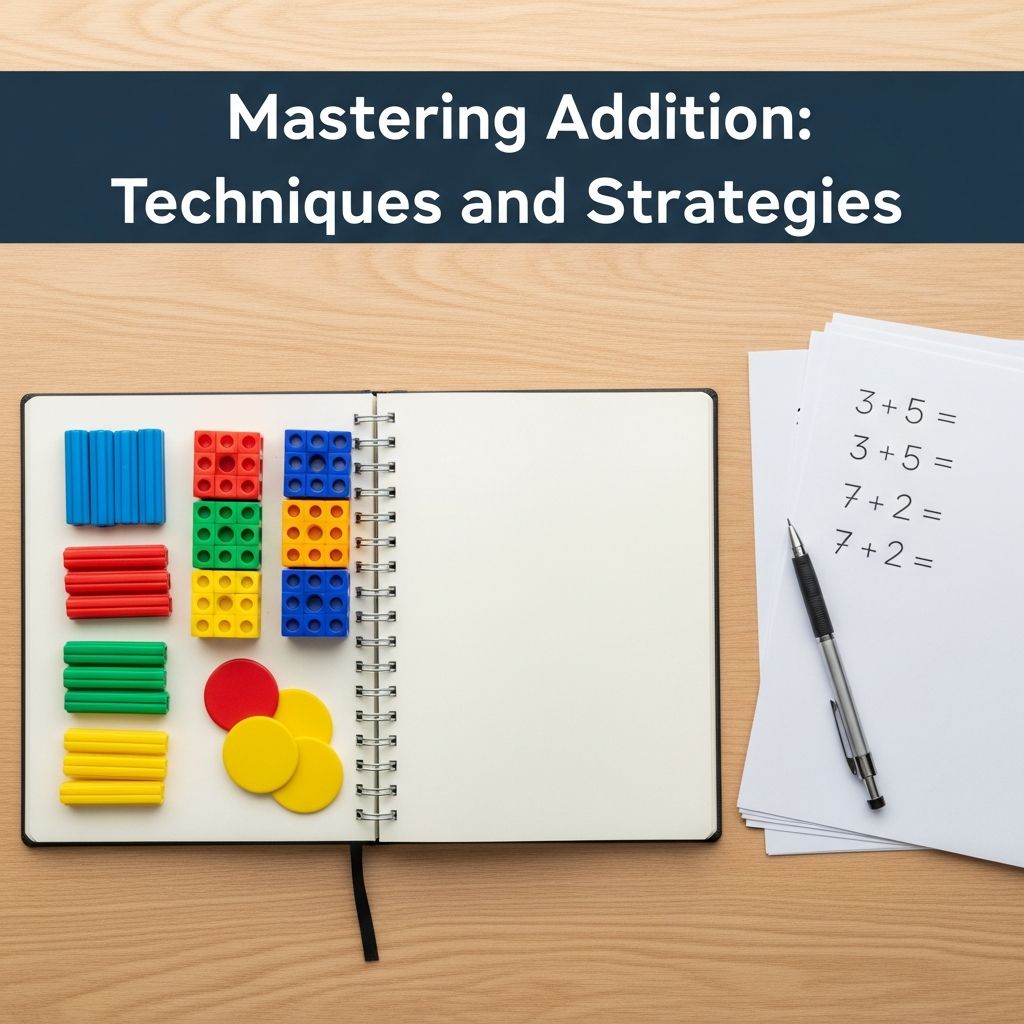
Addition forms the cornerstone of arithmetic, enabling us to combine quantities accurately in everyday scenarios and advanced computations. This guide explores foundational concepts, practical methods, and advanced applications to help learners of all ages excel.
Understanding the Basics of Addition
At its core, addition combines two or more values to find their total. Represented by the plus sign (+), it answers questions like ‘how many altogether?’ For instance, combining 4 apples and 3 apples yields 7 apples total.
Key properties define addition’s behavior:
- Commutative Property: The order of addends does not affect the sum, so 5 + 8 equals 8 + 5, both resulting in 13.
- Associative Property: Grouping addends changes without altering the result, as in (2 + 3) + 4 = 2 + (3 + 4) = 9.
- Identity Property: Adding zero leaves a number unchanged, like 7 + 0 = 7.
These properties streamline calculations, especially with multiple terms.
Visualizing Addition with Number Lines
A number line provides an intuitive way to grasp addition, particularly for beginners. Start at the first number and move right for positives or left for negatives.
For positive sums, like 5 + 7, begin at 5 and advance 7 units right to land on 12. With larger numbers, such as 57 + 16, break 16 into 10 + 6: jump 10 to 67, then 6 more to 73.
| Step | Action | Result |
|---|---|---|
| 1 | Start at 57 | 57 |
| 2 | Add 10 | 67 |
| 3 | Add 6 | 73 |
This method builds spatial awareness and aids integer addition.
Column Addition for Whole Numbers
Column method aligns numbers by place value—ones, tens, hundreds—for efficient summing, crucial for multi-digit problems.
Without Carrying Over
Align digits vertically and add column by column from right to left. For 41 + 26: ones (1 + 6 = 7), tens (4 + 2 = 6), total 67.
| Number | Tens | Ones |
|---|---|---|
| 41 | 4 | 1 |
| +26 | 2 | 6 |
| 67 | 6 | 7 |
With Carrying Over
When a column sums to 10 or more, write the ones digit and carry the tens to the next column. Example: 29 + 46. Ones: 9 + 6 = 15 (write 5, carry 1). Tens: 2 + 4 + 1 = 7, total 75.
Practice reinforces accuracy: 34 + 52 = ones 4 + 2 = 6, tens 3 + 5 = 8, sum 86.
Adding Integers: Positive and Negative
Integers include positives, negatives, and zero. Rules differ based on signs.
- Same Signs: Add absolute values, keep the sign. 6 + 6 = 12; -6 + (-6) = -12.
- Different Signs: Subtract smaller absolute value from larger, take larger’s sign. 7 + (-3): 7 – 3 = 4 (positive).
- With Zero: No change, e.g., -8 + 0 = -8.
- Additive Inverse: Number + opposite = 0, like 4 + (-4) = 0.
Example: 4 + (-6) + 13. First, 4 + 13 = 17, then 17 + (-6) = 11.
Strategies for Quick Mental Addition
Mental math boosts speed using known facts and adjustments. If 7 + 7 = 14, then 6 + 7 = 14 – 1 = 13.
Break apart numbers: 57 + 16 = (57 + 10) + 6 = 67 + 6 = 73. For three terms, associate: 5 + 7 + 9 = (5 + 7) + 9 = 21.
Real-world: 36 red roses + 18 white = 54 total.
Applications in Daily Life and Problem-Solving
Addition underpins budgeting (income + savings), shopping (items + tax), and measurements (lengths + widths). In equations, addition isolates variables: x + 8 = 20, add -8 both sides: x = 12.
Word problems: A bouquet with 36 red and 18 white roses totals 54.
Common Pitfalls and Fixes
Avoid errors by aligning places correctly, carrying properly, and checking signs in integers. Practice number lines for negatives to visualize direction.
Tip: Verify by reverse subtraction or estimating (50 + 20 = 70, close to 73 confirms 57 + 16).
Practice Problems
- Add: 23 + 47 (without carry: 70).
- 45 + 38 (with carry: 83).
- -5 + 12 = 7.
- 9 + (-9) + 3 = 3.
- 67 + 29 = 96.
FAQs
What happens when adding negatives?
Add absolute values, apply negative sign: -4 + (-5) = -9.
How to add on a number line?
Move right for positive addends, left for negative.
Why carry in column addition?
Place value: 10 ones become 1 ten.
Does order matter in addition?
No, commutative property ensures same sum.
Adding zero?
Result unchanged.
References
- Rules for Addition of Integers | How to Add Integers? — Cuemath. 2023. https://www.cuemath.com/numbers/adding-integers/
- What is Addition? Definition, Formula, Properties & Examples — SplashLearn. 2023. https://www.splashlearn.com/math-vocabulary/addition/addition
- 1.2 Rules for Addition (Basic Mathematics) — YouTube (Serge Lang). 2015. https://www.youtube.com/watch?v=iQ9KKohrD-Y
- The Addition Rule To Solve Equations — YouTube. 2023. https://www.youtube.com/watch?v=YZ3LIxXiLP0
- Addition Strategies Progression — Maine Department of Education (.gov). 2023. http://www.maine.gov/doe/pl/math/addition
- 1.4: Addition of Whole Numbers — Mathematics LibreTexts (.org, academic). 2023. https://math.libretexts.org/Bookshelves/PreAlgebra/Fundamentals_of_Mathematics_(Burzynski_and_Ellis)/01:_Addition_and_Subtraction_of_Whole_Numbers/1.04:_Addition_of_Whole_Numbers

- Integrated M.A. in Applied Linguistics, University of Hyderabad
- 5+ years in editorial, instructional, SEO, and research-based writing
Sneha is a relationships and lifestyle writer with a strong foundation in applied linguistics and certified training in relationship coaching. She brings over five years of writing experience to theskillvault, crafting thoughtful, research-driven content that empowers readers to build healthier relationships, boost emotional well-being, and embrace holistic living. Her writing and insights reflect the belief that beauty, happiness, and wellness…