
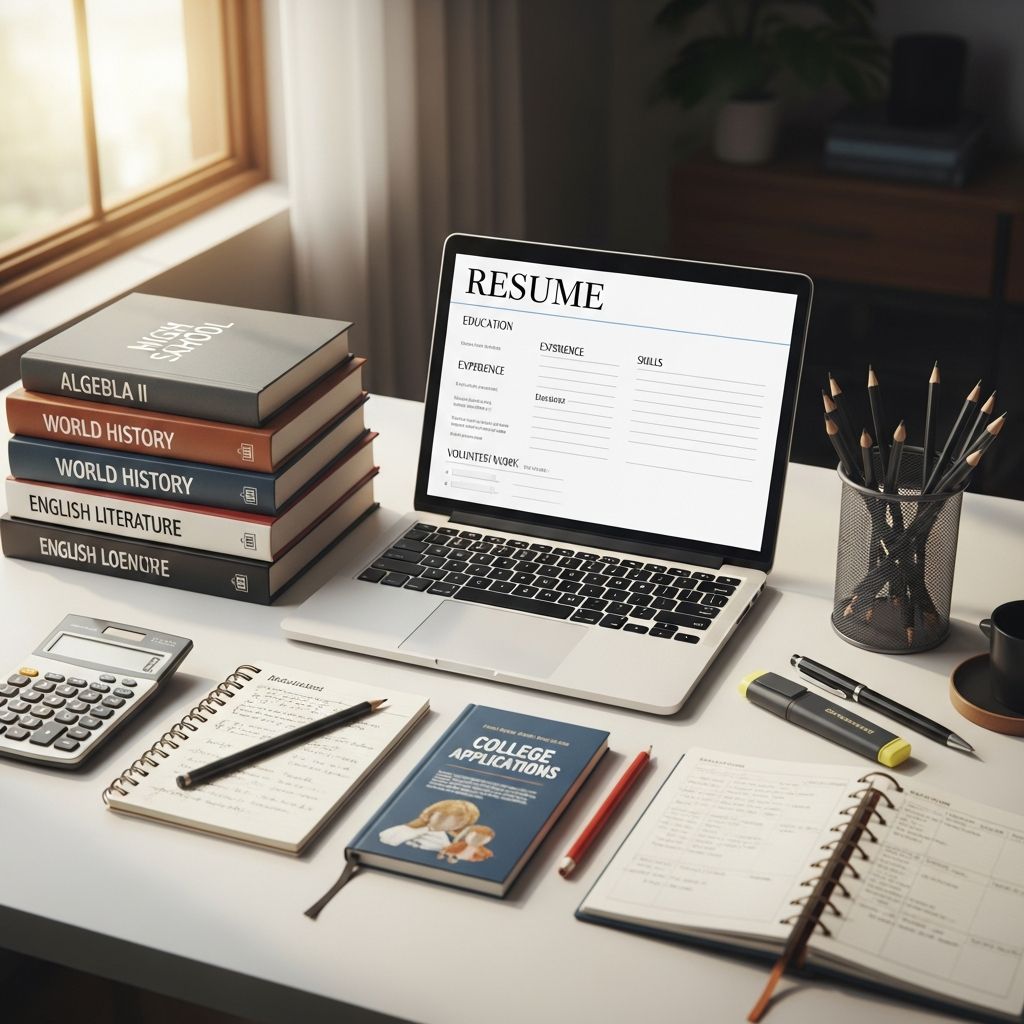
Building a resume during high school lays the foundation for future opportunities in college admissions, internships, and entry-level jobs. Even without extensive professional experience, students can create a document that highlights their unique strengths, achievements, and potential. This guide provides a comprehensive roadmap to developing a professional resume tailored for young applicants, drawing on best practices to make your profile shine.
Understanding the Purpose of a Student Resume
A high school resume serves as a concise snapshot of your academic journey, extracurricular involvement, and personal growth. It demonstrates to admissions officers, hiring managers, and scholarship reviewers that you are proactive, skilled, and ready for bigger challenges. Unlike adult resumes focused on work history, yours emphasizes education, activities, and transferable skills to show well-roundedness and initiative.
Key benefits include clarifying your goals, quantifying accomplishments, and differentiating you from peers. For instance, a strong resume can boost college applications by illustrating leadership beyond grades or boost job prospects by proving reliability through volunteer roles.
Selecting the Right Format and Layout
Opt for a clean, professional layout that prioritizes readability. Use standard fonts like Arial or Times New Roman at 11-12 point size, with one-inch margins and a one-page limit to respect reviewers’ time.
- Contact Header: Center your full name in bold at the top, followed by phone, professional email (e.g., firstname.lastname@gmail.com), city/state, and optional LinkedIn profile.
- Sections in Order: Objective/Summary, Education, Experience/Activities, Skills, Awards, Extracurriculars.
- Visual Tips: Bold section headings, use bullet points for achievements, and align dates right for scannability.
Avoid colors, graphics, or photos unless applying creatively; simplicity ensures ATS (Applicant Tracking Systems) compatibility for larger organizations.
Writing a Compelling Professional Summary
The summary is a 3-4 sentence opener that captures your essence and aligns with the opportunity. It replaces a traditional objective by focusing on strengths rather than needs.
Example: “Dedicated high school senior with exceptional leadership in student council and volunteer programs. Skilled in team collaboration and event coordination, raising $1,500 for local charities. Eager to apply communication and organizational talents to a marketing internship.”
Tailor it by incorporating job description keywords like “teamwork” or “customer service” to pass initial screens.
Prioritizing Education as Your Core Section
Since formal jobs may be limited, lead with education. List your high school, expected graduation date, GPA (if 3.5+), and relevant coursework or honors.
| Element | Example |
|---|---|
| School Name | ABC High School, Anytown, USA |
| Graduation | Expected June 2026 |
| GPA | 3.8/4.0 (Honors Track) |
| Coursework | AP Calculus, Biology, Digital Media |
Highlight rigorous classes like AP or IB to show academic rigor, especially for college apps.
Showcasing Experiences and Activities
Compile all non-academic involvements: part-time jobs, volunteering, clubs, sports, or freelance gigs. Focus on impact using action verbs and metrics.
Structure Each Entry:
- Position/Role, Organization, Dates (Month/Year).
- 3-5 Bullets starting with verbs like “Led,” “Organized,” “Developed.”
Sample Volunteer Role:
Babysitting Assistant, Local Family Network, Summer 2025
– Supervised groups of 5-8 children during community events, ensuring safety and engagement.
– Coordinated schedules and activities, improving parent satisfaction by 25% via feedback.
– Trained two new sitters on protocols, enhancing team efficiency.
Include leadership: captaincies, committee roles, or self-initiated projects to prove initiative.
Highlighting Transferable Skills
Skills sections bridge experience gaps. Categorize into soft (e.g., communication, adaptability) and hard (e.g., software proficiency).
- Communication: Public speaking in debate club.
- Technical: Microsoft Office, Google Workspace, basic HTML.
- Leadership: Organized fundraisers for 50+ participants.
- Teamwork: Varsity sports collaboration.
Quantify where possible: “Managed social media for club, growing followers by 40%.” Tailor to the role—customer service for retail, coding for tech.
Listing Awards, Honors, and Achievements
These validate excellence. Include academic (Honor Roll), athletic (MVP), or community (Service Award) honors with context.
Examples:
- National Honor Society Member, 2025 – Recognized for 100+ service hours.
- Best Feature Article, School Newspaper, 2025 – Covered environmental initiative.
- Varsity Soccer MVP, 2024 – Led team to regional finals.
Prioritize recent, relevant items; 4-6 suffice for impact.
Incorporating Extracurriculars and Hobbies
Beyond structured roles, add hobbies showing character: coding projects, blogging, or arts. Link to skills—photography for creative jobs.
Keep brief: 2-3 bullets under a “Interests” section if space allows, ensuring relevance.
Mastering Action Verbs and Quantification
Dynamic language elevates entries. Swap passive phrases for verbs like “Spearheaded,” “Boosted,” “Collaborated”.
Before/After:
Before: Helped with event.
After: Orchestrated annual fundraiser, generating $2,000 for charity.
Numbers amplify: percentages, hours, participants prove tangible results.
Customization and Tailoring Strategies
No generic resumes succeed. Analyze job postings for keywords (e.g., “multitasking” for retail) and mirror them.
- For Colleges: Emphasize leadership, academics.
- For Jobs: Prioritize customer-facing experience.
- For Internships: Highlight technical skills.
Proofreading and Final Polish
Errors undermine credibility. Proofread thrice, use tools like Grammarly, and seek teacher/parent feedback. Ensure consistency in tense (past for completed, present for ongoing).
Save as PDF to preserve formatting; name files “FirstName_LastName_Resume.pdf.”
Common Pitfalls to Avoid
Steer clear of these mistakes:
- Including personal details like age or photo (privacy risks).
- Listing irrelevant hobbies (e.g., gaming unless relevant).
- Exaggerating facts—verifiable inconsistencies hurt.
- Typos or poor spacing.
Sample High School Resume Template
Here’s a ready-to-adapt HTML-like structure:
<div class="resume"> <h2>Your Name</h2> <p>Phone | Email | City, State | LinkedIn</p> <h3>Professional Summary</h3> <p>...</p> <h3>Education</h3> <ul><li>...</li></ul></div>Frequently Asked Questions (FAQs)
Do high school students need a resume?
Yes, for jobs, colleges, scholarships—it’s essential to showcase beyond transcripts.
How long should it be?
One page maximum for focus.
What if I have no experience?
Emphasize school projects, volunteering, skills.
Should I include GPA?
Yes, if strong; otherwise, omit.
Can hobbies go on it?
Select relevant ones sparingly.
Next Steps for Resume Success
Update quarterly, build experiences via clubs or gigs, and practice interviews. A polished resume opens doors—start drafting today for tomorrow’s wins.
References
- How To Craft a High School Resume in 6 Steps (With Examples) — Indeed. 2023. https://www.indeed.com/career-advice/resumes-cover-letters/high-school-resume-tips
- Building a Strong Resume as a High School Student — Project Next. 2024. https://www.projectnext.org/building-a-strong-resume-as-a-high-school-student
- 5+ High School Resume Examples for 2026 — Resume Genius. 2025. https://resumegenius.com/resume-examples/high-school-resume-example
- Write a High School Student Resume for College Applications — Princeton Review. 2024. https://www.princetonreview.com/college-advice/high-school-resume
- Anatomy of a High School Résumé — College Board BigFuture. 2024. https://bigfuture.collegeboard.org/explore-careers/get-started/career-prep-high-school/anatomy-of-a-high-school-resume

- Integrated M.A. in Applied Linguistics, University of Hyderabad
- 5+ years in editorial, instructional, SEO, and research-based writing
Sneha is a relationships and lifestyle writer with a strong foundation in applied linguistics and certified training in relationship coaching. She brings over five years of writing experience to theskillvault, crafting thoughtful, research-driven content that empowers readers to build healthier relationships, boost emotional well-being, and embrace holistic living. Her writing and insights reflect the belief that beauty, happiness, and wellness…