
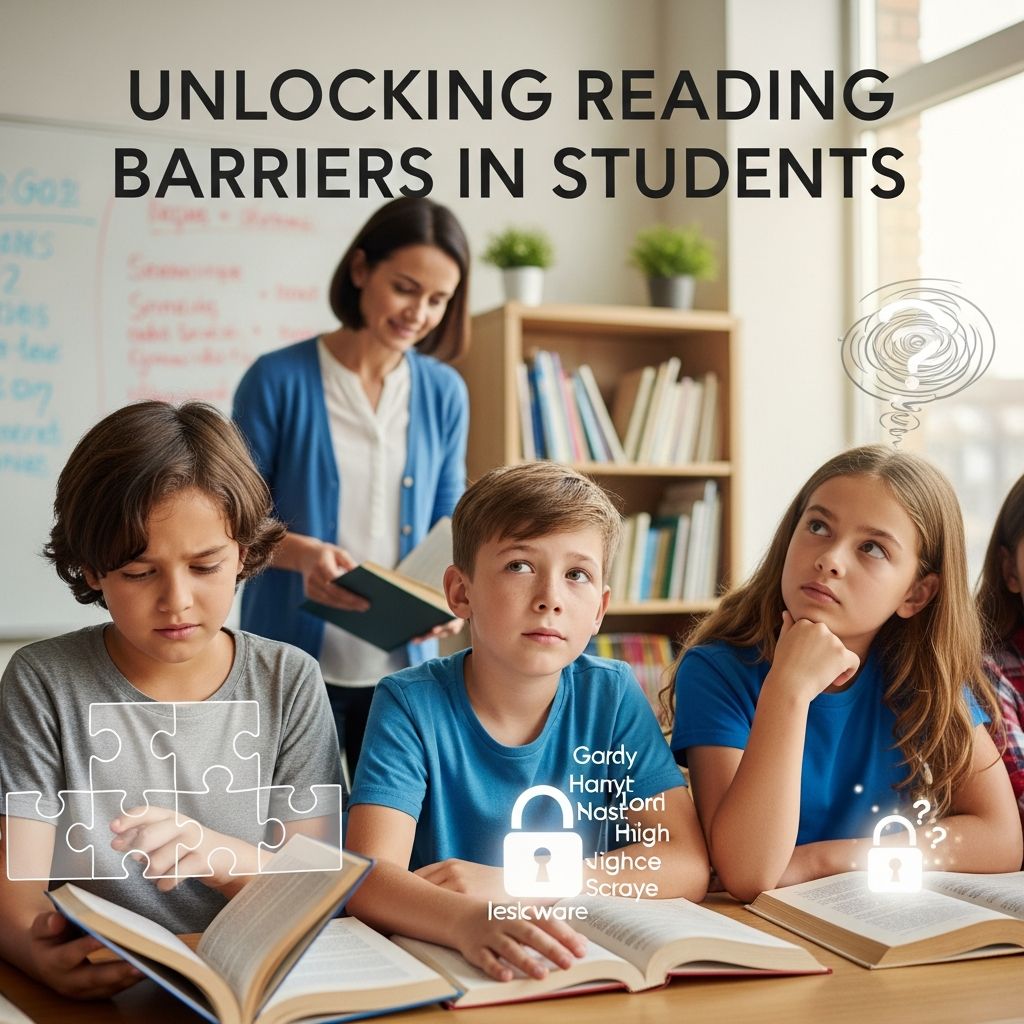
Reading forms the foundation of academic success and personal growth, yet many students encounter persistent obstacles that hinder their progress. These challenges can manifest early in elementary school or persist into higher grades, affecting confidence and performance across subjects. By pinpointing the underlying issues—such as word recognition problems, comprehension deficits, or motivational barriers—educators and parents can implement targeted interventions to transform struggling readers into proficient ones.
Core Challenges Disrupting Reading Development
Students’ reading difficulties often stem from distinct yet interconnected problems. Understanding these categories is essential for effective support, as each requires tailored approaches to address root causes rather than symptoms.
- Word Decoding Hurdles: Many learners falter when breaking down unfamiliar words, leading to slow and inaccurate reading.
- Comprehension Shortfalls: Even when words are read correctly, grasping meaning, inferences, or main ideas proves elusive.
- Attention and Motivation Gaps: Distractions or disinterest exacerbate issues, creating a cycle of avoidance and frustration.
Breaking Down Word-Level Reading Obstacles
At the heart of many reading struggles lies the inability to decode words efficiently. This involves sounding out letters and blending them into recognizable terms, a skill that demands phonological awareness—recognizing sounds within spoken words. Children with these issues often confuse similar letters like ‘b’ and ‘d’, substitute sounds, or guess words from context instead of decoding them properly.
For instance, multisyllabic words pose particular trouble for older students, who may skip them or pronounce them incorrectly, resulting in labored fluency. Signs include frequent pauses during oral reading, mispronunciations, and avoidance of complex texts. Research highlights that insufficient phonics instruction early on contributes significantly, as does brain processing differences affecting sound-symbol matching.
| Sign of Decoding Difficulty | Examples | Impact on Learning |
|---|---|---|
| Letter reversals | b/d, p/q confusion | Slow word recognition |
| Guessing from pictures | Skipping phonics | Poor fluency |
| Slow reading speed | Labored sounding out | Frustration in class |
Navigating Comprehension Deficits
Comprehension represents the ultimate goal of reading: extracting and integrating meaning. Students may decode fluently but fail to connect ideas, predict outcomes, or retain information. This specific reading comprehension difficulty (SRCD) often links to limited vocabulary, weak background knowledge, or underdeveloped strategies like summarizing or questioning text.
Common indicators include inability to retell stories, trouble with open-ended questions, or misinterpreting main points. For mixed reading difficulties (MRD), decoding and comprehension woes compound, leading to rushed reading without absorption. Older learners might avoid challenging materials or rely heavily on peers for explanations, masking deeper issues.
- Limited vocabulary hinders understanding nuanced terms.
- Poor sequencing skills confuse event order in narratives.
- Absence of inference-making prevents grasping implied meanings.
The Role of Attention, Focus, and Engagement
Beyond linguistic skills, cognitive factors like attention play a pivotal role. Students with ADHD or similar traits struggle to sustain focus, leading to frequent distractions and misinterpretations. Short attention spans result in abandoned tasks or superficial engagement, while low motivation stems from repeated failures, fostering avoidance behaviors.
Easily distracted readers often exhibit inconsistent performance, such as variable homework quality or disengagement in discussions. Building stamina requires creating engaging environments and breaking sessions into manageable chunks.
Unraveling Underlying Causes
Reading barriers arise from a mix of neurological, environmental, and instructional factors. Brain imaging studies reveal differences in white matter tracts crucial for reading efficiency, particularly in dyslexia—affecting 15-20% of students. Genetic predispositions and specific language impairments heighten risks, while inadequate early exposure to rich language delays development.
Environmental influences, like limited home reading or screen-heavy lifestyles, compound issues. For older students, gaps in foundational skills persist without intervention, evolving into complex text avoidance.
Practical Strategies for Parents at Home
Parents wield immense influence through daily routines. Start with paired reading: alternate sentences to model fluency and discuss content. Introduce sight word games and flashcards to bolster vocabulary, targeting weak areas like multisyllabic decoding.
Encourage active engagement by asking predictive questions pre-reading and reflective ones post-reading. Create a distraction-free zone and set short, achievable goals to build confidence. Track progress with reading logs to celebrate gains.
- Read aloud daily, emphasizing expression.
- Use audiobooks alongside print for modeling.
- Incorporate fun apps for phonics practice.
Effective Classroom Interventions for Educators
Teachers can deploy systematic phonics programs with ample practice at word, sentence, and passage levels. For comprehension, teach explicit strategies: visualizing, questioning, and connecting to prior knowledge. Differentiate instruction via small groups or tech tools assessing real-time needs.
Pre-teach vocabulary and build background with visuals or discussions. Monitor via informal assessments, adjusting for fluency and engagement. Foster a supportive culture where struggles are normalized and effort praised.
Spotting and Addressing Specific Disorders
Dyslexia, the most prevalent reading disorder, features phonological processing deficits, slow fluency, and spelling woes. Other types include phonological dyslexia (sound-symbol mismatches) and surface dyslexia (irregular word issues). Early screening via standardized tools identifies needs for specialized plans like Orton-Gillingham methods.
Intervene promptly: structured literacy programs yield strong outcomes when matched to profiles.
Leveraging Technology and Resources
Digital tools amplify support. Apps for phonemic awareness, text-to-speech software for accessibility, and gamified platforms engage reluctant readers. Adaptive programs provide personalized practice, tracking metrics for data-driven tweaks.
Combine with multisensory techniques—tracing letters in sand while sounding out—to reinforce neural pathways.
Building Long-Term Reading Resilience
Sustained improvement demands consistency and collaboration between home and school. Regular progress monitoring ensures strategies evolve with the student. Emphasize growth mindset: reading skill develops through practice, not innate talent.
Expose to diverse genres for motivation, from graphic novels to informational texts. Ultimately, empowered readers gain independence across disciplines.
Frequently Asked Questions (FAQs)
How do I know if my child has a reading disability?
Look for persistent issues like word confusion, poor fluency, or comprehension gaps despite instruction. Consult professionals for assessments.
Can reading struggles appear in smart students?
Yes, dyslexia affects intelligent children, decoupling IQ from reading ability.
What age should interventions start?
Early, ideally kindergarten, but effective at any stage with targeted support.
How long does improvement take?
Varies; consistent daily practice yields noticeable gains in months.
Are there free resources for home support?
Yes, public libraries offer phonics kits; online platforms provide free drills.
References
- How to Help Kids Overcome Common Reading Challenges — Books Are Fun. 2023. https://booksarefun.com/blog/how-to-help-kids-overcome-common-reading-challenges
- Top Reading Challenges for Kids and How to Overcome Them — Little Sunshine. 2024. https://littlesunshine.com/blog/top-reading-challenges-for-kids-and-how-to-overcome-them/
- Reading Difficulties: Strategies and Solutions — Forbrain. 2023-10-15. https://www.forbrain.com/dyslexia-children/reading-difficulties/
- Why Older Students Struggle with Reading — Savvas Learning Company. 2025. https://www.savvas.com/resource-center/blogs-and-podcasts/savvas-insights/2025/why-older-students-struggle-with-reading
- 11 Signs Your Child May Have A Reading Disability — Oxford Learning. 2023. https://oxfordlearning.com/signs-of-reading-disability/
- Spotting Reading Difficulties: Early Indicators for Middle and High School — Collaborative Classroom. 2024. https://www.collaborativeclassroom.org/blog/spotting-reading-difficulties-middle-high-school/
- Understanding Reading Disorders: A Guide for Parents — PAR, Inc. 2024-05-17. https://www.parinc.com/learning-center/par-blog/detail/content-hub/2024/05/17/understanding-reading-disorders–a-guide-for-parents

- Integrated M.A. in Applied Linguistics, University of Hyderabad
- 5+ years in editorial, instructional, SEO, and research-based writing
Sneha is a relationships and lifestyle writer with a strong foundation in applied linguistics and certified training in relationship coaching. She brings over five years of writing experience to theskillvault, crafting thoughtful, research-driven content that empowers readers to build healthier relationships, boost emotional well-being, and embrace holistic living. Her writing and insights reflect the belief that beauty, happiness, and wellness…