
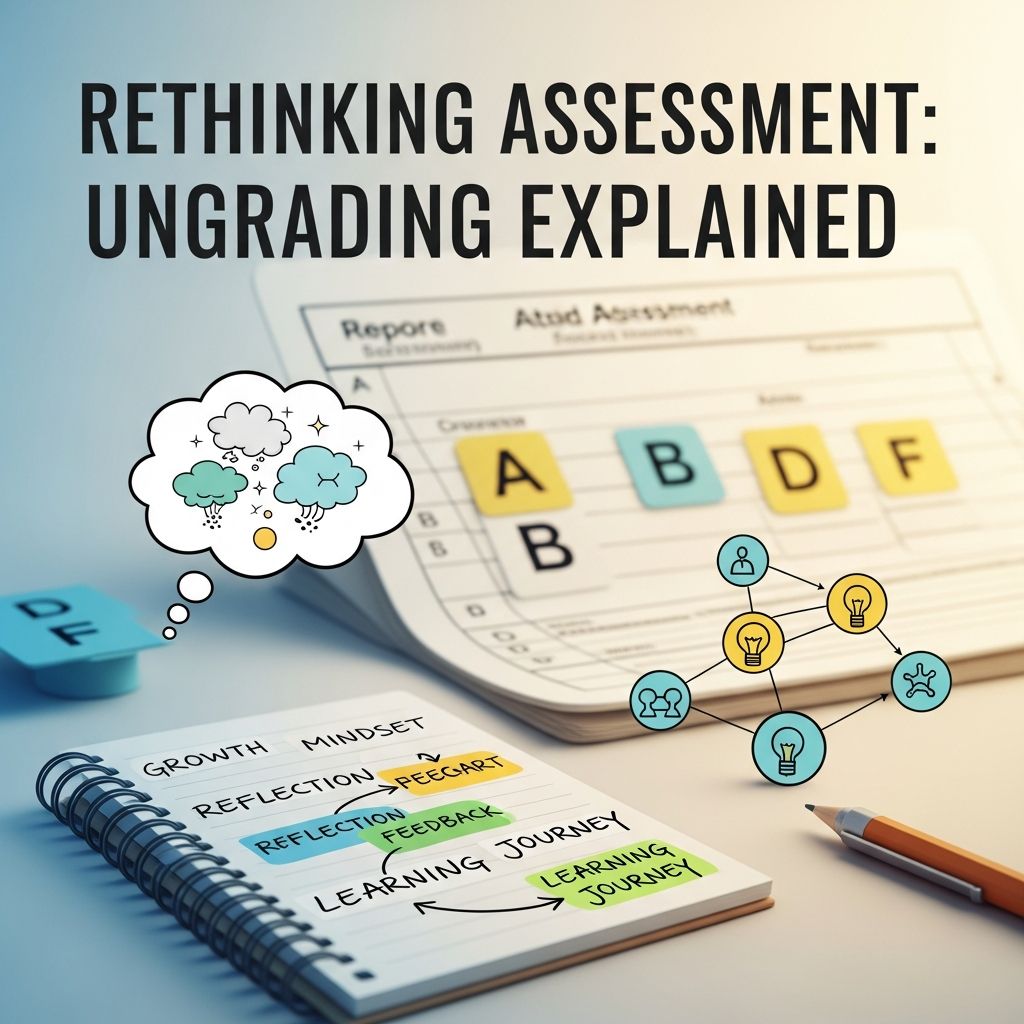
Ungrading represents a paradigm shift in educational assessment, where traditional letter or numerical grades are minimized or eliminated in favor of rich, process-oriented feedback. This method prioritizes student growth, intrinsic motivation, and meaningful engagement with course material over summative scoring.
The Core Principles of Ungrading
At its heart, ungrading focuses on learning objectives rather than competition. Educators provide frequent, specific comments on student work, encouraging self-assessment and revision. Students reflect on their progress against clear course goals, taking ownership of their development.
- Feedback-Centric Evaluation: Detailed instructor comments guide improvement without quantifying performance.
- Student Agency: Learners evaluate their own efforts, fostering metacognition and lifelong skills.
- Iterative Improvement: Assignments can be resubmitted based on feedback, emphasizing mastery.
This approach aligns assessments directly with educational outcomes, ensuring every activity contributes to skill-building.
Key Advantages for Student Learning
Ungrading yields intellectual benefits by cultivating a growth mindset. Without the fear of low scores, students experiment boldly, producing higher-quality work.
| Benefit Category | Description | Impact on Students |
|---|---|---|
| Intellectual | Promotes risk-taking and creativity | Higher engagement and innovative projects |
| Personal | Reduces stress tied to grades | Boosts well-being and internal motivation |
| Social | Fosters collaboration over competition | Builds supportive classroom communities |
Research indicates students in ungraded systems complete more thorough assignments, as the absence of punitive metrics frees mental energy for deep thinking.
How Ungrading Supports Mental Health
Grade anxiety plagues many learners, linking self-worth to arbitrary numbers. Ungrading decouples identity from scores, allowing students to view setbacks as learning opportunities.
In practice, first-year students report palpable relief, balancing academic demands with mental health needs. This safety net encourages openness about challenges, creating empathetic classroom dynamics.
- Eliminates “A student” or “C student” labels that harm self-esteem.
- Encourages mental health days without grade penalties.
- Promotes resilience through reflective practices.
Promoting Equity and Inclusion
Traditional grading often amplifies disparities from socioeconomic, racial, or gender differences. Ungrading counters this by valuing diverse thinking styles and providing tailored feedback.
Students from underrepresented backgrounds note rebuilt confidence in ungraded spaces, feeling included rather than judged by standardized metrics. It highlights assessment power dynamics, sparking discussions on fairness.
Practical Strategies for Implementation
Transitioning to ungrading requires planning. Start with transparent learning objectives aligned to assignments.
- Define Clear Goals: Outline course and module objectives upfront.
- Incorporate Reflections: Assign periodic self-assessments where students gauge progress.
- Offer Peer Review: Build community through collaborative feedback sessions.
- Provide Opt-Outs: Allow students uncomfortable with self-grading to receive traditional marks.
- End with Holistic Review: Students propose final standings based on portfolio evidence.
Reflective writing, for instance, prompts analysis of strengths and growth areas, enhancing critical self-awareness.
Challenges and Solutions in Ungrading
Not all students adapt easily; some crave the structure of grades. Address this with hybrid models or clear guidelines.
| Challenge | Solution |
|---|---|
| Student Resistance | Explain benefits early; offer opt-outs |
| Instructor Workload | Streamline feedback templates |
| Institutional Requirements | Translate ungrading to final grades via portfolios |
Faculty report initial trust concerns dissipate as students rise to the responsibility, often exceeding expectations.
Real-World Examples from Classrooms
In writing seminars, ungrading sparks ambitious research projects students previously avoided due to grade fears. Music courses see students co-design content, producing work they proudly extend beyond the class.
Chemistry educators note sustained agency post-course, with students mastering feedback-driven improvement. Across disciplines, ungrading builds partnerships where professors and students co-navigate learning.
Evidence from Educational Research
Studies affirm ungrading’s efficacy. Lafayette College highlights reduced stress and equitable outcomes. Inside Higher Ed documents creativity surges and mental health gains.
Columbia’s Center for Teaching emphasizes equitable reimagining of assessment. These insights from academic centers underscore ungrading’s transformative potential.
Building a Supportive Ungrading Environment
Success hinges on trust. Instructors model vulnerability by sharing goals, while students prepare for discussions. This reciprocity accountability drives effective learning.
Classrooms evolve into communities where collective creativity flourishes, sustaining post-course connections like group chats.
Future Directions for Ungrading
As education evolves, ungrading aligns with competency-based models. It prepares students for real-world evaluations like performance reviews, emphasizing reflection over metrics.
Scalability to larger classes or online formats remains promising with digital tools for feedback.
Frequently Asked Questions (FAQs)
What exactly is ungrading?
Ungrading minimizes or removes grades, replacing them with feedback, self-assessment, and reflections focused on learning goals.
Does ungrading mean no evaluation at all?
No, evaluation persists through qualitative feedback and student-led assessments against objectives.
Can ungrading work in large classes?
Yes, with peer review, rubrics, and digital platforms to manage feedback volume.
How do students receive final course credit?
Many use portfolios or self-proposed grades at term’s end, often pass/fail or holistic reviews.
Is ungrading suitable for all subjects?
It adapts across disciplines, from humanities to STEM, prioritizing mastery.
Ungrading empowers educators to foster curiosity, resilience, and joy in learning, challenging outdated paradigms for a more humane system.
References
- Why Do Ungrading? — CITLS, Lafayette College. 2023. https://citls.lafayette.edu/why-do-ungrading/
- Four powerful benefits of ungrading (opinion) — Inside Higher Ed. 2025-03-21. https://www.insidehighered.com/opinion/career-advice/teaching/2025/03/21/four-powerful-benefits-ungrading-opinion
- Feedback and Grading: Ungrading — COD Library, College of DuPage. 2023. https://library.cod.edu/feedback/grading/un
- Adventures in Ungrading — The Scholarly Teacher. 2023. https://www.scholarlyteacher.com/post/adventures-in-ungrading
- Ungrading: Reimagining Assessment of Student Learning — CTL, Columbia University. 2023. https://ctl.columbia.edu/faculty/sapp/ungrading/
- Ungrading: What is it and why should we use it? — ChemEd X. 2023. https://www.chemedx.org/blog/ungrading-what-it-and-why-should-we-use-it
- What is Ungrading? — Duke Center for Teaching and Learning. 2022-09. https://learninginnovation.duke.edu/blog/2022/09/what-is-ungrading/

Medha Deb is an editor with a master's degree in Applied Linguistics from the University of Hyderabad. She believes that her qualification has helped her develop a deep understanding of language and its application in various contexts. Medha specializes in the areas of beauty, health, sports, and wellness and is committed to ensuring that the content on the website is…