
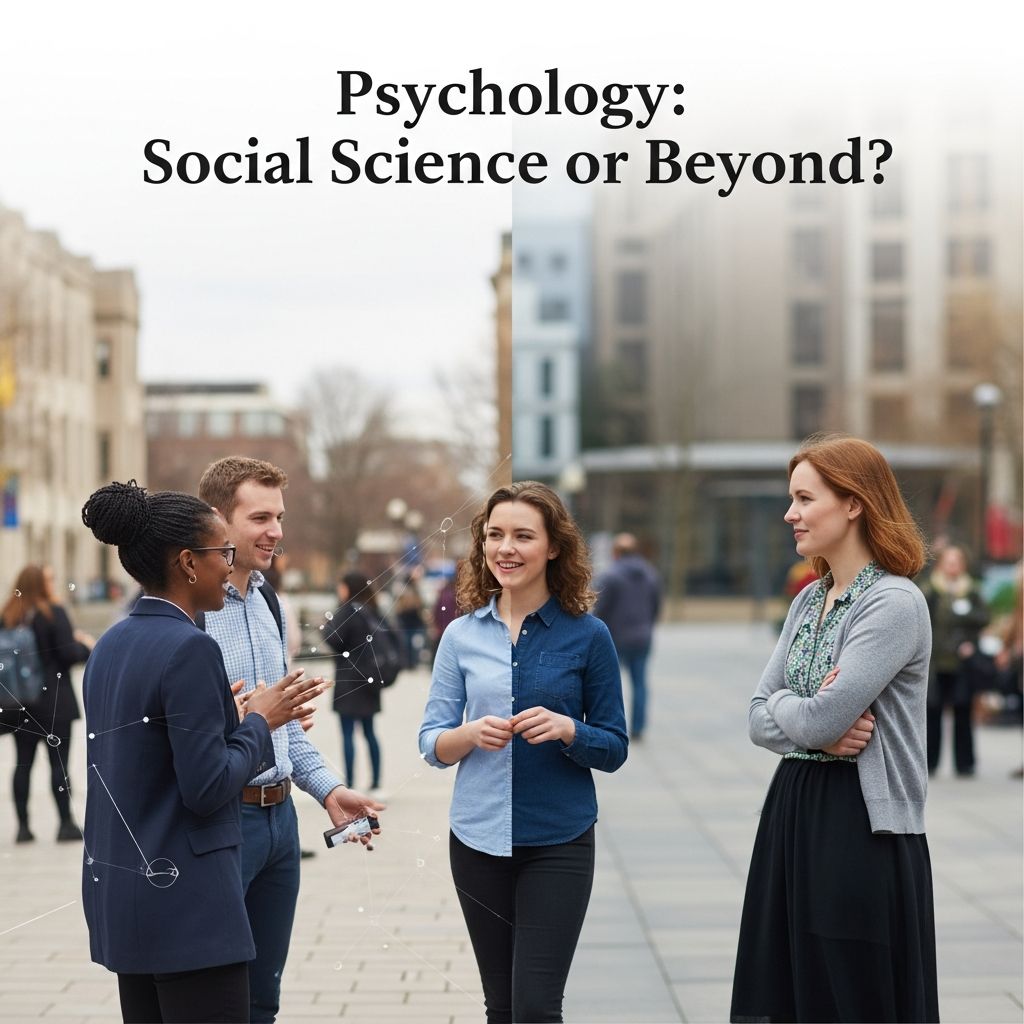
Psychology stands at the intersection of human experience and empirical inquiry, often sparking debate about its proper classification among academic disciplines. While many institutions group it with social sciences due to its emphasis on behavior within societal contexts, its methodologies and subfields extend into biological and cognitive realms, challenging a singular label.
Defining Social Sciences and Psychology’s Place
Social sciences encompass disciplines that systematically study human society, relationships, and interactions, including anthropology, economics, sociology, and political science. These fields rely on empirical data to analyze social structures, cultural norms, and collective behaviors. Psychology aligns here through its investigation of individual and group dynamics, such as how emotions, cognition, and social influences shape actions.
However, psychology’s scope transcends purely social analysis. It employs rigorous scientific methods—hypothesis testing, controlled experiments, statistical analysis—to explore the mind and brain, akin to natural sciences. This dual nature positions psychology as a bridge discipline, sometimes termed a “behavioral science” for its focus on observable actions across species and environments.
Core Characteristics That Bind Psychology to Social Sciences
Psychology’s social science credentials stem from its foundational questions about human interaction. Social psychology, a prominent branch, dissects phenomena like conformity, prejudice, and groupthink, revealing how societal pressures mold individual choices. Researchers use surveys, observational studies, and lab simulations to quantify these effects, mirroring sociological approaches.
- Empirical Foundations: Like economics or sociology, psychology prioritizes data-driven insights over anecdotal evidence, employing tools such as longitudinal studies and meta-analyses.
- Societal Focus: It examines how cultural, economic, and political factors influence mental health, education, and policy.
- Interdisciplinary Ties: Collaborations with anthropology yield insights into cross-cultural behaviors, while overlaps with political science inform voter psychology.
In university curricula and library classifications, psychology frequently resides alongside social sciences, reflecting administrative and thematic alignments. For instance, the Library of Congress and Dewey Decimal systems often pair it with related fields, underscoring its role in understanding social aggregates like classes or organizations.
Challenges to the Social Science Label
Not all aspects of psychology fit the social science mold. Subfields like biological psychology delve into neural mechanisms, genetics, and physiological responses, employing techniques from neuroscience and employing animal models—hallmarks of natural sciences. Neuropsychology, for example, maps brain lesions to cognitive deficits, producing findings indistinguishable from medical research.
This breadth fuels ongoing debates. Critics argue that psychology’s individual-level focus (e.g., decision-making in lab settings) diverges from social sciences’ emphasis on group-level patterns. Evolutionary psychology further blurs lines by applying Darwinian principles to mating strategies and altruism, integrating biology seamlessly.
| Aspect | Social Science Traits | Natural Science Traits |
|---|---|---|
| Subject Matter | Group dynamics, culture, norms | Brain function, genetics, perception |
| Methods | Surveys, ethnographies | Brain imaging, experiments |
| Examples | Social psychology, I-O psych | Biopsychology, sensation |
Despite these tensions, psychology’s holistic approach enriches both paradigms, fostering innovations like behavioral economics.
Key Branches Illustrating Psychology’s Versatility
Psychology’s subdisciplines highlight its multifaceted identity. Developmental psychology tracks lifespan changes in cognition and social skills, informing education policy—a social application. Cognitive psychology models memory and problem-solving, with roots in computer science and philosophy.
- Abnormal Psychology: Studies mental disorders’ societal impacts, blending clinical treatment with epidemiological analysis.
- Forensic Psychology: Applies behavioral insights to legal systems, assessing criminal motivations within cultural contexts.
- Industrial-Organizational (I-O) Psychology: Optimizes workplace dynamics, merging social theory with productivity metrics.
These branches demonstrate psychology’s practical utility, from therapy to organizational consulting, often requiring social science lenses for real-world efficacy.
Psychology’s Scientific Rigor: Evidence and Methods
Affirming its scientific status, psychology adheres to the scientific method: forming testable hypotheses, collecting replicable data, and refining theories through peer review. Controlled experiments, such as Milgram’s obedience studies, exemplify this, yielding quantifiable insights into authority’s social power.
Statistical tools like ANOVA and regression ensure objectivity, while ethical standards from bodies like the American Psychological Association (APA) safeguard participant welfare. Recent advancements, including fMRI and big data analytics, bolster its empirical foundation, countering past criticisms of subjectivity.
Career Pathways in Psychology as a Social Science
Pursuing psychology opens doors to diverse roles leveraging its social insights. Clinical psychologists diagnose societal stressors’ mental toll, while school psychologists enhance educational equity.
In policy, psychologists advise on public health campaigns, drawing from behavioral data to combat issues like addiction or inequality. Corporate sectors value I-O experts for diversity training and leadership development.
| Career | Focus Area | Avg. Salary Insight |
|---|---|---|
| Clinical Psychologist | Mental health in communities | High demand in social services |
| Social Researcher | Policy and trends | Growing with data needs |
| HR Specialist | Workplace behavior | Essential for modern firms |
Advanced degrees amplify opportunities, with PhDs leading research at universities or think tanks.
Intersections with Other Disciplines
Psychology’s social science status amplifies through synergies. With sociology, it unpacks inequality’s psychological scars; economics benefits from nudge theory in decision-making. Geography incorporates environmental psychology to study space-behavior links.
Emerging fields like computational social science harness AI to model networks, positioning psychology at tech-humanity’s forefront. These fusions underscore its evolving role beyond traditional boundaries.
Educational Journeys into Psychology
Undergraduate programs blend theory and practice: intro courses cover history (e.g., Wundt’s lab), while labs teach experimentation. Majors select electives in social, cognitive, or biological tracks, culminating in capstones or internships.
AP Psychology in high schools introduces these concepts, classified as social studies for its societal focus. Graduates pursue master’s for counseling or doctorates for research, with accreditation ensuring quality.
FAQs
Is psychology strictly a social science?
No, it’s interdisciplinary, incorporating social, biological, and cognitive elements.
How does psychology use the scientific method?
Through experiments, statistics, and replication to test behavior hypotheses.
What jobs can a psychology degree lead to?
Therapy, research, HR, policy advising, and more.
Does psychology study animals?
Yes, especially in biological subfields, informing human applications.
Why the debate over its classification?
Due to fuzzy boundaries with natural sciences and humanities.
Psychology’s classification debate reflects its richness, equipping students to navigate human complexity with scientific precision. Whether labeled social science or broader, its contributions to understanding society endure.
References
- Is Psychology a Social Science? – MedCircle Mental Health — MedCircle. 2023. https://medcircle.com/articles/is-psychology-a-social-science/
- Classification of the social sciences (IEKO) — International Society for Knowledge Organization. 2022-10-15. https://www.isko.org/cyclo/social_sciences
- Is Psychology a Science? Analyzing the Evidence and Methodology — Sociology.org. 2024. https://sociology.org/is-psychology-a-science-the-evidence-behind-the-discipline/
- Social science – Wikipedia — Wikipedia Contributors. 2026-02-01. https://en.wikipedia.org/wiki/Social_science
- 8 Types of Psychology With Real-World Perspective — Southern New Hampshire University. 2023-05-12. https://www.snhu.edu/about-us/newsroom/social-sciences/types-of-psychology
- Changes Announced to AP Psychology and AP Physics Courses — College Board. 2023. https://allaccess.collegeboard.org/changes-announced-ap-psychology-and-ap-physics-courses
- Introduction to Psychology as a Social Science — Portland State University Pressbooks. 2024. https://pdx.pressbooks.pub/psy204flippedclassedition/chapter/subfields-within-psychology/

- Integrated M.A. in Applied Linguistics, University of Hyderabad
- 5+ years in editorial, instructional, SEO, and research-based writing
Sneha is a relationships and lifestyle writer with a strong foundation in applied linguistics and certified training in relationship coaching. She brings over five years of writing experience to theskillvault, crafting thoughtful, research-driven content that empowers readers to build healthier relationships, boost emotional well-being, and embrace holistic living. Her writing and insights reflect the belief that beauty, happiness, and wellness…