
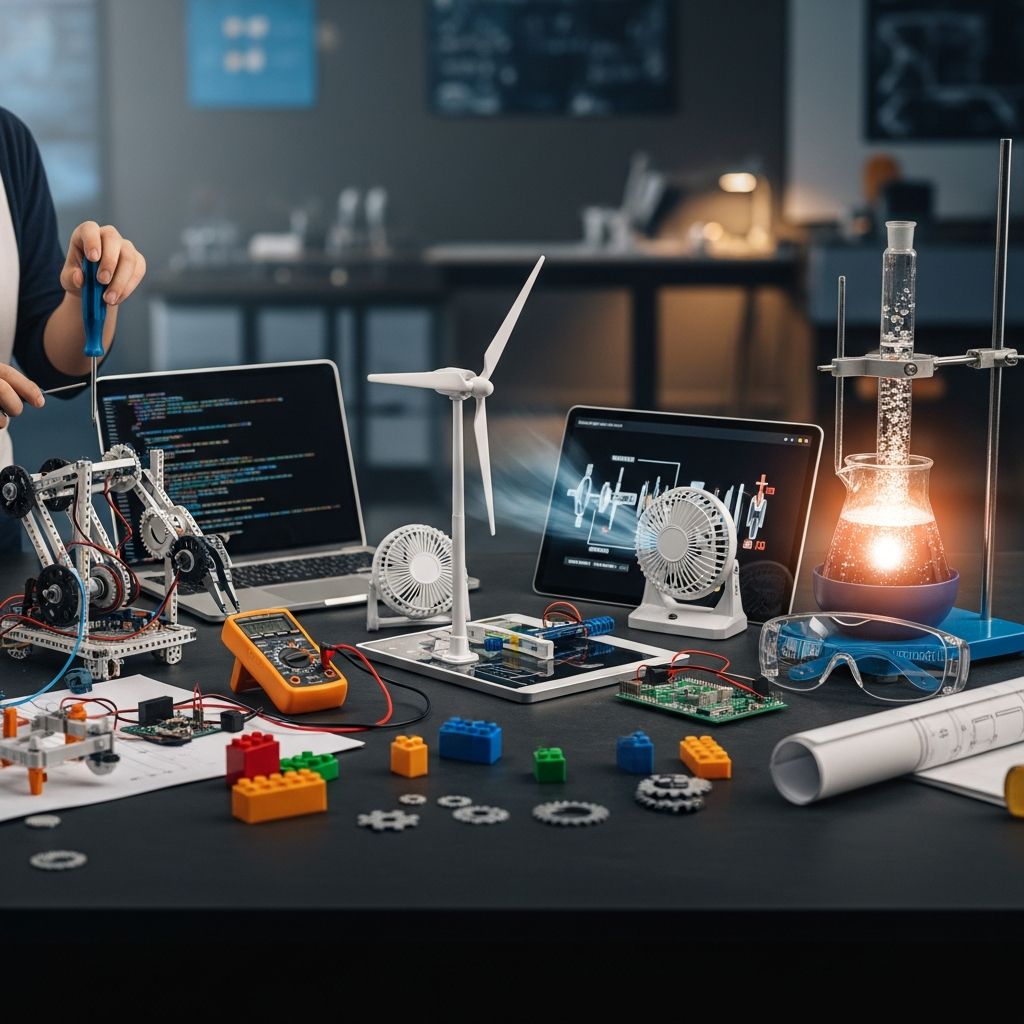
High school is a pivotal time for students to dive into STEM fields, where they can experiment, innovate, and prepare for college and careers in growing industries. These 10 projects offer accessible ways to explore science, technology, engineering, and mathematics using everyday materials. Each activity emphasizes critical thinking, teamwork, and practical application, helping students grasp complex concepts through doing rather than just reading.
Why STEM Projects Matter for Teens
STEM education equips high schoolers with skills essential for the modern workforce. According to the U.S. Bureau of Labor Statistics, jobs in STEM occupations are projected to grow by 10.5% from 2022 to 2032, much faster than the average for all occupations.US Bureau of Labor Statistics Hands-on projects bridge theoretical knowledge with real-world problem-solving, boosting confidence and retention. They also encourage collaboration, as many activities work best in groups, mirroring professional environments.
Project 1: Construct a Basic Electric Circuit
Start with the fundamentals of electricity by building a simple circuit that lights up an LED. This project introduces concepts like voltage, current, and resistance.
- Materials: Breadboard, LED lights, jumper wires, resistors (220 ohms), 9V battery, battery clip.
- Steps:
- Insert the LED into the breadboard, ensuring the longer leg (anode) connects to the positive side.
- Add a resistor in series to protect the LED.
- Connect wires from the battery to complete the circuit.
- Test and troubleshoot if the light doesn’t glow—check polarity and connections.
This builds electrical engineering basics and debugging skills. Extend it by adding a switch for control.
Project 2: Code a Simple Python Game
Programming fosters logical thinking. Create a number-guessing game in Python to learn variables, loops, and conditionals.
- Materials: Computer with Python installed (use IDLE or online editors like Replit).
- Steps:
- Import the random module:
import random. - Generate a random number:
secret = random.randint(1, 100). - Use a loop for guesses with hints like ‘too high’ or ‘too low’.
- Add a guess counter for scoring.
- Import the random module:
Skills gained include coding logic and iteration. Challenge: Add graphics with Pygame library.
Project 3: Egg Drop Engineering Challenge
Test physics principles by designing a contraption to protect an egg from a 10-foot drop. This highlights impact forces, materials science, and prototyping.
- Materials: Straws, tape, cardboard, cotton balls, plastic bags, raw eggs.
- Steps:
- Brainstorm designs considering cushioning and aerodynamics.
- Build prototypes within a weight or size limit.
- Drop from increasing heights and analyze failures.
- Iterate based on tests.
Emphasizes trial-and-error, key to engineering.
Project 4: Design a Water Filtration System
Address environmental issues by building a filter to clean dirty water, exploring chemistry and sustainability.
- Materials: Plastic bottles, sand, gravel, activated charcoal, coffee filters, dirty water (mud + food coloring).
- Steps:
- Cut the bottle bottom and invert it as a funnel.
- Layer gravel, sand, and charcoal.
- Pour dirty water through and test clarity with TDS meter if available.
- Compare filtration rates and purity.
Teaches layers of filtration and water quality standards.
Project 5: Build a Solar-Powered Vehicle
Harness renewable energy to power a mini car, understanding photovoltaics and mechanics.
- Materials: Small solar panel, DC motor, wheels, cardboard chassis, hot glue.
- Steps:
- Attach solar panel to motor for energy conversion.
- Mount wheels on a lightweight base.
- Test in sunlight; optimize angle for max speed.
- Race designs on a track.
Promotes green tech awareness.
Project 6: Bridge Construction Contest
Engineer a bridge to hold maximum weight using limited materials, applying structural principles.
- Materials: Popsicle sticks, glue, string, weights (books or coins).
- Steps:
- Research truss designs (Warren or Howe).
- Build to span 12 inches.
- Test load capacity; calculate efficiency (weight held / material used).
- Redesign for improvements.
Develops statics and optimization skills.
Project 7: Extract DNA from Fruit
Dive into biotechnology by isolating DNA, demystifying genetics.
- Materials: Strawberries, dish soap, salt, rubbing alcohol, coffee filter, test tube.
- Steps:
- Mash fruit with soap-salt solution to break cells.
- Filter liquid.
- Add cold alcohol; DNA precipitates as white strands.
- Spool it out with a stick.
Illustrates cell structure and lab techniques.
Project 8: Model Roller Coaster Physics
Apply energy conservation by building a marble roller coaster.
- Materials: Foam pipe insulation, marbles, tape, cardboard supports.
- Steps:
- Design track with loops and drops.
- Measure heights and speeds.
- Calculate potential/kinetic energy: (PE = mgh, KE = 1/2 mv^2).
- Minimize friction losses.
Teaches Newtonian physics.
Project 9: Program an Arduino Robot
Enter robotics by coding a bot to navigate obstacles.
- Materials: Arduino Uno, ultrasonic sensor, motors, chassis kit.
- Steps:
- Wire components.
- Code in Arduino IDE: use sensor data for decisions.
- Test avoidance behaviors.
- Add line-following.
Combines hardware and software.
Project 10: Oil Spill Cleanup Simulation
Simulate environmental remediation using nanotechnology-inspired methods.
- Materials: Vegetable oil, water, feathers, ferrofluid or magnets, dish soap.
- Steps:
- Create spill in tray.
- Test skimmers, absorbents, dispersants.
- Evaluate effectiveness on wildlife proxies.
Highlights real-world applications.
Skill Comparison Table
| Project | Core STEM Discipline | Key Skills |
|---|---|---|
| Electric Circuit | Technology/Engineering | Debugging, Electronics |
| Python Game | Technology/Math | Logic, Programming |
| Egg Drop | Engineering/Physics | Prototyping, Forces |
| Water Filter | Science/Engineering | Chemistry, Sustainability |
| Solar Car | Engineering/Science | Energy, Design |
| Bridge | Engineering/Math | Structures, Load Testing |
| DNA Extraction | Science | Biotech, Lab Safety |
| Roller Coaster | Physics/Math | Energy Conservation |
| Arduino Robot | Technology/Engineering | Robotics, Sensors |
| Oil Spill | Science/Engineering | Environmental Science |
Getting Started: Parental and Teacher Tips
Supervise projects involving chemicals or heights. Source materials affordably from dollar stores or recyclables. Track progress in a journal for reflection. Tie to curriculum—e.g., circuits for physics class. Budget: Most under $20. Time: 1-3 hours each.
FAQs
Are these projects suitable for beginners?
Yes, they scale from basic to advanced with extensions.
What if I lack materials?
Substitutes work: online simulators for coding, household items for builds.
How do these prepare for college?
They build portfolios for STEM applications and demonstrate initiative.
Can groups do them?
Absolutely—divide roles like designer, builder, tester.
Where to expand learning?
MIT OpenCourseWare or Khan Academy for deeper dives.
References
- STEM Blazers: STEM Activities for High School — STEM Blazers. 2023. https://www.stemblazers.org/blog/stem-activities-for-high-school-engaging-students-in-future-ready-skills
- Project Pals: 17 Examples of STEM Project-Based Learning — Project Pals. 2023. https://projectpals.com/post/17-examples-of-stem-project-based-learning-activities/
- U.S. Bureau of Labor Statistics: Occupational Outlook Handbook — U.S. Department of Labor. 2024-09-04. https://www.bls.gov/ooh/
- DiscoverE: Grades 9-12 Engineering Activities — DiscoverE. 2024. https://discovere.org/student-activities/grades/grade-9-12/
- STEM.org.uk: 50+ STEM Activities for Secondary — STEM Learning. 2020-09. https://www.stem.org.uk/system/files/elibrary-resources/2020/09/50+%20STEM%20activities%20for%20any%20classroom%20-%20Secondary.pdf

- Integrated M.A. in Applied Linguistics, University of Hyderabad
- 5+ years in editorial, instructional, SEO, and research-based writing
Sneha is a relationships and lifestyle writer with a strong foundation in applied linguistics and certified training in relationship coaching. She brings over five years of writing experience to theskillvault, crafting thoughtful, research-driven content that empowers readers to build healthier relationships, boost emotional well-being, and embrace holistic living. Her writing and insights reflect the belief that beauty, happiness, and wellness…