
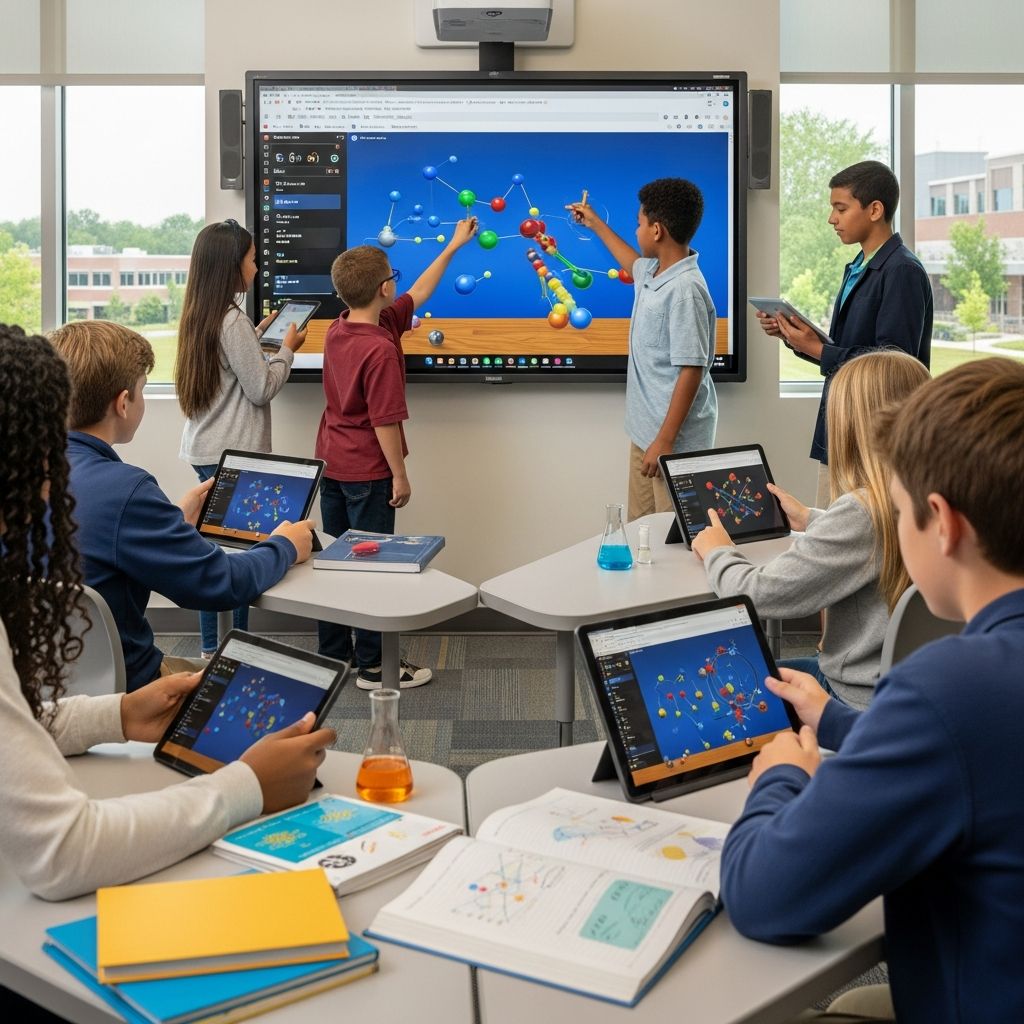
Interactive simulations like those from PhET are reshaping how K-12 students approach science, turning abstract concepts into tangible explorations through digital platforms. These tools, developed by the University of Colorado Boulder, provide free access to hundreds of research-based activities that mimic real-world experiments, fostering deeper comprehension and enthusiasm for STEM subjects.
The Rise of Virtual Learning Tools in Modern Classrooms
In an era where digital natives dominate classrooms, traditional lecture-based science instruction often falls short in captivating young minds. PhET simulations address this by offering immersive environments where students manipulate variables, observe outcomes, and draw conclusions independently. Unlike static textbooks, these tools leverage animations, sliders, and real-time feedback to visualize phenomena such as wave propagation or chemical reactions, making science accessible even in resource-limited settings.
Research highlights how such simulations enhance motivation and process skills, allowing educators to assess understanding dynamically. For instance, they enable adaptive testing where difficulty adjusts based on student responses, providing insights into individual progress. This shift supports inquiry-based learning, where curiosity drives discovery rather than rote memorization.
Core Advantages of PhET for Young Learners
PhET stands out for its design principles, emphasizing real-world connections and minimal text to maximize interactivity. Students engage via click-and-drag interfaces, fostering cause-and-effect reasoning across physics, chemistry, biology, and math.
- Boosts Conceptual Mastery: Abstract ideas like atomic interactions become visible, helping students build mental models that textbooks alone cannot convey.
- Fosters Active Experimentation: Virtual labs let learners test hypotheses repeatedly without material costs or safety concerns, promoting trial-and-error learning.
- Heightens Engagement: Gamified elements and immediate results keep students hooked, improving retention through multi-sensory input.
- Ensures Equity and Accessibility: Free and browser-based, PhET eliminates barriers for underfunded schools, supporting diverse learning paces with instant feedback.
- Supports Skill Development: Encourages critical thinking, problem-solving, and data analysis, preparing students for real-world STEM challenges.
Practical Applications Across Science Disciplines
PhET’s library spans K-12 curricula, aligning with standards for seamless integration. In physics, the “Forces and Motion” simulation lets students apply Newton’s laws by dragging objects and adjusting friction, revealing relationships dynamically. Chemistry learners explore the “pH Scale” to understand acids and bases through color changes and measurements, grasping equilibrium concepts intuitively.
| Discipline | Key PhET Simulation | Educational Focus | Grade Level |
|---|---|---|---|
| Physics | Energy Skate Park | Conservation of energy | 6-10 |
| Chemistry | Build a Molecule | Molecular geometry | 7-12 |
| Biology | Natural Selection | Evolution principles | 9-12 |
| Earth Science | Greenhouse Effect | Climate dynamics | 5-8 |
Beyond PhET, complementary tools like Gizmos extend this model with curriculum-aligned labs for genetics and algebra, while NASA’s simulations immerse students in space physics. These resources collectively bridge theory and practice, enhancing outcomes in blended learning environments.
Implementation Strategies for Educators
Integrating PhET requires thoughtful planning to maximize impact. Start by mapping simulations to lesson objectives, using them for pre-lab predictions or post-lecture reinforcement. Encourage group work where students collaborate on multi-user setups, simulating team-based research.
Combine virtual and physical activities: follow a PhET circuit-building exercise with simple wire kits to solidify concepts. Track progress via built-in logs that capture decision sequences, enabling targeted feedback and differentiated instruction. Professional development resources from PhET, including teacher guides, ensure confident adoption.
- Lesson Planning: Select 2-3 simulations per unit, allocating 20-30 minutes per session.
- Assessment Integration: Use simulation data for formative quizzes on variable effects.
- Home Extension: Assign browser-based activities for homework, promoting anytime access.
- Equity Measures: Provide offline versions or screen-sharing for low-connectivity areas.
Evidence of Impact from Research and Practice
Studies affirm PhET’s efficacy; simulations improve conceptual understanding in lectures, labs, and homework by creating effective analogies. A National Academies report notes their role in deepening science process skills and motivation, with adaptive features aiding personalized education.
In K-12 settings, teachers report higher engagement and retention, particularly for visual learners. Virtual repeatability allows exploring edge cases—like extreme temperatures in gas laws—impossible in physical labs, reinforcing principles through iteration. Metrics from platforms show students mastering topics 20-30% faster with interactive tools.
Overcoming Challenges in Adoption
While powerful, hurdles like device access or teacher training exist. Solutions include grant-funded Chromebooks and free PhET webinars. Bandwidth issues are mitigated by HTML5 versions loading quickly on modest connections. Ongoing updates ensure compatibility with evolving tech, maintaining relevance.
For special needs students, adjustable interfaces and multilingual options promote inclusivity. Data privacy is prioritized, with no user tracking in core simulations.
Future Directions for Interactive Science Education
As AI and VR advance, PhET-like tools will incorporate adaptive narratives and augmented reality, blending virtual with real-world overlays. Expect deeper integration with curricula platforms, enabling seamless progress tracking across devices. Policymakers should prioritize funding for digital equity to scale these innovations nationwide.
Ultimately, PhET exemplifies how technology democratizes high-quality science education, equipping K-12 students with skills for a tech-driven future.
Frequently Asked Questions (FAQs)
What is PhET and who created it?
PhET Interactive Simulations is a free platform from the University of Colorado Boulder, offering research-based science and math activities.
Are PhET simulations suitable for all grade levels?
Yes, with activities from kindergarten basics to high school advanced topics, customizable for diverse classrooms.
Do they replace physical labs?
No, they complement them by providing safe, unlimited practice before hands-on experiments.
How can teachers access PhET resources?
All simulations are browser-based and free at phet.colorado.edu, with teacher accounts for customization.
Is there evidence they improve learning outcomes?
Yes, studies show enhanced understanding, engagement, and skills via interactive feedback.
References
- How Interactive Simulations Make STEM Concepts Come Alive for K12 Students — MITR Media. 2023. https://www.mitrmedia.com/resources/blogs/how-interactive-simulations-make-stem-concepts-come-alive-for-k12-students/
- Introduction to PhET Interactive Simulations: Transforming Science Learning with K12 — K12.com. 2024. https://www.k12.com/what-kids-are-learning/introduction-to-phet-interactive-simulations-transforming-science-learning-with-k12/
- Virtual Science Experiments: Transforming Education — PraxiLabs. 2024-12-30. https://praxilabs.com/en/blog/2024/12/30/virtual-science-experiments/
- Why Are Online Simulations Such a Powerful Educational Tool? — SimTutor. 2023. https://simtutor.com/resources/why-are-online-simulations-such-a-powerful-educational-tool/
- 5 The Role of Simulations and Games in Science Assessment — National Academies Press. 2011 (authoritative on learning theory). https://www.nationalacademies.org/read/13078/chapter/7
- Understanding Interactive Science and Its Impact on Education — ExploreLearning Gizmos. 2024. https://gizmos.explorelearning.com/resources/insights/what-is-interactive-science

Medha Deb is an editor with a master's degree in Applied Linguistics from the University of Hyderabad. She believes that her qualification has helped her develop a deep understanding of language and its application in various contexts. Medha specializes in the areas of beauty, health, sports, and wellness and is committed to ensuring that the content on the website is…