
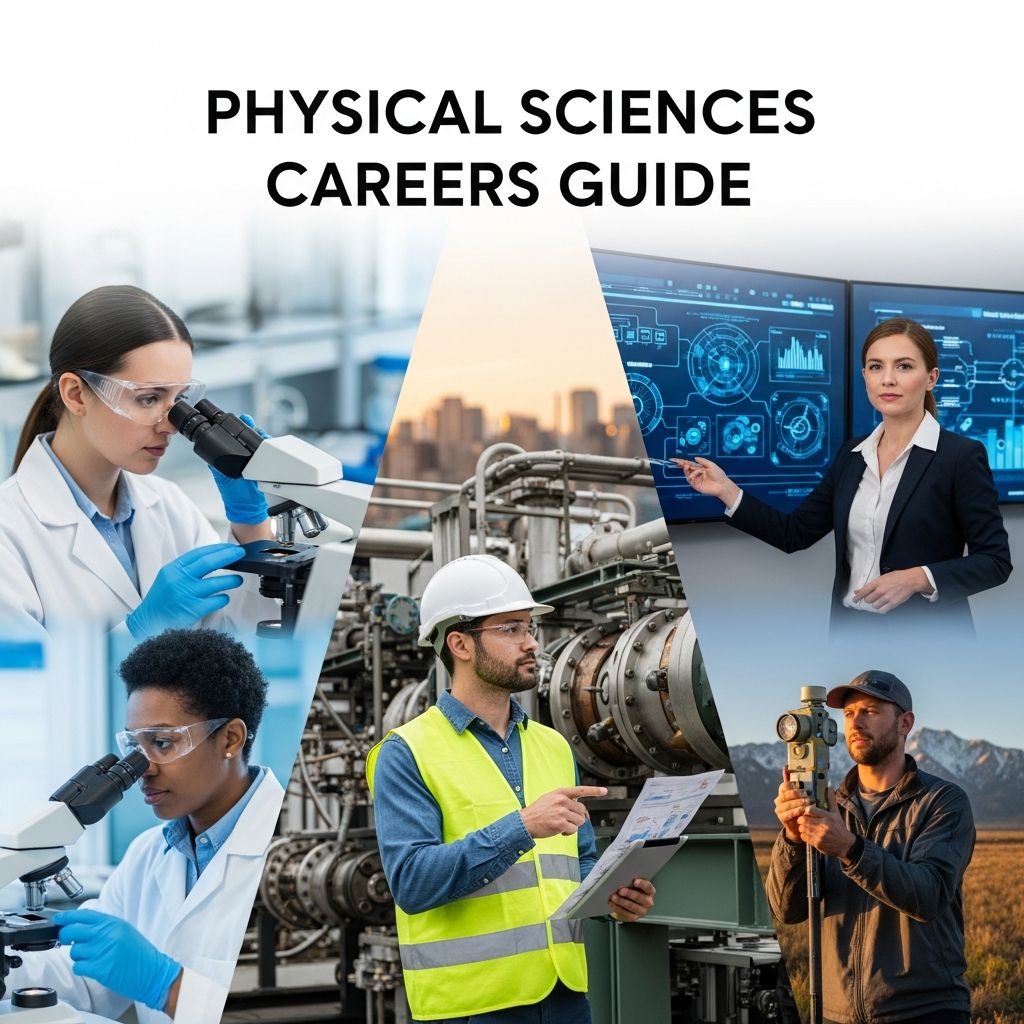
Physical sciences encompass disciplines like physics, chemistry, astronomy, and earth sciences, opening doors to dynamic careers that shape technology, environment, and exploration. Professionals in this field apply rigorous analytical methods to solve real-world problems, from developing sustainable energy to mapping celestial bodies.
Understanding Physical Sciences
At its core, physical sciences study non-living systems and fundamental forces governing the universe. This includes mechanics, thermodynamics, electromagnetism, and chemical reactions. Graduates gain expertise in modeling complex phenomena, conducting precise experiments, and interpreting vast datasets, skills transferable to numerous sectors.
Education typically starts with an Associate of Science (A.S.) for foundational knowledge, progressing to a Bachelor of Science (B.S.) with lab-intensive courses in physics, chemistry, and geology. Advanced degrees like Master of Science (M.S.) or Ph.D. enable specialized research roles.
Essential Skills for Success
Success demands a blend of technical and soft skills. Key competencies include:
- Analytical Thinking: Breaking down problems using math and logic to predict outcomes.
- Laboratory Proficiency: Handling equipment, ensuring safety, and analyzing samples accurately.
- Data Interpretation: Using software to process experimental results and draw evidence-based conclusions.
- Problem-Solving: Designing experiments or models to test hypotheses in dynamic environments.
- Communication: Presenting findings to diverse audiences, from peers to policymakers.
Mathematical proficiency underpins all areas, enabling simulations of physical processes.
Top Career Paths in Research and Academia
Research roles leverage deep scientific inquiry. Physicists explore quantum mechanics and particle interactions, often in labs or accelerators. Astronomers analyze data from telescopes to study stars, galaxies, and cosmic events, typically requiring a Ph.D..
Chemists investigate molecular structures for pharmaceuticals or materials. In academia, roles like professors involve teaching and grant-funded research, fostering the next generation of scientists.
Engineering and Technology Opportunities
Physical sciences fuel engineering innovations. Aerospace engineers design aircraft and spacecraft using aerodynamics and materials science. Chemical engineers optimize industrial processes for fuels and plastics.
| Career | Median Salary (USD) | Key Responsibilities | Education Required |
|---|---|---|---|
| Aerospace Engineer | $122,270 | Design propulsion systems | B.S. in Engineering |
| Chemical Engineer | $108,540 | Develop manufacturing processes | B.S. in Chemical Engineering |
| Materials Scientist | $104,100 | Create advanced alloys | B.S./M.S. in Materials Science |
Data from U.S. Bureau of Labor Statistics highlights strong growth in these fields.
Environmental and Earth Sciences Roles
Addressing climate challenges, geologists map subsurface resources and assess hazards like earthquakes. Hydrologists model water cycles for conservation, vital amid global shortages.
Meteorologists forecast weather using atmospheric models, aiding disaster preparedness. Oceanographers probe marine dynamics, influencing fisheries and pollution control. Environmental consultants guide compliance with regulations, blending science and policy.
Emerging Fields: Energy and Beyond
Clean energy demands physical sciences expertise. Roles in renewable technologies improve solar panels and batteries via materials chemistry.
In photonics and lasers, experts develop optics for telecom and medicine. Robotics and AI integrate physics for sensor design and motion control. Finance values physicists’ modeling for risk analysis, while law firms seek them for patent expertise.
Industry-Specific Applications
Beyond labs, physical scientists enter diverse sectors:
- Healthcare: Medical physicists calibrate radiation therapy equipment.
- Energy: Engineers advance nuclear fusion and wind turbines.
- Government: Agencies like NOAA employ meteorologists and hydrologists.
- Private Sector: Tech firms hire for data science in semiconductors.
Salaries vary: Research technicians earn around $40,000 annually, while water resource engineers average $50,000+, scaling with experience.
Educational Pathways and Preparation
Start with a B.S. in physics, chemistry, or earth sciences, incorporating internships. Graduate programs specialize further; Ph.D.s dominate research.
Build experience via undergrad research, co-ops, or programs like UChicago’s Clean Energy Track. Certifications in GIS or environmental management boost employability.
Job Market Outlook and Growth
Physical science occupations project steady growth, driven by sustainability and tech needs. Hydrologists see 7% increase due to water demands. Overall, BLS forecasts positive trends for scientists and engineers.
Challenges and Rewards
Challenges include competitive academia and funding uncertainties, but rewards abound: intellectual stimulation, societal impact, and high earning potential. Flexibility allows shifts from research to industry.
FAQs
What degree is best for physical sciences careers?
A B.S. in physics, chemistry, or related field; advanced degrees for research.
Are physical science jobs in demand?
Yes, especially in energy, environment, and tech, with strong projections.
Can I enter finance with a physics degree?
Absolutely, modeling skills are highly valued.
What skills should I develop?
Math, programming, lab techniques, and communication.
Is a Ph.D. necessary?
For top research, yes; industry often suffices with B.S./M.S..
Physical sciences offer boundless potential for curious minds to innovate and contribute globally.
References
- Physical Sciences – UChicago Career Advancement — University of Chicago. 2023. https://careeradvancement.uchicago.edu/careers-in/physical-sciences/
- Physical science degree overview – CareerExplorer — CareerExplorer. 2023. https://www.careerexplorer.com/degrees/physical-science-degree/
- Physical Science: Career Guides — Indiana University. 2023. https://careerexploration.indiana.edu/career-guides/physical-science.html
- Where physics could take you: Career paths — Institute of Physics. 2023. https://www.iop.org/careers-physics/your-future-with-physics/career-paths
- 15 Careers in the Physical Science Industry — Indeed. 2025-06-09. https://www.indeed.com/career-advice/finding-a-job/physical-science-careers
- Physical Sciences Major – BigFuture — College Board. 2023. https://bigfuture.collegeboard.org/majors/physical-sciences
- Life, Physical, and Social Science Occupations — U.S. Bureau of Labor Statistics. 2023. https://www.bls.gov/ooh/life-physical-and-social-science/

- Integrated M.A. in Applied Linguistics, University of Hyderabad
- 5+ years in editorial, instructional, SEO, and research-based writing
Sneha is a relationships and lifestyle writer with a strong foundation in applied linguistics and certified training in relationship coaching. She brings over five years of writing experience to theskillvault, crafting thoughtful, research-driven content that empowers readers to build healthier relationships, boost emotional well-being, and embrace holistic living. Her writing and insights reflect the belief that beauty, happiness, and wellness…