
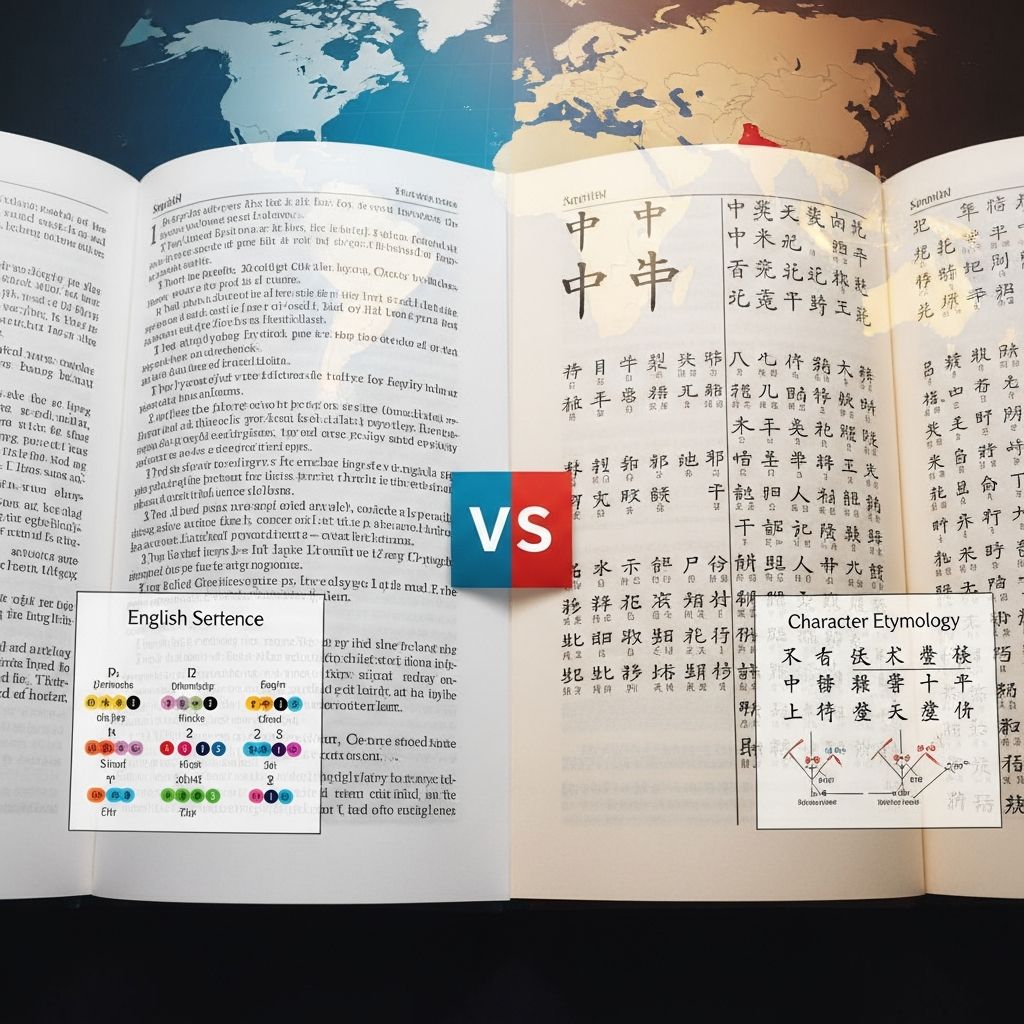
English and Mandarin Chinese represent two of the world’s most spoken languages, yet they emerge from entirely different linguistic traditions and structural frameworks. For learners attempting to bridge the communication gap between these languages, understanding their fundamental differences is essential for developing effective study strategies and avoiding common pitfalls. The challenges arise not merely from vocabulary memorization but from the contrasting ways each language constructs meaning, organizes information, and conveys nuance through sound and symbol.
The Foundation: Alphabetic Versus Character-Based Writing Systems
The most immediately apparent distinction between English and Chinese lies in their written representation systems. This foundational difference creates cascading challenges for learners and shapes how speakers of each language approach reading and writing in the other.
English operates through an alphabetic system comprising 26 individual letters that combine phonetically to form words. Each letter carries no inherent meaning; rather, letters function as building blocks that, when assembled, produce pronounceable units. A speaker encountering an unfamiliar English word can often decode its pronunciation by applying consistent phonetic rules, even without knowing the word’s definition.
Chinese, conversely, employs a character-based system where thousands of distinct symbols represent meaning units directly. Rather than sounding out words from component letters, Chinese readers must memorize the visual appearance and meaning of individual characters. Each character constitutes a complete morpheme carrying semantic weight, and combinations of characters generate new meanings or nuances. This distinction fundamentally alters how native speakers process written language, affecting everything from reading speed to literacy acquisition timelines.
For Chinese students learning English, this represents a wholesale cognitive shift. Their brains have been trained to recognize visual patterns and extract meaning directly from symbols; English demands they develop phonetic decoding skills and appreciate how meaningless letters combine to produce pronunciation and meaning.
Grammatical Architecture and Temporal Expression
Beyond their surface appearance, English and Chinese organize grammatical information through fundamentally different mechanisms, particularly regarding how they mark time and voice.
Verb Tense Systems
English employs an elaborate system of verb conjugations to mark temporal relationships. Present, past, and future tenses each receive distinct verb forms—”walk,” “walked,” “will walk”—with additional complexity through perfect tenses (“has walked,” “had walked,” “will have walked”). These modifications are obligatory; English speakers cannot avoid marking whether an action occurred, is occurring, or will occur through verb form changes.
Chinese handles temporal marking through an entirely different approach. Rather than conjugating verbs, Chinese employs temporal particles and contextual indicators. Words like “tomorrow,” “yesterday,” or “already” provide temporal context, while verb forms remain unchanged. This means a Chinese speaker might express past, present, and future through the identical verb form, relying on surrounding context and temporal markers for clarity.
This difference creates predictable struggles for Chinese learners of English. They frequently produce errors such as “I work yesterday” rather than “I worked yesterday,” reflecting their native language’s different approach to time marking. The English tense system requires conscious attention and memorization since it operates differently from their linguistic instincts.
Active and Passive Voice
English speakers regularly employ both active and passive voice in everyday communication. Passive constructions (“The letter was written by the author”) are grammatically correct and frequently used in both formal and casual contexts. Learners must recognize and produce both forms comfortably.
Chinese grammar privileges active voice construction overwhelmingly. Passive expressions exist but appear far less frequently in natural speech and writing. Chinese students encountering English passive voice often find the concept perplexing, leading to difficulties both in reading comprehension and in producing their own passive constructions. They may struggle to understand why English speakers would restructure a thought to deemphasize the agent, as this approach contradicts their native language’s preferences.
The Sound System: Phonological Distinctions
Pronunciation presents perhaps the most immediately noticeable challenge for speakers of one language learning the other. The sound inventories and prosodic patterns differ substantially.
Vowel Distinctions and Length
English distinguishes between long and short vowels, a feature that carries meaningful differentiation. “Beat” and “bit” are completely different words; “fool” and “full” are distinct concepts. The vowel length carries semantic weight; speakers cannot casually interchange these sounds without altering meaning.
Mandarin Chinese does not maintain vowel length distinctions. All vowels exist at essentially one duration, simplifying the vowel system but creating difficulties when Mandarin speakers encounter English vowel pairs. Many speakers cannot initially perceive the difference between short and long vowels, much less produce them distinctly. This limitation affects comprehension and intelligibility, as speakers may pronounce words unclearly or mishear others.
Consonant Cluster Challenges
English frequently positions consonant clusters at syllable and word endings—”fast,” “and,” “strength,” “sixth.” These consonant combinations create distinct syllable structures that English speakers navigate automatically.
Mandarin Chinese syllables rarely end with consonant clusters. Most Chinese syllables conclude with either a vowel or a nasal sound (n or ng). When confronted with English consonant clusters, Chinese speakers typically respond in predictable ways: they either add an extra vowel sound to separate the consonants (making “fast” sound like “fast-uh”), or they omit final consonants entirely (reducing “fast” to “fas”). Neither approach produces authentic English pronunciation, but both represent logical adaptations of their native phonological patterns.
Tonal Systems Versus Stress Patterns
Mandarin Chinese employs a four-tone system, where the pitch contour applied to each syllable determines its meaning. A single sound pronounced with different tones becomes entirely different words, making tone essential for comprehension. Mandarin speakers have developed refined sensitivity to pitch changes at the syllable level.
English, by contrast, uses stress and intonation rather than lexical tones. Emphasis (stress) distinguishes meanings at the word level—”REcord” versus “reCORD”—and intonation patterns mark sentence-level features like questions, emotions, and emphasis. English stress operates at the whole-word and sentence levels rather than individual syllables.
This represents a fundamental perceptual reorientation. Mandarin speakers initially listen for pitch changes that English doesn’t employ for meaning, while missing the stress patterns that English emphasizes. They often place stress on final function words (like pronouns) rather than content words, producing speech that sounds unusual to native English ears.
Sentence Construction and Information Ordering
Both English and Chinese follow a subject-verb-object word order pattern, yet they diverge significantly in sentence length preferences and information sequencing.
Sentence Length and Complexity
English readily accommodates long, complex sentences with multiple embedded clauses, relative pronouns, and layered modifiers. An English writer might construct a single sentence spanning multiple lines, incorporating parenthetical information and subordinate clauses while maintaining clarity through grammatical markers like “which” and “that.”
Chinese strongly prefers short, discrete sentences. Lengthy sentences in Chinese become burdensome and difficult to parse. Instead, Chinese writers string together multiple short statements, often separated by commas rather than periods, creating a cumulative effect rather than an integrated complex structure. This stylistic preference reflects the language’s emphasis on clarity through brevity rather than grammatical specification.
Information Sequencing and Emphasis
English and Chinese place emphasis at opposite ends of sentences. English typically presents conclusions, main ideas, or most important information first, followed by supporting details and evidence. This “front-loaded” structure helps readers immediately grasp the central point, with subsequent information providing context and elaboration.
Chinese reverses this pattern, presenting supporting information and context first, with conclusions or main ideas emerging at the end. This structure builds understanding gradually, with each element contributing to the final point. The sequence feels more inductive, allowing listeners or readers to draw conclusions themselves rather than having conclusions imposed at the outset.
Word Choice Patterns and Linguistic Philosophy
The languages reflect different philosophical approaches to clarity and expression, evident in their characteristic word choices and usage patterns.
Pronoun and Preposition Frequency
In Chinese, personal pronouns appear frequently, while prepositions and conjunctions occur less often. This reflects Chinese’s reliance on context and direct reference to participants in discourse.
English reverses this pattern, employing prepositions and conjunctions extensively. These words establish spatial, temporal, and logical relationships explicitly, reducing reliance on contextual understanding. English demands specification of these relationships through dedicated grammatical words.
Concrete Versus Abstract Expression
Chinese gravitates toward concrete, specific language, preferring example-based illustration and idiomatic expressions to convey meaning. Abstract generalization plays a smaller role in typical Chinese discourse.
English more readily engages abstract terminology and generalized concepts, particularly in formal contexts. English academic and professional writing extensively employs abstract nouns and theoretical language, whereas Chinese prefers concrete instantiation and narrative illustration.
Common Pitfalls for Learners
Understanding these systematic differences illuminates why certain errors appear predictably in learner speech and writing:
- Tense omission: Chinese learners frequently forget to conjugate English verbs, producing “I go yesterday” rather than “I went yesterday”
- Vowel confusion: Mandarin speakers struggle distinguishing and producing English long/short vowel pairs, affecting intelligibility
- Passive voice avoidance: Chinese learners underutilize passive constructions, viewing them as unnecessarily complex
- Sentence length: Chinese learners often produce overly brief sentences, not recognizing English acceptance of longer constructions
- Word order in information: Learners place conclusions at the end of sentences, contrary to English expectations
- Consonant cluster reduction: Mandarin speakers add vowels or drop final consonants in English words
Strategic Approaches for Effective Language Learning
Recognizing these differences enables learners to adopt targeted strategies addressing specific challenges rather than attempting to learn languages as equivalent systems.
For English learners: Explicit tense practice proves essential; teachers should present English tense systems not as refinements but as fundamentally different from Chinese time marking. Passive voice should receive dedicated instruction and practice, positioned as standard English feature rather than optional complexity. Pronunciation work must address vowel pairs, consonant clusters, and stress patterns with explicit contrast training.
For Chinese learners: Understanding that English requires explicit temporal marking helps justify tense system emphasis. Recognition that passive voice serves communicative functions in English legitimizes its study. Phonetic training emphasizing the alphabetic system’s predictability can accelerate reading skill development.
Conclusion: Bridging Linguistic Gaps
English and Chinese represent profoundly different ways of organizing and expressing human thought. Rather than viewing one language’s approach as superior, learners benefit from recognizing how each system reflects different priorities and values. English emphasizes explicit grammatical marking, structural clarity, and abstract generalization. Chinese prioritizes contextual understanding, brevity, and concrete expression. Neither approach proves superior; they simply solve communicative problems differently. By understanding these deep structural differences, learners can appreciate why certain aspects challenge them, anticipate their likely errors, and develop targeted strategies for improvement. This linguistic awareness transforms language learning from rote memorization into genuine comprehension of how languages work.
References
- 3 Differences Between Chinese and English Language — International Child Book. 2024. https://www.internationalchildbook.com/blogs/news/3-differences-between-chinese-and-english-language
- Three Differences Between Mandarin Chinese and English — Excelen English Institute. 2024. https://excelenglishinstitute.com/english-vs-mandarin-chinese-three-main-differences-between-the-languages
- 6 Major Differences between English and Chinese — DigMandarin. 2024. https://www.digmandarin.com/6-major-differences-between-english-and-chinese.html
- Comparative Analysis on English and Chinese in Multi-Dimensions — Scientific Research Publishing. 2023. https://www.scirp.org/journal/paperinformation?paperid=137905

- Integrated M.A. in Applied Linguistics, University of Hyderabad
- 5+ years in editorial, instructional, SEO, and research-based writing
Sneha is a relationships and lifestyle writer with a strong foundation in applied linguistics and certified training in relationship coaching. She brings over five years of writing experience to theskillvault, crafting thoughtful, research-driven content that empowers readers to build healthier relationships, boost emotional well-being, and embrace holistic living. Her writing and insights reflect the belief that beauty, happiness, and wellness…