
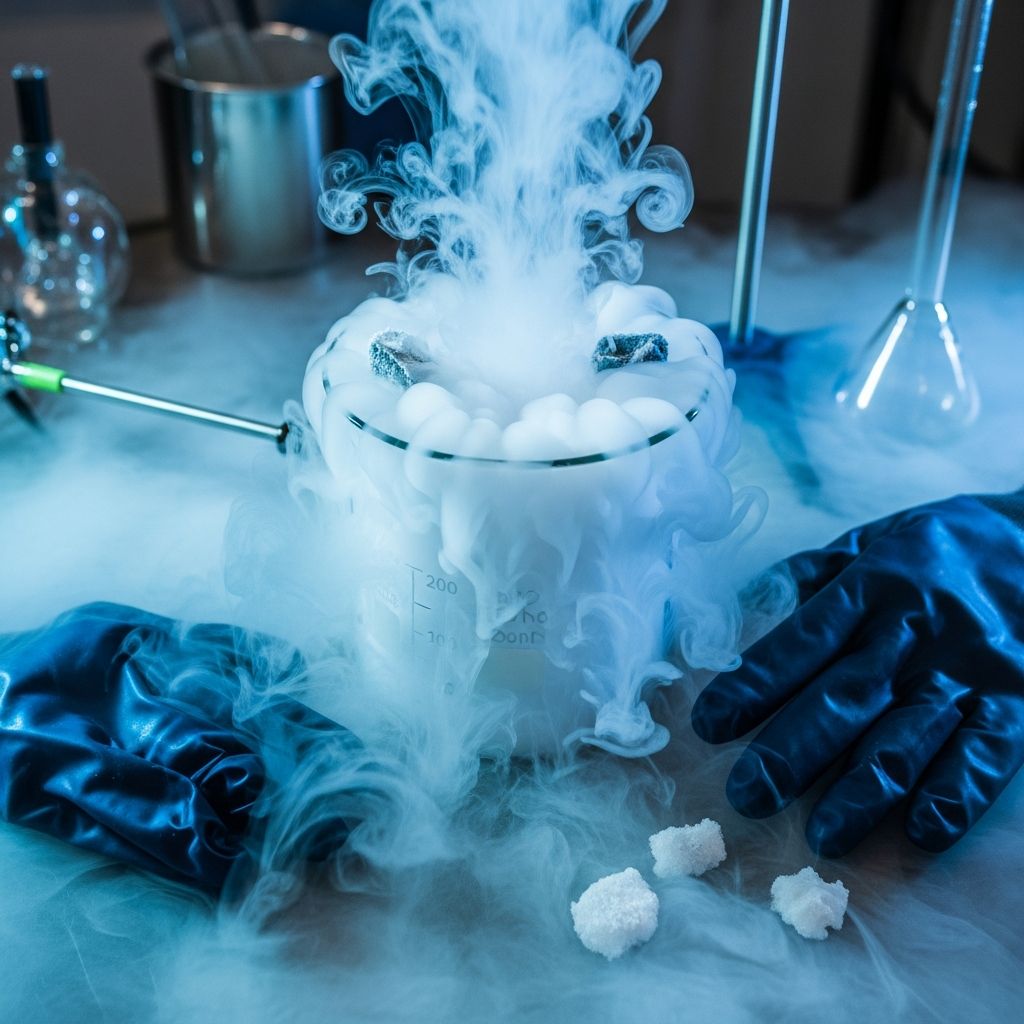
Liquid nitrogen, a colorless liquid at -196°C (-321°F), offers a gateway to exploring cryogenics through captivating demonstrations. These experiments highlight rapid freezing, material expansion, and molecular behavior, making complex physics accessible and exciting.
Understanding Liquid Nitrogen Basics
Nitrogen gas constitutes about 78% of Earth’s atmosphere. When cooled to its boiling point of -196°C, it liquefies, enabling safe handling in insulated containers like Dewar flasks. This extreme cold causes water vapor in the air to condense, producing the foggy clouds often seen during demos.
Key properties include its non-flammable nature and ability to rapidly extract heat from objects, leading to brittle freezing. Always use protective gear: insulated gloves, face shields, and perform in well-ventilated areas to avoid asphyxiation risks from nitrogen gas displacement.
Preparation and Safety Protocols
Before any experiment, secure liquid nitrogen from reputable suppliers like scientific supply companies. Store in approved cryogenic containers to prevent pressure buildup. Conduct demos under supervision, especially with students, and never allow direct skin contact or ingestion attempts.
- Essential Gear: Cryogenic gloves, safety goggles, aprons, tongs, ladles.
- Venue Setup: Open space, blast shields, fire extinguishers nearby.
- Emergency Plan: First aid for frostbite, oxygen supply.
These measures ensure experiments educate without incident, as emphasized in university demo protocols.
Balloon Shrinkage: Gas Behavior at Low Temperatures
Inflate a latex balloon with air and predict its fate in liquid nitrogen. Upon immersion or pouring liquid nitrogen over it, the balloon shrinks dramatically, fitting into narrow spaces like a thermos neck.
This occurs because cooling slows air molecules inside, reducing their kinetic energy and volume per the ideal gas law: PV = nRT, where temperature (T) drops sharply.
- Show the inflated balloon bouncing energetically.
- Pour 1-2 ladles of liquid nitrogen atop it.
- Observe deflation as molecules “dance” slower.
- Remove and watch reinflation at room temperature.
This demo vividly illustrates temperature’s impact on gas states, ideal for introducing thermodynamics.
Fruit Hammer Time: Freezing Bananas and Lemons
A ripe banana resists nail penetration at room temp but becomes hammer-tough after 1-2 minutes in liquid nitrogen. Smash it on a hard surface for a satisfying crack, revealing shattered cell structure from ice expansion.
Similarly, dunk a lemon: it freezes solid, shatters like glass, and releases citrus mist—perfect for sensory engagement. Water in fruits expands 9% upon freezing, rupturing cells.
| Item | Freeze Time | Effect | Educational Value |
|---|---|---|---|
| Banana | 1-2 min | Hammerable | Cell rupture |
| Lemon | 30 sec | Shatters, mists | Phase change |
| Strawberry | 10 sec | Brittle snap | Food cryogenics |
These transform snacks into props, teaching biology alongside physics.
Flower Shatter: Delicate Destruction
Select fresh roses or carnations. Dip the bloom briefly (8-10 seconds), then tap against a shield—it explodes into petals. Thawing reveals wilting from damaged cells, mimicking frost injury in plants.
High water content in petals (over 90%) crystallizes into sharp ice, fracturing delicate tissues. Compare to untreated flowers for contrast.
- Pro Tip: Use tongs for precision dipping.
- Extension: Discuss plant cryopreservation techniques.
Rubber Reversal: Bouncy Ball to Rock
A lively racquetball bounces high normally. Submerge in liquid nitrogen for 2 minutes using tongs—it becomes brittle. Strike it: it shatters like ice.
Polymers in rubber stiffen at cryogenic temps, losing elasticity as molecular chains immobilize. Re-warming restores bounce, demonstrating reversible phase changes.
Alternatives: Freeze marshmallows (they shatter) or balloons (they shrink).
Hand of Steel: Leidenfrost Protection
Demonstrate safety myth-busting: Hover hand over open Dewar, dip briefly (1-2 seconds), repeat. Skin remains unharmed due to Leidenfrost effect—liquid nitrogen vaporizes on contact, creating insulating gas layer.
Pour a ladle onto palm: droplets roll off like mercury. Limits exposure time; never hold submerged.
Food Freezes: Strawberries, Onions, and More
Experiment with edibles: Strawberries snap after 10 seconds; onions dice effortlessly post-freeze; eggs crack open to reveal solid yolk whites.
A frozen Big Mac crumbles, exposing bun fragility. Mushrooms and sushi yield similar brittle results, but warn against consumption—toxic at these temps.
These tie cryogenics to culinary science, like flash-freezing in food industry.
Advanced Demos: Boiling Water Meets Ice
Pour boiling water into liquid nitrogen: instant fog explosion as water flash-freezes into mist. Reverse: Liquid nitrogen in hot water evaporates violently, demonstrating phase transitions.
Rubber tubing stiffens and snaps; soapy solutions boil into massive bubbles.
Educational Applications and Variations
These experiments suit K-12 to college levels, aligning with NGSS standards on matter states. Adapt for virtual demos via video.
- Classroom: Group predictions.
- Outreach: Public fog effects.
- Extensions: Measure temp changes with probes.
Frequently Asked Questions (FAQs)
Is liquid nitrogen safe for school demos?
Yes, with proper training, gear, and ventilation. Universities like MSU use it routinely.
How do I obtain liquid nitrogen?
From lab suppliers; requires signature and training acknowledgment.
Why does the balloon reinflate?
Warming restores molecular motion, expanding gas per gas laws.
Can I eat frozen foods post-demo?
No—extreme cold damages cells, making them unsafe.
What’s the coldest safe demo?
All listed are safe if protocols followed; avoid ingestion stunts.
Conclusion: Igniting Scientific Curiosity
Liquid nitrogen experiments blend spectacle with substance, demystifying cryogenics. They foster wonder, teaching irreversible changes, gas laws, and safety—sparking lifelong science passion.
References
- Super “Cool” Experiments with Liquid Nitrogen – Sci Sparks — McWane Science Center. 2023-05-15. https://www.youtube.com/watch?v=1puOubu7fv4
- Top 10 experiments with liquid nitrogen — MEL Chemistry. 2023-01-01. https://melscience.com/US-en/articles/top-10-experiments-liquid-nitrogen/
- Fun With Liquid Nitrogen – Cool Science Experiment — Steve Spangler Science. 2022-06-20. https://www.youtube.com/watch?v=MaxZwsqstFs
- Liquid Nitrogen Demonstrations — Michigan State University Physics and Astronomy. 2025-03-10. https://pa.msu.edu/science-theatre/demos/liquid-nitrogen.aspx
- Liquid Nitrogen Experiment — Pacific Science Center. 2024-11-05. https://pacificsciencecenter.org/resources/liquid-nitrogen-experiment/
- 3 liquid nitrogen experiments: Rubber tubes, soapy boiling water — The Kid Should See This. 2023-08-12. https://thekidshouldseethis.com/post/liquid-nitrogen-experiments-museum-of-science-boston

- Integrated M.A. in Applied Linguistics, University of Hyderabad
- 5+ years in editorial, instructional, SEO, and research-based writing
Sneha is a relationships and lifestyle writer with a strong foundation in applied linguistics and certified training in relationship coaching. She brings over five years of writing experience to theskillvault, crafting thoughtful, research-driven content that empowers readers to build healthier relationships, boost emotional well-being, and embrace holistic living. Her writing and insights reflect the belief that beauty, happiness, and wellness…