
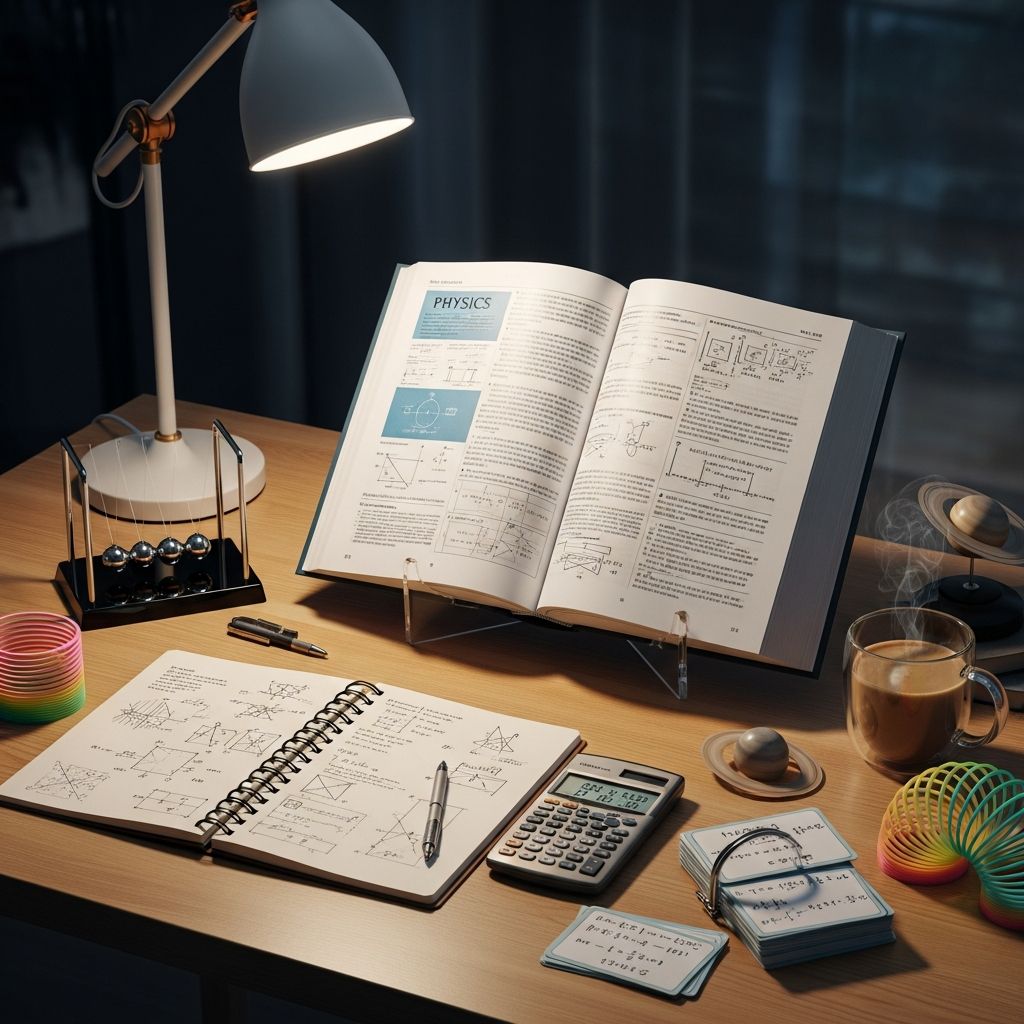
Physics demands a blend of mathematical precision, conceptual insight, and persistent practice. Success comes from structured approaches that reinforce understanding over rote memorization. This guide equips students with tools to conquer challenging topics like mechanics, electromagnetism, and quantum principles.
Building a Strong Foundation in Physics Fundamentals
Start with core math skills, as physics relies heavily on algebra, calculus, and vectors. Without these, advanced concepts become inaccessible. Dedicate time to review prerequisites: solve equations, differentiate functions, and manipulate vectors daily.
Key topics form the backbone:
- Motion and Kinematics: Understand displacement, velocity, and acceleration using equations like \( v = u + at \).
- Forces and Dynamics: Apply Newton’s laws to predict object behavior.
- Energy and Work: Grasp conservation principles in real-world scenarios.
Review textbooks chapter-by-chapter, focusing on derivations rather than just formulas. For instance, derive kinematic equations from basic definitions to internalize them.
Creating a Consistent Daily Study Routine
Physics builds cumulatively; gaps in early material hinder progress. Establish a routine: 1-2 hours daily, reviewing prior lessons before new ones. Use spaced repetition—revisit topics weekly to embed them in long-term memory.
| Time Slot | Activity | Duration |
|---|---|---|
| Morning (30 min) | Quick review of yesterday’s notes | Flashcards for formulas |
| Afternoon (1 hr) | New lecture material | Take active notes, draw diagrams |
| Evening (45 min) | Practice problems | 10-15 varied questions |
Track progress in a journal: note solved problems and lingering doubts. Adjust based on weak areas, like dedicating extra time to rotational dynamics if needed.
Active Problem-Solving: The Heart of Physics Learning
Passive reading fails in physics; active solving builds intuition. Approach problems systematically:
- Read carefully, identify givens and unknowns.
- Sketch diagrams for visual clarity.
- Plan: select equations, list steps.
- Execute calculations, check units.
- Reflect: does the answer make sense?
Aim for 50-60 problems per topic, mixing easy and challenging ones. Use question banks for depth—solve until errors drop below 10%. When stuck, step back rather than peek at solutions immediately.
For circuits or waves, build models: simulate with breadboards or apps to see principles in action.
Deepening Conceptual Understanding
Memorizing formulas leads to fragile knowledge. Instead, explain concepts aloud or teach peers—this reveals gaps. Visualize: for electromagnetism, imagine field lines around charges; for relativity, ponder time dilation scenarios.
Common pitfalls:
- Confusing similar laws: Distinguish Faraday’s from Lenz’s law.
- Unit mismatches: Always convert to SI units.
- Overlooking assumptions: Note when friction is negligible.
Watch demos: replicate class experiments at home, like pendulum oscillations, to link theory and observation.
Choosing the Right Resources and Curriculum Path
Select materials matching your level—high school, AP/IB, or college. Free guides cover vectors, energy, momentum, and fluids efficiently. Pair with textbooks like University Physics for derivations.
Progression roadmap:
| Level | Core Topics | Recommended Time |
|---|---|---|
| Beginner | Vectors, Motion, Forces | 4-6 weeks |
| Intermediate | Energy, Momentum, Rotations | 5-6 weeks |
| Advanced | Electromagnetism, Quantum Basics | 6-8 weeks |
Supplement with videos for visuals, but always follow with problems.
Group Study and Seeking Help Effectively
Collaborate in small groups: discuss problems, quiz each other. Teaching clarifies your grasp. Office hours or tutors help with persistent issues—prepare specific questions.
Online forums offer insights, but verify against textbooks. Form accountability pairs for daily check-ins.
Mastering Exams and Assessments
Simulate exam conditions: timed practice with past papers. Review mistakes thoroughly—what assumption failed? Prioritize high-yield topics from class emphasis.
Night before: light review, sleep well. During: scan all questions first, tackle confident ones.
Advanced Topics: From Electrodynamics to Quantum Mechanics
Once basics solidify, tackle modern areas. Electrodynamics covers Maxwell’s equations and waves—master vector calculus first. Quantum introduces wave functions; practice perturbation theory problems.
Self-study tip: 5-6 hours per subtopic, combining reading and 60+ problems.
Overcoming Common Challenges in Physics
Frustration hits when stuck—take breaks, return fresh. Combat cramming with spaced practice: weekly retrieval quizzes. Track improvement to build confidence.
For math-physics disconnect, interleave: solve pure math then apply immediately.
Frequently Asked Questions (FAQs)
How many hours daily to study physics effectively?
1-2 hours of focused practice daily outperforms marathon sessions. Consistency trumps intensity.
Should I memorize physics formulas?
No—understand derivations. Use formula sheets during practice to build recall naturally.
What’s the best way to prepare for physics exams?
Timed mock tests and error analysis. Review concepts daily leading up.
Can I self-study physics without a teacher?
Yes, with structured guides, problem banks, and persistence. Expect 1-2 months for core topics.
How do I improve problem-solving speed?
Practice varied problems, categorize by type, and reflect on strategies post-solution.
Long-Term Habits for Physics Excellence
Integrate physics into life: analyze sports trajectories or circuit designs. Stay curious—explore astrophysics or particle physics extensions. Consistent application turns effort into mastery.
References
- The Ultimate Physics Study Guide — Study.com. Accessed 2026. https://study.com/resources/ultimate-physics-study-guide.html
- Learn Physics! How to Self Study Physics – A Complete Guide For Beginners — Nerd-Notes. Accessed 2026. https://nerd-notes.com/learn-physics-self-study-physics-a-complete-guide-for-beginners/
- How to Succeed in Physics FAST FACTS — Carnegie Mellon University. Accessed 2026. https://www.cmu.edu/student-success/other-resources/fast-facts/succeed-in-physics.pdf
- Physics Study Tips — University of North Carolina Physics. Accessed 2026. https://users.physics.unc.edu/~deardorf/phys104/studytips.html
- Physics Study Skills and Hints — AcademicTips.org. Accessed 2026. https://www.academictips.org/acad/physic/physics_study_skills.html
- So You Want to Learn Physics — Susan J. Fowler. 2016-08-13. https://www.susanjfowler.com/blog/2016/8/13/so-you-want-to-learn-physics
- The Science of Learning Physics: Practice and Study Skills — Physics Teacher Momma. 2020-12-28. https://physicsteachermomma.com/2020/12/28/the-science-of-learning-physics-practice-and-study-skills/

- Integrated M.A. in Applied Linguistics, University of Hyderabad
- 5+ years in editorial, instructional, SEO, and research-based writing
Sneha is a relationships and lifestyle writer with a strong foundation in applied linguistics and certified training in relationship coaching. She brings over five years of writing experience to theskillvault, crafting thoughtful, research-driven content that empowers readers to build healthier relationships, boost emotional well-being, and embrace holistic living. Her writing and insights reflect the belief that beauty, happiness, and wellness…