
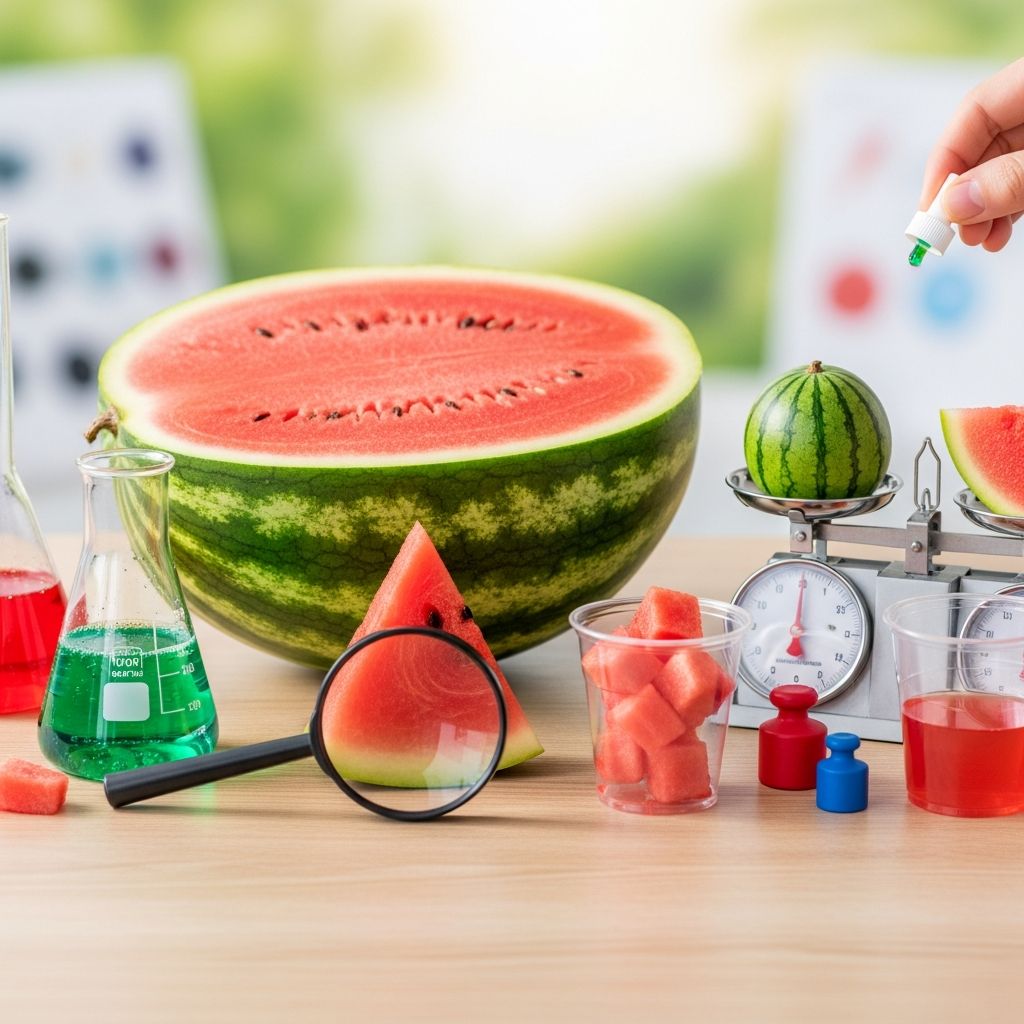
Watermelons offer a refreshing canvas for educational exploration, combining juicy fun with fundamental science principles. These projects engage children in chemistry reactions, physics demonstrations, mathematical concepts, and sensory development, all using this summer staple fruit. Ideal for ages 3-12, they require minimal supplies and deliver maximum excitement.
Explosive Watermelon Volcano Eruption
Transform a hollowed watermelon into a vibrant volcano that erupts with colorful foam. This classic chemical reaction experiment demonstrates acid-base interactions through everyday kitchen items.
Materials Needed
- 1-2 small watermelons (regular green or yellow varieties)
- Baking soda (1/4 cup)
- Vinegar (1 cup)
- Dish soap (1 tsp)
- Food coloring (optional, assorted colors)
- Melon baller or spoon
- Knife (adult supervision required)
- Safety goggles and gloves
Step-by-Step Guide
- Prepare the base: Select firm watermelons. Cut each in half horizontally. Use a melon baller to scoop out the flesh, creating bowl-shaped rinds. Save the fruit for snacks or further activities.
- Add personality: Children can carve simple faces—eyes and a wide mouth—into the rind’s edge using a spoon or safe tool for a dramatic eruption effect.
- Load the crater: Spoon 2 tablespoons of baking soda into the hollow. Add a squirt of dish soap and 3-4 drops of food coloring for fizz and color.
- Trigger the reaction: Slowly pour vinegar over the mixture. Watch as bubbles form and foam overflows from the carved mouth, mimicking lava flow.
- Extend the fun: Repeat with additional baking soda and vinegar for multiple eruptions. Use an eyedropper for precise pours to prolong the show.
The Science Explained
Baking soda (sodium bicarbonate) reacts with vinegar (acetic acid) to produce carbon dioxide gas, water, and sodium acetate. The gas creates bubbles that expand rapidly, especially with soap’s foaming action. This endothermic reaction releases gas without significant heat, making it safe for kids.
- Safety tip: Perform outdoors to manage mess.
Rubber Band Watermelon Implosion Challenge
Test structural limits with this physics spectacle: stretch rubber bands around a whole watermelon until it bursts under pressure. It illustrates force, tension, and energy transfer.
Gathering Supplies
- 1 medium watermelon
- 100-200 rubber bands (assorted sizes)
- Tray or outdoor surface
- Tongs for handling
Conducting the Experiment
- Start wrapping: Place the watermelon on a stable surface. Loop rubber bands equatorially, one at a time, evenly spaced.
- Build tension: Continue adding bands in layers. Listen for cracking sounds as rind compresses—typically after 80-120 bands.
- Observe changes: Note deformation: the fruit bulges at poles and constricts midsection. Pressure builds internally from compressed flesh.
- The big burst: Suddenly, the melon explodes, flinging seeds and juice. Count total bands used for records.
- Cleanup and discussion: Discuss variables like watermelon size or ripeness affecting results.
Physics Principles at Play
Each rubber band applies elastic potential energy. Cumulatively, they create compressive force exceeding the rind’s tensile strength, leading to catastrophic failure. This demonstrates Boyle’s law indirectly as internal pressure rises.
| Variable | Effect on Bands Needed |
|---|---|
| Ripeness | Riper = Fewer bands (weaker rind) |
| Size | Larger = More bands |
| Band Size | Thicker = Fewer needed |
Watermelon Math and Measurement Adventures
Incorporate geometry and fractions using watermelon pieces. Kids practice slicing, comparing, and quantifying for practical math skills.
Key Activities
- Fraction Slicing: Cut melon into halves, quarters, eighths. Have kids identify and label pieces, then reassemble wholes.
- Seed Counting: Extract and tally seeds from sections. Graph colors (black/white) or sizes for data analysis.
- Volume Estimation: Fill scooped rinds with water, measure displacement to approximate original volume.
- Pattern Creation: Use cookie cutters for shapes (stars, hearts); sort by size or color.
Enhancement Tips
Combine with scales for weight comparisons or rulers for diameter. Chart results: “How many seeds per quarter?” Builds estimation and averaging skills.
Sensory Exploration with Watermelon
Engage senses mess-free or hands-on. These promote fine motor skills, texture recognition, and imaginative play.
Squish Bags for Tiny Hands
- Fill zip-top bags with watermelon chunks, red gel, green paint, seeds. Seal securely.
- Squish to mix colors, form shapes, trace letters. Lightbox beneath enhances visuals.
Texture Trays
- Layer rind (tough), flesh (juicy), seeds (hard), juice (wet) in trays.
- Blindfold touch tests: Describe sensations, match items.
Floating and Sinking Tests
Cut pieces varying sizes. Predict and test in water tubs: rind floats, dense seeds sink. Discuss density (mass/volume).
Watermelon Life Cycle and Plant Science
Extend outdoors: Plant seeds to observe germination. Dissect flowers for pollination insights—male/female parts, bee roles. Track growth: vine spread, fruit development over weeks.
Simple Grow Journal
- Day 1: Plant 3-5 seeds in pots.
- Weekly: Measure height, leaf count, photos.
- Harvest mini-melons if possible.
Frequently Asked Questions
What age group suits these watermelon projects?
Most activities fit ages 4-10, with adult supervision for cutting. Simplify for toddlers (sensory only), add complexity for older kids (data logging).
Are these experiments safe?
Yes, with precautions: goggles for eruptions, outdoors for implosions/mess. Non-toxic ingredients; supervise tools.
How to minimize waste?
Eat scooped flesh immediately, use in smoothies, or share. Choose small/personal watermelons.
Can I adapt for classrooms?
Absolutely—group stations rotate activities. Scale materials for numbers; print prediction sheets.
What if vinegar/baking soda unavailable?
Alternatives: citric acid + base for volcanoes; more bands for implosions.
Benefits of Watermelon-Based Learning
These projects foster curiosity, teach scientific method (hypothesis, test, observe), and integrate STEM. Summer theme keeps kids engaged, fighting ‘brain drain.’ Nutrition bonus: Watermelons hydrate (92% water), provide vitamins A/C.
Parental involvement builds bonds; cleanup teaches responsibility. Track progress: Before/after quizzes on reactions or fractions.
References
- The Big Watermelon Experiment Fact Sheet — Science Week Australia. 2020-06-15. https://www.scienceweek.net.au/wp-content/uploads/2020/06/The-big-watermelon-experiment-fact-sheet.docx.pdf
- Watermelon Pop Experiment — Fizzics Education. 2023-01-10. https://www.fizzicseducation.com.au/150-science-experiments/force-movement-experiments/watermelon-pop/
- Exploding Watermelon Volcano — Little Bins for Little Hands. 2024-05-20. https://littlebinsforlittlehands.com/watermelon-volcano-activity-baking-soda-vinegar-science/
- Cool Watermelon Science Experiments for Kids — Go Science Girls. 2023-07-12. https://gosciencegirls.com/taste-science-watermelon/
- Watermelon Theme Experiments — Tina’s Dynamic Homeschool Plus. 2022-11-05. https://tinasdynamichomeschoolplus.com/watermelon-theme/

Medha Deb is an editor with a master's degree in Applied Linguistics from the University of Hyderabad. She believes that her qualification has helped her develop a deep understanding of language and its application in various contexts. Medha specializes in the areas of beauty, health, sports, and wellness and is committed to ensuring that the content on the website is…