
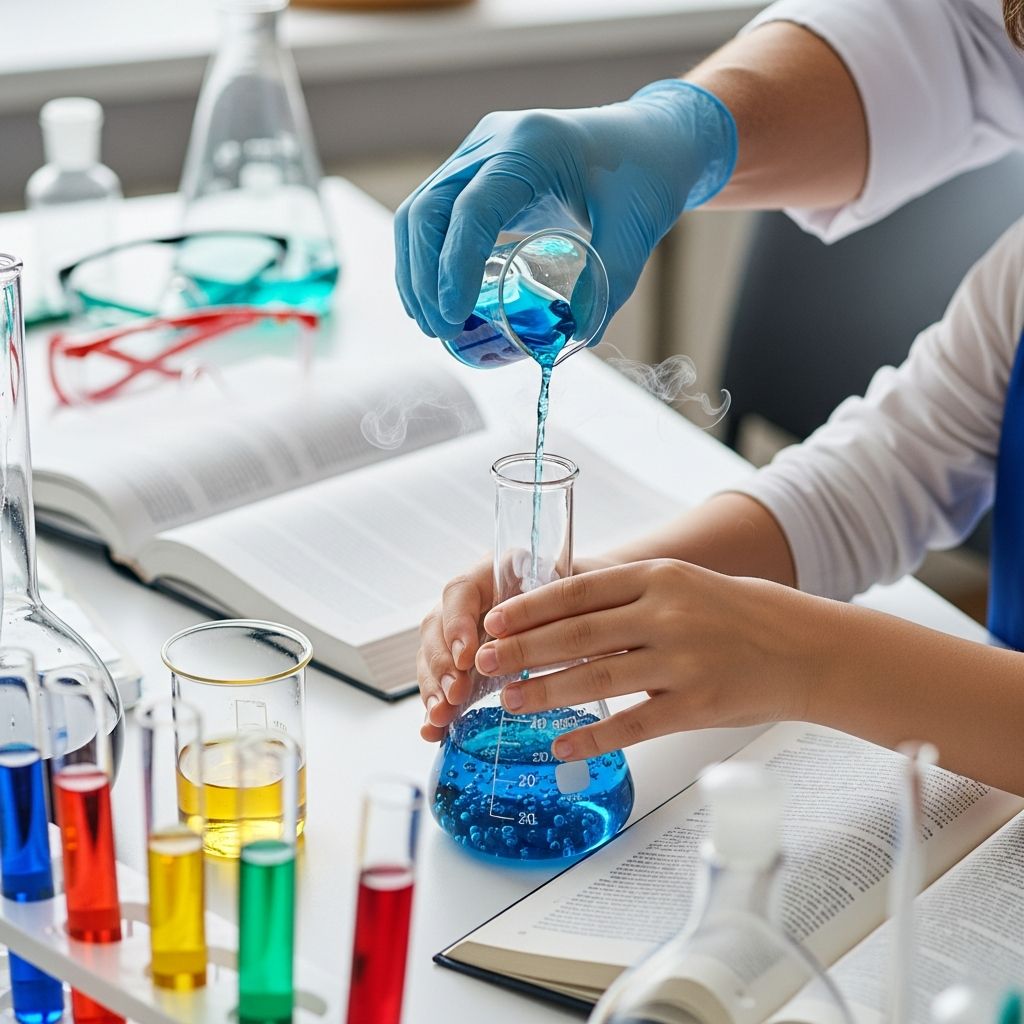
Chemistry comes alive through practical activities that transform abstract concepts into tangible experiences. These experiments, designed for home or classroom settings, use common materials to explore fundamental principles such as chemical reactions, physical changes, and molecular interactions. Whether you’re a teacher planning lessons or a parent fostering curiosity, these activities promote safe scientific inquiry and deeper understanding.
Essential Safety Guidelines for All Experiments
Before starting any chemistry activity, prioritize safety. Wear protective eyewear and gloves where appropriate, work in well-ventilated areas, and supervise children closely. Avoid tasting substances unless explicitly stated as safe, and never mix chemicals without adult oversight. Dispose of materials responsibly by diluting with water and rinsing down the drain if non-toxic.
- Supervision: Essential for participants under 12.
- Materials Check: Verify allergies to ingredients like food items.
- Emergency Prep: Keep baking soda nearby for acid spills and water for rinses.
Exploring Reactions with Baking Soda and Vinegar
This timeless reaction illustrates acid-base chemistry and gas production. Baking soda (sodium bicarbonate) reacts with vinegar (acetic acid) to form carbon dioxide gas, water, and sodium acetate, demonstrating a classic double displacement reaction.
Materials: Baking soda, vinegar, clear glass, food coloring (optional), balloon.
- Add 2 tablespoons of baking soda to the glass.
- Pour in 1/2 cup vinegar quickly; observe fizzing.
- Stretch a balloon over the glass mouth to capture gas; watch it inflate.
The rapid gas release mimics volcanic eruptions, teaching Le Chatelier’s principle as pressure builds. Extend by varying ratios to measure gas volume, linking to stoichiometry basics.
Non-Newtonian Fluids: Creating Oobleck
Oobleck, a mixture of cornstarch and water, behaves as both a liquid and solid, exemplifying shear-thickening properties. This activity reveals how particle interactions change under stress.
Materials: Cornstarch (2 cups), water (1 cup), food coloring.
Mix cornstarch and water gradually until it holds shape when squeezed but flows when loose. Roll into balls, then pour—observe the transformation. This demonstrates colloidal suspensions where starch particles in water resist rapid movement due to hydrodynamic forces.
Educational Value: Introduces states of matter distinctions and viscosity concepts. Challenge learners to test with different forces, like poking versus pouring, and hypothesize why it ‘hardens.’
Surface Tension Challenges: The Penny Drop Test
Surface tension, the cohesive force at liquid-air interfaces, allows drops to bead up. Compare water, soapy water, rubbing alcohol, and oil on a penny to quantify intermolecular forces.
Materials: Penny, eyedropper, water, dish soap, rubbing alcohol, vegetable oil.
| Liquid | Avg. Drops Before Overflow | Reason |
|---|---|---|
| Water | 20-25 | Strong hydrogen bonding |
| Soapy Water | 5-10 | Soap disrupts cohesion |
| Rubbing Alcohol | 10-15 | Weaker forces |
| Oil | 30+ | Higher cohesion |
Drop liquids one by one until overflow. Soap reduces tension by acting as a surfactant, breaking hydrogen bonds. This ties into real-world applications like insect-walking-on-water phenomena.
Density Rainbow in Layers
Demonstrate density gradients by layering liquids of varying densities, visualizing the principle that less dense substances float atop denser ones.
Materials: Honey, dish soap, water (with food coloring), vegetable oil, rubbing alcohol (colored), tall clear glass.
- Pour honey (densest) first, slowly layering each without mixing.
- Observe stable columns forming a colorful gradient.
Densities: Honey (1.42 g/mL), soap (1.03), water (1.0), oil (0.92), alcohol (0.79). Discuss buoyancy and Archimedes’ principle; add small objects to predict sinking/floating positions.
Acid-Base Indicators from Kitchen Staples
Red cabbage juice serves as a natural pH indicator, changing color across the pH scale due to anthocyanin pigments.
Materials: Red cabbage, blender, water, vinegar, baking soda solution, lemon juice, household cleaners (diluted).
Boil chopped cabbage in water, strain purple juice. Test solutions: acid (pink/red), neutral (purple), base (green/blue). Create a pH color chart and test unknowns like shampoo or soda.
This experiment links organic chemistry to everyday pH effects in digestion and cleaning products.
Elephant Toothpaste: Catalytic Decomposition
A dramatic display of catalysis where hydrogen peroxide decomposes rapidly into water and oxygen, foamed by dish soap.
Materials: 30% hydrogen peroxide (supervised), dry yeast, warm water, dish soap, food coloring, large tray.
- Mix yeast in warm water (catalyst).
- Add to peroxide-soap-color mixture; watch foam erupt.
Yeast’s catalase enzyme speeds 2H₂O₂ → 2H₂O + O₂. Scale up for visual impact while discussing reaction rates and catalysts in biology.
Crystal Growth Over Time
Grow borax crystals to explore supersaturation and nucleation, forming intricate structures on pipe cleaners.
Materials: Borax, boiling water, pipe cleaners, jars, string.
Dissolve 3 tbsp borax per cup boiling water; suspend shape and let sit overnight. Crystals precipitate as solution cools. Variables: temperature, concentration. Relate to rock candy and geological formations.
Investigating Dissolution Rates
Test how temperature, stirring, and particle size affect sugar or Alka-Seltzer dissolving in water, isolating one variable at a time.
| Variable | Effect on Rate | Explanation |
|---|---|---|
| Surface Area (cube vs. powder) | Powder faster | More exposure |
| Temperature | Hotter faster | Increased kinetic energy |
| Stirring | Faster | Enhances diffusion |
Time trials build data analysis skills, graphing results for trends.
Hidden Messages with Invisible Ink
Use lemon juice or baking soda as inks that reveal under heat, introducing oxidation and pH changes.
Materials: Lemon juice, cotton swab, paper, heat source (lamp).
Write message, dry, heat gently—browning appears. Acids caramelize under heat. Alternate: grape juice with baking soda.
Advanced Home Analysis: Water Hardness Test
Simulate hardness testing with soap and water samples (tap vs. distilled), observing suds formation.
Hard water’s minerals reduce lathering; quantify by drop counts. Ties to environmental chemistry.
Edible Experiments: Ice Cream in a Bag
Harness colligative properties—salt lowers ice’s freezing point for ultra-cold freezing.
Materials: Milk, sugar, vanilla, ice, salt, ziplock bags.
Mix cream in small bag, submerge in salted ice bag, shake. Freezes via depression: ΔT = Kf * m * i.
Frequently Asked Questions
What age groups are these experiments suitable for?
Most suit ages 8+, with supervision; simplify for younger by focusing on observation.
Can these be done without lab equipment?
Yes, all use household items; substitutes like plastic cups work fine.
How do I scale for classrooms?
Group rotations, pre-measure materials for efficiency.
Are there risks with hydrogen peroxide?
Use 3-6% household grade; higher needs gloves/ventilation.
What if an experiment fails?
Troubleshoot variables like purity or temperature; science involves iteration.
These activities not only entertain but cultivate critical thinking, hypothesis testing, and appreciation for chemistry’s role in daily life. Encourage journaling predictions, observations, and conclusions for full learning cycle.
References
- Classic Chemistry Demonstrations — Royal Society of Chemistry (RSC) Education. 2023-10-15. https://edu.rsc.org/resources/collections/classic-chemistry-demonstrations
- Chemistry Lab Experiments — Lehigh Carbon Community College (LCCC). 2025-01-20. https://www.lccc.edu/science-in-motion/labs-equipment/chemistry-lab-experiments/
- Adventures in Chemistry: Hands-on Experiments — American Chemical Society (ACS). 2024-05-12. https://www.acs.org/education/whatischemistry/adventures-in-chemistry/experiments.html
- 15 No Chemical Chemistry Labs — Kelsey Reavy, Educator. 2023-08-05. https://kelseyreavy.com/no-chemical-chemistry-labs/
- Easy Chemistry Experiments At-Home — PBS LearningMedia. 2024-02-28. https://www.pbslearningmedia.org/resource/easy-chemistry-experiments-at-home-media-gallery/science-trek/

- Integrated M.A. in Applied Linguistics, University of Hyderabad
- 5+ years in editorial, instructional, SEO, and research-based writing
Sneha is a relationships and lifestyle writer with a strong foundation in applied linguistics and certified training in relationship coaching. She brings over five years of writing experience to theskillvault, crafting thoughtful, research-driven content that empowers readers to build healthier relationships, boost emotional well-being, and embrace holistic living. Her writing and insights reflect the belief that beauty, happiness, and wellness…