
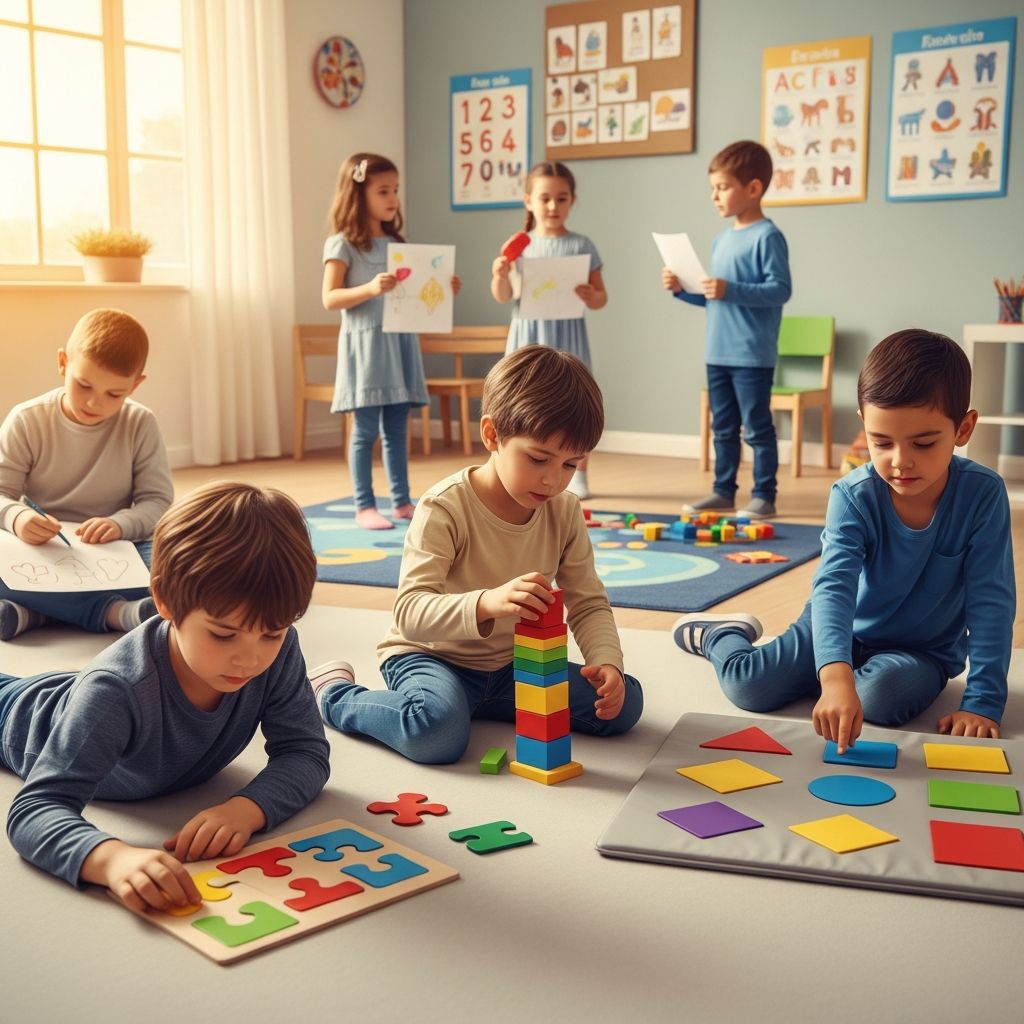
Kindergarten marks a pivotal transition in a child’s educational journey, where foundational cognitive abilities begin to shape their academic trajectory and social interactions. These skills, encompassing attention, memory, language processing, basic numeracy, and logical thinking, are critical for children aged 4 to 6 to navigate classroom demands effectively. Research demonstrates that early development in these areas predicts later success in reading and math, highlighting the need for targeted nurturing at home and in preschool settings.
Building a Strong Foundation: Why Cognitive Skills Matter Now
At the kindergarten stage, children’s brains undergo rapid neural pruning and connection formation, making it an ideal period for skill acquisition. Cognitive development involves not just rote learning but the integration of executive functions like focus and self-regulation, which underpin all learning. High-quality kindergarten programs emphasize exploration, problem-solving, and questioning to foster these abilities, helping children organize their understanding of the world.
Parents and educators play a complementary role. Daily interactions, such as shared reading or play-based challenges, reinforce these skills. Without this foundation, children may struggle with following instructions or engaging in group activities, potentially widening readiness gaps linked to socioeconomic factors.
Mastering Attention and Focus
Attention is the gateway to learning, divided into sustained attention for prolonged tasks and selective attention to filter distractions. Children with strong attention can complete puzzles or listen to stories without constant redirection, a skill essential for kindergarten routines.
- Sustained attention: Allows focus on one activity, like coloring within lines, preventing task-switching.
- Selective attention: Ignores irrelevant stimuli, such as classroom noise during storytime.
- Alternating attention: Shifts between tasks, like moving from art to cleanup.
Deficits here lead to unfinished work and frustration. Activities like timed games or mindfulness exercises build this skill. Studies show attention control in pre-kindergarten predicts emergent literacy growth, independent of initial abilities.
Harnessing Working Memory for Learning
Working memory holds and manipulates information temporarily, crucial for following multi-step directions like “Pick up the blocks, count them, and place them in the bin.” It’s linked to math and reading gains, as children must remember sequences or sounds while processing new input.
Signs of strong working memory include recalling a short list of items or reversing a sequence of actions. Challenges appear as repeated requests for instructions or difficulty in games like Simon Says. To develop it:
- Practice repeating phone numbers or shopping lists.
- Use board games requiring memory matching.
- Incorporate songs with cumulative verses, like “The Twelve Days of Christmas.”
Longitudinal data confirms that pre-kindergarten working memory growth uniquely contributes to kindergarten achievement, even after accounting for domain-specific skills.
Developing Language and Communication Proficiency
Clear verbal expression enables children to articulate thoughts, ask questions, and collaborate. By kindergarten, children should form 5-6 word sentences understandably, narrate events sequentially, and distinguish reality from fiction—skills foundational to literacy.
| Skill | Kindergarten Benchmark | Development Activity |
|---|---|---|
| Sentence Formation | Clear 5-6 word phrases | Daily conversations about routines |
| Sequential Storytelling | Relate events in order | Recount picture book plots |
| Fact vs. Fiction | Identify real vs. imagined | Discuss “Once upon a time” stories |
These abilities support independent learning and peer interactions. Language-rich environments, including read-alouds and discussions, accelerate progress.
Establishing Early Numeracy Concepts
Basic counting from 1 to 10 demonstrates number recognition, sequencing, and one-to-one correspondence—core to math readiness. It enables concepts like “more/less” and simple sorting, preparing for addition and beyond.
Children must not only recite numbers but apply them, such as counting objects accurately without aids. This skill integrates with spatial reasoning for tasks like arranging shapes. Hands-on tools like counters or number lines build confidence.
- Count daily items: stairs, toys, snacks.
- Sort by size/color while counting groups.
- Play store with pretend money for value conversion.
Emergent numeracy growth, bolstered by cognitive skills, forecasts kindergarten math performance.
Cultivating Logic, Reasoning, and Problem-Solving
Logic and reasoning allow children to analyze patterns, draw conclusions, and solve puzzles. Verbal reasoning processes word problems; non-verbal handles shapes and diagrams. These skills aid decision-making and abstract thinking emergence.
In kindergarten, expect children to classify objects, predict outcomes, or complete patterns. Struggles manifest in math errors or poor choices. Foster through:
- Puzzle assembly and block building.
- “What happens next?” scenarios.
- Simple riddles or “why” discussions.
Cognitive programs emphasize planning and critical discussion to deepen reasoning.
Strategies for Home and Classroom Skill Building
Integrate skills daily without drills. Play-based learning trumps worksheets:
- Outdoor exploration: Enhances observation and sustained attention.
- Story circles: Boosts sequencing and expression.
- Math games: Reinforces counting via fun.
- Direction games: Builds working memory.
Consistency matters; short, frequent sessions yield gains. Track progress via milestones like independent task completion.
Overcoming Common Challenges and Red Flags
Not all children develop evenly. Watch for persistent issues like inability to follow two-step directions or count reliably, warranting early intervention. Socioeconomic disparities amplify gaps, but targeted pre-kindergarten programs mitigate them via executive function training.
Collaborate with educators for individualized plans. Professional assessments distinguish typical variation from needs like ADHD.
Frequently Asked Questions (FAQs)
What if my child struggles with counting to 10?
Practice through play; use manipulatives and songs. If persistent by mid-kindergarten, consult a specialist. Consistent exposure builds mastery over time.
How much screen time aids cognitive growth?
Limit to educational apps under 1 hour daily; prioritize interactive play for better attention and memory development.
Can cognitive skills predict school success?
Yes, pre-kindergarten working memory and attention strongly forecast reading/math outcomes.
What’s the role of play in cognitive development?
Pretend play builds reasoning, memory, and language, laying groundwork for abstract thought.
When should I worry about attention issues?
If a child can’t focus for age-appropriate durations (10-15 minutes) despite engagement, seek evaluation.
Long-Term Impact: From Kindergarten to Lifelong Learning
Kindergarten cognitive foundations influence trajectories through elementary school and beyond. Strong starters excel in complex tasks, adapting to abstract concepts by ages 6-12. Investing now yields dividends in resilience, creativity, and achievement.
Empower children with these tools for a confident start. Early cognitive nurturing isn’t just preparation—it’s the spark for curious, capable minds.
References
- The Development of Cognitive Skills and Gains in Academic School Readiness for Children From Low-Income Backgrounds — PMC/NCBI. 2010-04-15. https://pmc.ncbi.nlm.nih.gov/articles/PMC2856933/
- 5 Cognitive Skills That Are Important for Kindergarten — Education Corner. Accessed 2026. https://www.educationcorner.com/cognitive-skills-important-for-kindergarten/
- 7 Cognitive Skills to Develop — International School of Denver. Accessed 2026. https://www.isdenver.org/newspost/~board/adcellerant-blog/post/cognitive-skills-to-develop
- What Do Children Learn in a High-Quality Kindergarten? — NAEYC. Accessed 2026. https://www.naeyc.org/our-work/families/what-do-children-learn-kindergarten-program
- Cognitive Skills for Each Age: Important Milestones — ECCM. Accessed 2026. https://www.eccm.org/blog/cognitive-skills-for-each-age-important-milestones
- Cognition — HeadStart.gov. Accessed 2026. https://headstart.gov/school-readiness/article/cognition

Medha Deb is an editor with a master's degree in Applied Linguistics from the University of Hyderabad. She believes that her qualification has helped her develop a deep understanding of language and its application in various contexts. Medha specializes in the areas of beauty, health, sports, and wellness and is committed to ensuring that the content on the website is…