
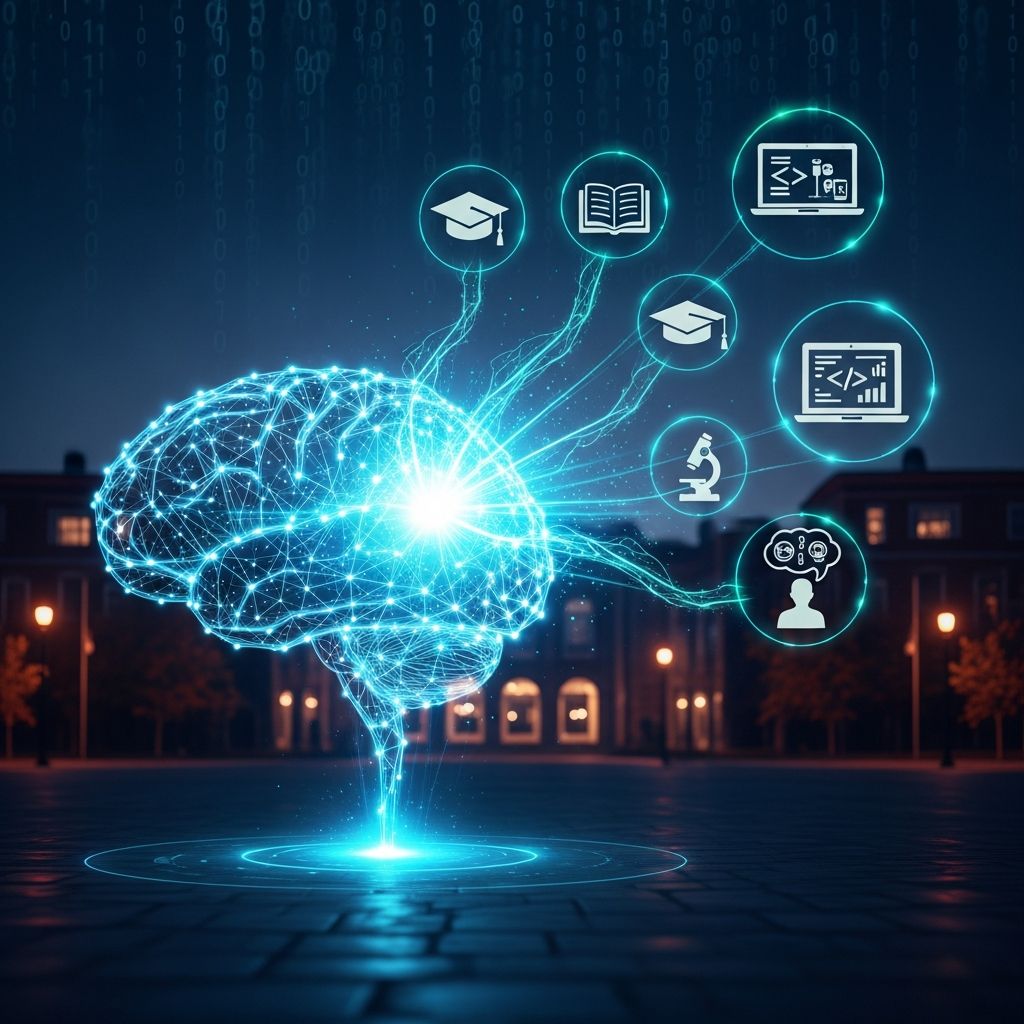
Generative AI is reshaping the landscape of education by offering tools that personalize learning, foster critical thinking, and streamline teaching processes. These technologies enable educators and students to create customized content, receive instant feedback, and explore complex topics in innovative ways, leading to improved outcomes across diverse subjects.
Understanding Generative AI in Learning Environments
Generative AI refers to systems capable of producing new content such as text, images, or code based on user prompts. In education, it acts as a dynamic assistant, adapting to individual needs and providing resources on demand. Unlike traditional tools, it generates original outputs tailored to specific learning objectives, making it ideal for higher education, K-12, and professional development.
Research indicates that integrating these tools enhances higher-order thinking skills, motivation, and active participation. A meta-analysis revealed positive effects in university courses across arts, humanities, health sciences, and social sciences, particularly through personalized content and immediate feedback. This shift allows learners to focus on deep analysis rather than rote memorization.
Personalized Learning Paths with AI
One of the most impactful applications is creating individualized study plans. Students input their strengths, weaknesses, and course objectives, and AI generates targeted practice questions, summaries, and schedules. This approach reinforces knowledge and builds critical thinking by simulating real-world problem-solving.
- Generate custom quizzes from lecture notes or readings to test comprehension.
- Develop adaptive schedules that prioritize challenging topics.
- Provide multilingual glossaries for subject-specific terms, aiding non-native speakers.
For instance, in language classes, AI translates and simplifies vocabulary, enabling deeper engagement with academic materials. Studies show this leads to better retention and confidence.
Boosting Critical Thinking and Problem-Solving
Generative AI excels at challenging students with complex scenarios. It creates simulations, debates diverse viewpoints, and offers step-by-step explanations of intricate concepts, particularly in STEM fields. By simplifying advanced topics into accessible language, it broadens access to critical activities.
In design and medical education, AI supports deeper analysis—such as evaluating sketches or medical terminology—fostering metacognition and teamwork skills. One study noted improved conspiracy theory debunking through chatbot interactions, highlighting its role in cognitive development.
| Subject Area | AI Application | Reported Benefits |
|---|---|---|
| STEM | Code debugging, concept explanations | Enhanced problem-solving, higher-order thinking |
| Humanities | Perspective generation, essay refinement | Increased motivation, deeper analysis |
| Health Sciences | Terminology quizzes, team simulations | Better understanding, collaboration skills |
AI as a 24/7 Tutoring Companion
Available anytime, AI tutors quiz students, explain ideas, and deliver instant feedback, outperforming traditional methods in some cases. Harvard research shows AI-tutored students match or exceed classroom peers, especially in STEM, due to personalized pacing.
Instructors can use AI to produce course materials, summarize discussions, and offer tailored feedback, saving time while elevating quality. Tools like chatbots encourage reflection and ownership of learning, as seen in composition classes with higher pass rates.
Enhancing Classroom Dynamics and Collaboration
AI enriches in-class activities by generating alternative explanations, analogies, and multilingual examples. Students compare AI outputs to develop contextual understanding and debate biases in responses.
For group work, AI facilitates peer reviews, project ideation, and real-time insights. Platforms analyze discussions for engagement, helping teachers adjust strategies on the fly. This promotes experimentation, emotional safety in querying, and collective innovation.
Practical Strategies for Ethical AI Integration
To maximize benefits, educators guide prompt engineering, tying inputs to learning objectives for precise outputs. Encourage reflection on AI-generated content, such as varying prompts to observe changes, building critical evaluation skills.
- Incorporate AI in assignments requiring human-AI collaboration, like refining prototypes.
- Use for scoping topics: summarize readings for class discussions.
- Promote responsible use to complement, not replace, deep learning.
While most studies report gains, some note risks like over-reliance leading to lower grades. Balanced integration addresses this by emphasizing AI as a tool for enhancement.
Future Directions: AI as Co-Pilot for Educators
Emerging tools act as teaching co-pilots, customizing lessons, assessments, and feedback loops. AI-driven platforms support professional learning communities, enabling custom tool design. In regions like Kenya and India, they save time and boost engagement.
Expect wider adoption in adaptive games, real-time analytics, and inclusive education, preparing students for AI-augmented careers.
Frequently Asked Questions (FAQs)
What is generative AI in education?
Generative AI creates original content like text or quizzes from prompts, personalizing education and supporting skills like critical thinking.
Does AI improve learning outcomes?
Yes, meta-analyses show positive effects on motivation, higher-order thinking, and participation, especially in short courses and problem-based learning.
How can teachers use AI ethically?
Integrate it for feedback and materials while teaching prompt skills and reflection to ensure it enhances, not undermines, learning.
Is AI suitable for all subjects?
Highly effective across STEM, humanities, and languages, with tools for code analysis, translations, and scenario-building.
What are the risks of AI in classrooms?
Potential over-dependence or inaccuracies; mitigate by verifying outputs and designing AI-inclusive assessments.
References
- What we are learning about generative AI in education — University of Kansas Center for Teaching Excellence. 2024. https://cte.ku.edu/what-we-are-learning-about-generative-ai-education
- Using Generative AI to Enhance Student Learning — Metropolitan State University of Denver CTLD Ready. 2024-08-21. https://ready.msudenver.edu/canvas-spotlight/using-generative-ai-to-enhance-student-learning/
- An introduction to the use of generative AI tools in teaching — University of Oxford Centre for Teaching and Learning. Accessed 2026. https://www.ctl.ox.ac.uk/ai-tools-in-teaching
- Teach with Generative AI — Harvard University. Accessed 2026. https://www.harvard.edu/ai/teaching-resources/
- Enhancing Learning Through AI: Generating Better Study Habits — University of Colorado Denver. Accessed 2026. https://www.ucdenver.edu/student/stories/library/stories-from-the-hub/enhancing-learning-through-ai-generating-better-study-habits
- Generative AI & The Future of Learning — Aurora Institute. Accessed 2026. https://aurora-institute.org/cw_post/generative-ai-the-future-of-learning/
- Generative Artificial Intelligence — Cornell University Center for Teaching Innovation. Accessed 2026. https://teaching.cornell.edu/generative-artificial-intelligence

- Integrated M.A. in Applied Linguistics, University of Hyderabad
- 5+ years in editorial, instructional, SEO, and research-based writing
Sneha is a relationships and lifestyle writer with a strong foundation in applied linguistics and certified training in relationship coaching. She brings over five years of writing experience to theskillvault, crafting thoughtful, research-driven content that empowers readers to build healthier relationships, boost emotional well-being, and embrace holistic living. Her writing and insights reflect the belief that beauty, happiness, and wellness…