
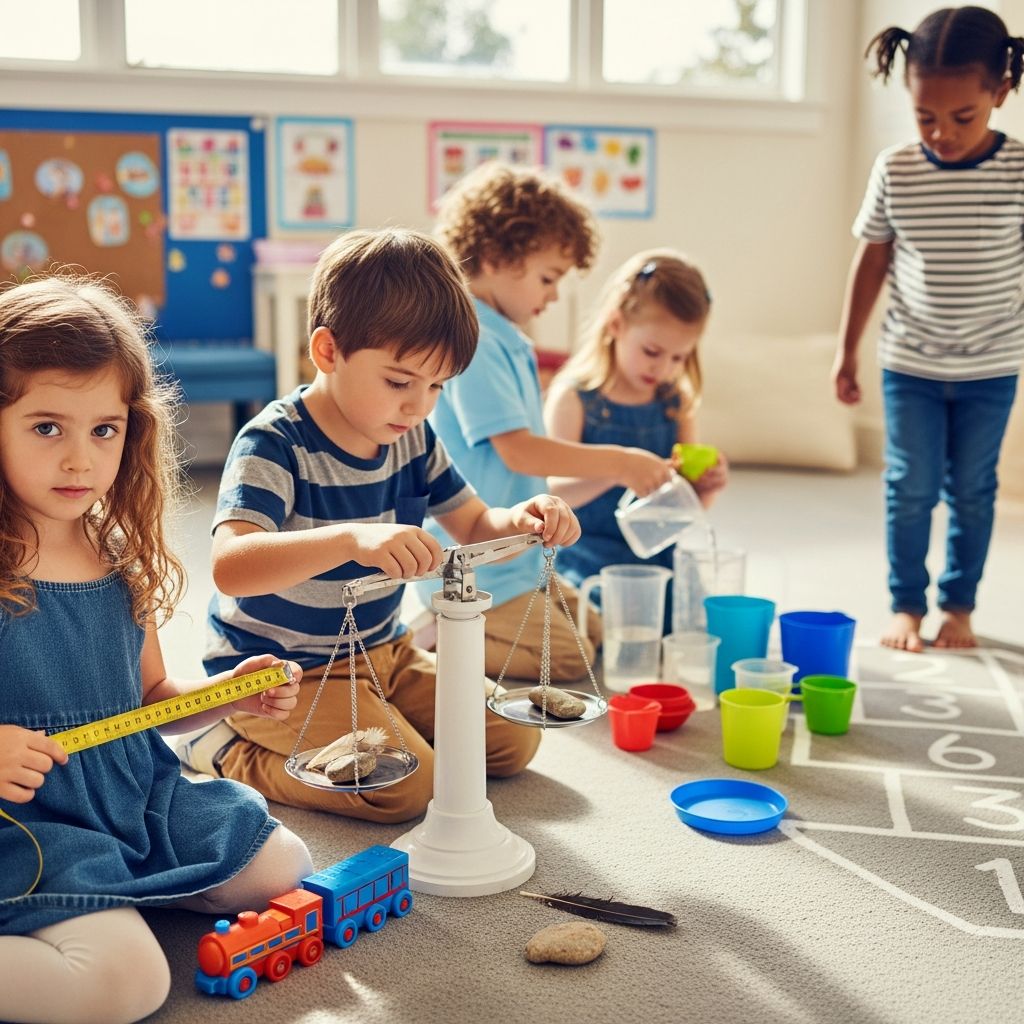
Measurement forms the foundation of mathematical understanding for children, helping them grasp concepts like size, quantity, and space in everyday life. By integrating play-based games, parents and educators can make these abstract ideas concrete and exciting. This article presents original, engaging activities tailored for preschoolers and kindergarteners, focusing on non-standard units to build confidence before introducing formal tools like rulers.
Why Measurement Matters in Early Childhood
Early exposure to measurement enhances cognitive development, spatial awareness, and problem-solving abilities. Children learn to compare objects, estimate sizes, and understand relationships between quantities, which are crucial for later math success. Hands-on games encourage exploration without pressure, fostering a love for learning.
Activities using everyday items promote fine motor skills and vocabulary growth, as kids describe what is ‘longer,’ ‘taller,’ or ‘fuller.’ Research from educational resources emphasizes starting with direct comparisons to build intuitive sense before precise metrics.
Getting Started: Non-Standard Measurement Basics
Begin with non-standard units like hands, blocks, or paper clips, as young children may not yet handle inches or centimeters effectively. These methods allow focus on the concept of iteration—laying units end-to-end—without numerical complexity.
- Direct Comparison: Place objects side by side to see which is bigger.
- Indirect Comparison: Use a string or stick to transfer measurements.
- Unit Iteration: Repeat a single item to cover the length.
This progression scaffolds learning, making transitions to standard tools seamless.
Outdoor Exploration Games
Take learning outside where space abounds for dynamic measurement challenges. Nature provides endless opportunities to compare and quantify the world.
Footprint Trails Adventure
Create a pathway by dipping feet in washable paint and stamping across paper or pavement. Measure trail length with strides or sticks, comparing sizes among friends. This reveals personal scale differences vividly.
Jumping Challenges
Mark a start line, jump forward, and measure distance using foot lengths or ropes. Challenge kids to beat their personal best, introducing repetition and improvement.
Nature Scavenger Quests
Hunt for leaves, sticks, or rocks sorted by size: tiniest, medium, largest. Use hands or twigs to gauge, discussing findings to reinforce descriptive language.
Indoor Building and Stacking Fun
Indoor activities harness imagination with household toys, turning playtime into math lessons.
Block Tower Contests
Build towers to specified ‘heights’ using same-size blocks, then measure with additional blocks or hands. Compare structures: ‘Whose is tallest?’ Enhances spatial reasoning.
Playdough Creations
Roll dough into ropes or shapes, measuring with paper clips or cubes. Predict how many units fit before testing, building estimation skills.
Toy Measuring Madness
Select toys like cars or animals; measure lengths with linking cubes or LEGO bricks. Record on paper for visual comparison.
Water and Capacity Experiments
Sensory water play introduces volume and capacity without formal tools.
Pouring Predictions
Fill varied containers from small cups, guessing how many cups per bowl. Pour and count, exploring ‘more’ or ‘less’.
Sink or Float Volumes
Compare water levels in clear glasses after adding objects. Which displaces more? Links to real-world science.
String and Circumference Tricks
Flexible strings measure curves and irregular shapes effortlessly.
Around-the-House Loops
Wrap string around wrists, tables, or fruits; lay flat and compare lengths with blocks. Great for girths.
Body Part Mapping
Measure arms, legs, heads; create a class ‘body chart’ comparing averages.
Comparing Heights and Lengths
Personal measurements make concepts relatable.
Stand and Stretch
Line up against a wall, mark heights with tape; compare growth over time.
Shadow Puppets
Project shadows at noon; measure and discuss size distortions.
Cooking as Measurement Mastery
Kitchen tasks blend math with life skills.
Ingredient Hunts
Measure cups of flour or spoons of sugar; double recipes to explore scaling.
Snack Sorting
Count and compare gummy bears or cereal by handfuls.
Digital and Game-Infused Learning
Blend tech with tactile for modern engagement.
Interactive Apps
Use kid-safe games estimating volumes or lengths digitally.
Board Game Twists
Modify hopscotch or bean bag toss to measure throws.
Activity Comparison Table
| Activity | Skills Taught | Materials Needed | Age Group |
|---|---|---|---|
| Footprint Trails | Length, Comparison | Paint, Paper | 3-5 |
| Block Towers | Height, Stacking | Blocks, Ruler | 4-6 |
| Water Pouring | Volume, Estimation | Cups, Water | 3-5 |
| String Loops | Circumference, Flexibility | String, Objects | 4-6 |
| Jumping Distances | Distance, Physical | Tape, Chalk | 5-7 |
Tips for Success and Extensions
Supervise for safety; adapt for group sizes. Extend by introducing centimeters post-mastery. Track progress in journals.
Frequently Asked Questions (FAQs)
What age is best for starting measurement games?
Ages 3-5 for basics like comparison; 5+ for units.
Do I need special tools?
No—use household items first.
How to handle kids who struggle with estimation?
Model, then guide; celebrate efforts.
Can these work in classrooms?
Yes, scale for groups with rotations.
What if my child resists math play?
Follow interests; integrate into favorites.
References
- 10 Fun and Interactive Measurement Activities for Preschoolers — ABCmouse. 2023. https://www.abcmouse.com/learn/activities/10-fun-and-interactive-measurement-activities-for-preschoolers/2837
- 15 Best Hands-On Measurement Activities for Kids — SplashLearn. 2023. https://www.splashlearn.com/blog/measurement-activities-for-kids/
- How to Teach Measurement: Measuring Activities for Kids — Alphapals. 2023. https://alphapals.com/blogs/news/measurement-measuring-activities-for-kids
- 27 Clever Ideas for Teaching Measurement of All Kinds — WeAreTeachers. 2023. https://www.weareteachers.com/teaching-measurement/

Medha Deb is an editor with a master's degree in Applied Linguistics from the University of Hyderabad. She believes that her qualification has helped her develop a deep understanding of language and its application in various contexts. Medha specializes in the areas of beauty, health, sports, and wellness and is committed to ensuring that the content on the website is…