
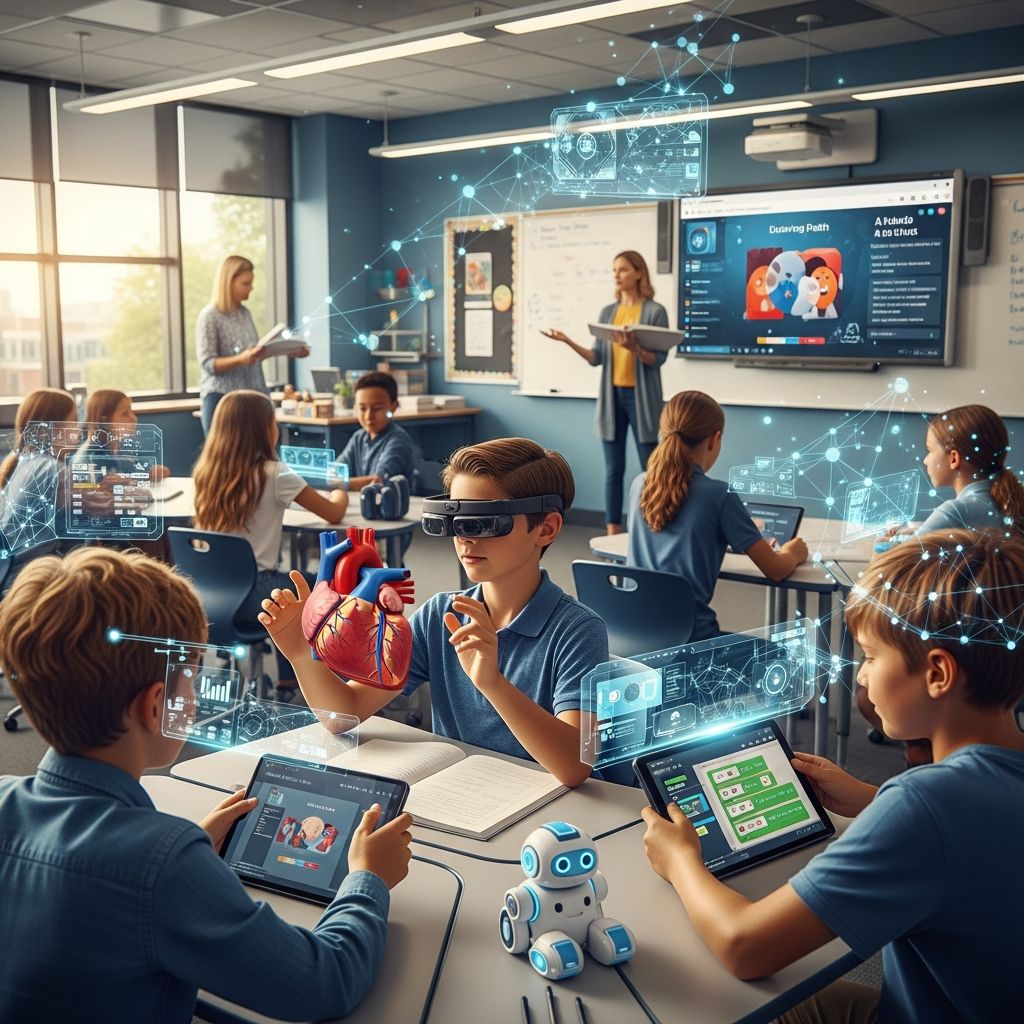
Artificial intelligence is fundamentally altering the landscape of K-12 education by enabling tailored learning experiences, streamlining teacher workflows, and preparing students for a tech-driven world. Educators are increasingly integrating AI tools to meet diverse student needs while addressing longstanding challenges in traditional classrooms.
Core Advantages of AI Integration in Schools
AI’s entry into K-12 settings offers transformative benefits that enhance both teaching and learning processes. By leveraging data analytics and machine learning, these technologies adapt to individual learners, providing immediate insights that human instructors alone cannot match at scale.
- Customized Instruction Paths: AI systems analyze student performance in real-time, adjusting lesson difficulty and pace to suit each learner’s strengths and gaps.
- Instant Feedback Mechanisms: Tools deliver prompt evaluations on assignments, helping students correct errors without delay.
- Resource Optimization: Teachers gain time previously lost to routine tasks, redirecting efforts toward mentorship and creative teaching.
Over 85% of teachers and students now incorporate AI in daily activities, reflecting widespread recognition of its value in fostering engagement and outcomes.
Personalization: The Heart of AI-Driven Learning
One of AI’s most compelling applications lies in creating individualized education plans that cater to varied learning styles, speeds, and abilities within a single classroom. Traditional one-size-fits-all models often leave some students behind; AI counters this by generating adaptive content dynamically.
For instance, platforms use algorithms to recommend resources—videos, quizzes, or exercises—based on past interactions. This not only boosts comprehension but also builds confidence as students progress at their own rhythm. Early detection of struggles allows for proactive support, preventing minor issues from becoming major hurdles.
| Traditional Learning | AI-Enhanced Learning |
|---|---|
| Uniform pacing for all | Adaptive speed per student |
| Delayed feedback | Real-time corrections |
| Generic assignments | Personalized challenges |
Research indicates these shifts lead to higher retention and success rates, particularly in diverse classrooms.
Empowering Teachers with Efficiency Tools
Teachers face heavy administrative loads, from grading to planning, which detract from direct student interaction. AI automates these, saving an average of six hours weekly per educator. Automated essay scoring, report generation, and lesson outlining free professionals to focus on high-impact activities like fostering critical thinking.
Natural language processing advancements enable detailed feedback on extended writing, analyzing patterns across assignments for targeted advice. This symbiosis positions AI as a collaborator, amplifying rather than replacing human expertise.
Accessibility and Inclusion Through Technology
AI bridges gaps for underserved populations, including those with disabilities or in remote areas. Adaptive textbooks and real-time transcription tools make materials accessible globally, as seen in initiatives by organizations like UNICEF.
In special education, AI supports individualized education plans (IEPs) by customizing interventions and tracking progress. Virtual tutors provide round-the-clock assistance, ensuring no student is left without resources.
- Real-time language translation for multilingual classrooms.
- Voice-to-text for students with motor challenges.
- Visual aids generated for auditory learners.
Boosting Engagement and Retention Rates
Personalized pathways keep students motivated, reducing dropout risks. AI-driven analytics predict at-risk individuals, enabling timely interventions that improve overall persistence. In online and hybrid models, chatbots offer instant query resolution, mimicking in-person support.
Skill Development for an AI-Enabled Future
Beyond academics, AI integration cultivates essential competencies like adaptability, creativity, and ethical reasoning—skills machines cannot replicate. Classrooms emphasize AI collaboration, where students use tools for project-based exploration, honing problem-solving in real-world contexts.
Curricula must evolve to include AI literacy, teaching students to critically evaluate outputs, recognize biases, and innovate alongside technology. This prepares them for workforce demands where human-AI partnerships dominate.
Navigating Risks and Ethical Concerns
Despite benefits, AI introduces challenges: data privacy, algorithmic bias, and over-reliance. Rapid adoption—AI apps surging to 100 million users in 60 days—demands cautious governance.
- Privacy Risks: Student data collection requires robust safeguards.
- Bias Amplification: Unchecked models can perpetuate inequities.
- Integrity Issues: Deepfakes and hallucinations necessitate verification skills.
Equity remains critical; without universal access, AI could widen digital divides. Policymakers urge balanced approaches: quick implementation with transparency and collaboration.
Practical Strategies for Implementation
Schools can harness AI responsibly through structured steps:
- Teacher Training: Hands-on professional development to build proficiency and address fears.
- Curriculum Revamp: Embed AI in experiential learning, not just efficiency.
- Equity Measures: Ensure device and connectivity access for all demographics.
- Ethical Frameworks: Develop policies on data use, bias audits, and human oversight.
AI-supported tasks, like designing cognitively challenging projects, integrate technology meaningfully.
Emerging Innovations on the Horizon
Future AI promises immersive virtual environments and predictive analytics for holistic student wellness. Generative AI, under teacher supervision, enhances content creation while maintaining pedagogical control. Longitudinal studies will refine these tools, ensuring evidence-based evolution.
Frequently Asked Questions (FAQs)
What percentage of teachers use AI tools?
Six in ten teachers used AI in 2024–25, saving significant time weekly.
Does AI replace teachers?
No, AI acts as a partner, handling routines to allow focus on mentorship and complex instruction.
How does AI address learning differences?
Through adaptive platforms that customize content, feedback, and pacing for diverse needs.
What are key risks of AI in schools?
Privacy breaches, biases, and equity gaps if not managed properly.
Can AI improve student outcomes?
Yes, early studies show gains in engagement and personalization, with potential for retention.
References
- Impact of AI on Education: K12 and Beyond — Keiser University. 2024. https://www.keiseruniversity.edu/articles/impact-ai-education-k12-beyond/
- Rethinking K-12 Education in the Age of AI — Online Learning Consortium. 2025-03. https://onlinelearningconsortium.org/olc-insights/2025/03/rethinking-k12-education-in-the-age-of-ai/
- Artificial Intelligence in K-12 Education: Opportunities, Challenges, and Policy Implications — Guinn Center. 2024. https://www.guinncenter.org/research/artificial-intelligence-in-k-12-education-opportunities-challenges-and-policy-implications
- A Roadmap for Responsible and Effective Use of AI in K-12 Classrooms — Southern Regional Education Board (SREB). 2024. https://www.sreb.org/news/roadmap-responsible-and-effective-use-ai-k-12-classrooms
- Using Learning Science to Analyze the Risks and Benefits of AI in K-12 Education — Center for American Progress. 2024. https://www.americanprogress.org/article/using-learning-science-to-analyze-the-risks-and-benefits-of-ai-in-k-12-education/
- Generative AI use in K-12 education: a systematic review — Frontiers in Education. 2025. https://www.frontiersin.org/journals/education/articles/10.3389/feduc.2025.1647573/full
- How artificial intelligence will impact K–12 teachers — McKinsey & Company. 2023. https://www.mckinsey.com/industries/education/our-insights/how-artificial-intelligence-will-impact-k-12-teachers

Medha Deb is an editor with a master's degree in Applied Linguistics from the University of Hyderabad. She believes that her qualification has helped her develop a deep understanding of language and its application in various contexts. Medha specializes in the areas of beauty, health, sports, and wellness and is committed to ensuring that the content on the website is…