
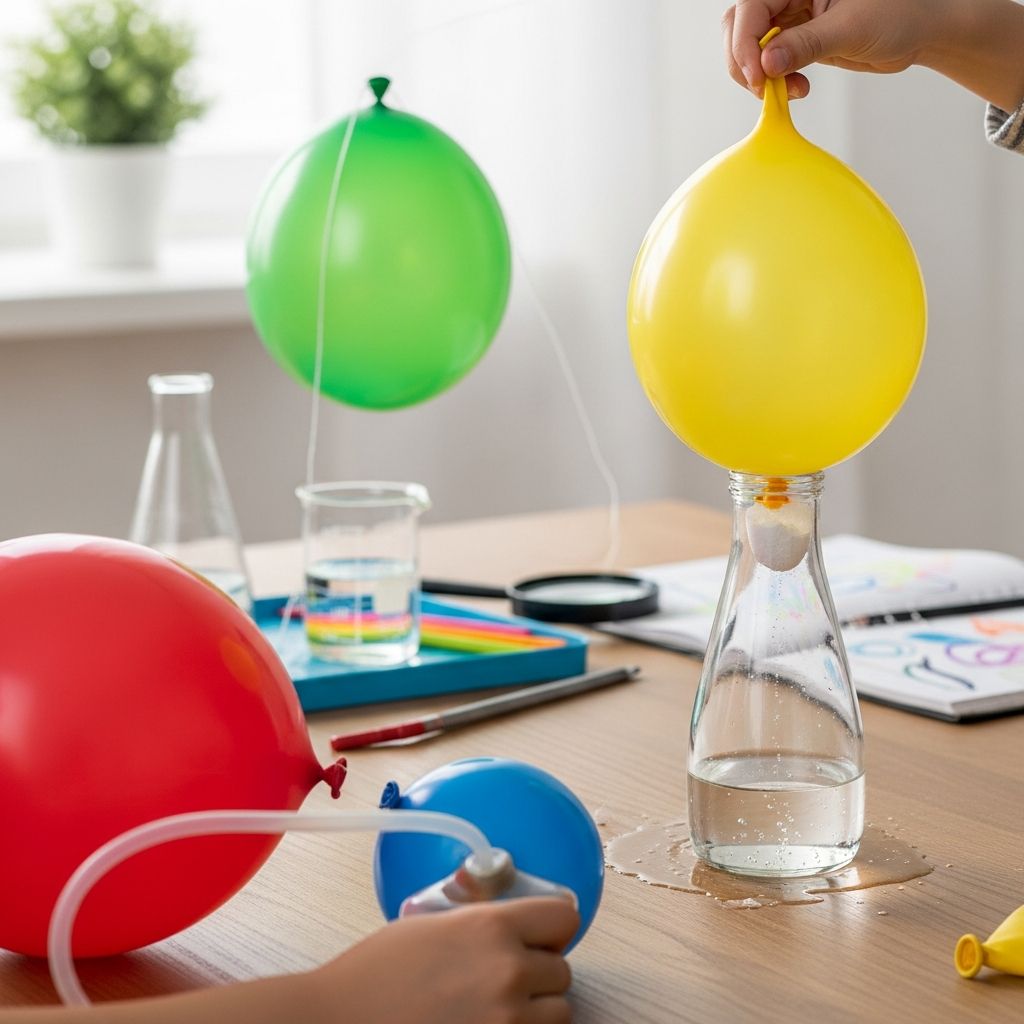
Balloons offer an accessible gateway to exploring fundamental scientific principles like gas production, air pressure, density, and electrostatic forces. These experiments use common household materials to create dramatic, memorable demonstrations that captivate children and adults alike, fostering a love for STEM through play.
Why Balloons Make Perfect Science Tools
Balloons are elastic, lightweight, and responsive to changes in volume and pressure, making them ideal for visualizing invisible concepts such as gases and forces. When a chemical reaction generates carbon dioxide inside a balloon, it expands visibly, teaching cause-and-effect relationships. Similarly, rubbing a balloon on fabric builds static charge, allowing kids to see electricity in action without complex equipment.
These activities align with educational standards in physics and chemistry, suitable for ages 5-12. They encourage prediction, observation, and explanation, key elements of the scientific method.
Effervescent Balloon Inflation
This classic reaction between an acid and a base produces gas rapidly, inflating a balloon without lung power. It’s a staple for introducing chemical reactions.
- Materials: Empty plastic bottle, balloon, 1/2 cup vinegar, 2 tablespoons baking soda, funnel.
- Steps:
- Pour vinegar into the bottle.
- Use funnel to add baking soda to balloon.
- Stretch balloon neck over bottle mouth without releasing powder.
- Lift balloon to drop baking soda into vinegar; watch inflation.
- Science Explained: Baking soda (sodium bicarbonate) reacts with vinegar (acetic acid) to form carbon dioxide gas, water, and sodium acetate. The gas fills the balloon as pressure builds inside the sealed system.
Variations include drawing faces on balloons for thematic fun, like ghosts or pumpkins, enhancing creativity.
Fermentation-Powered Balloon Growth
Observe biology in action as yeast ferments sugar, slowly producing gas over minutes. This demonstrates living organisms’ role in chemistry.
- Materials: Bottle, balloon, 1 packet yeast, 1/4 cup warm water, 2 tablespoons sugar.
- Steps:
- Mix warm water, sugar, and yeast in bottle; swirl gently.
- Attach balloon securely over bottle top.
- Wait 5-10 minutes for bubbling and inflation.
- Science Explained: Yeast consumes sugar in respiration, releasing CO2. The process mimics bread rising or beer brewing, showing fermentation’s power.
Ideal for time-lapse observation; discuss why warm water speeds activation.
Static Electricity Balloon Tricks
Harness invisible electric charges to move objects, introducing electrostatics.
- Materials: Balloon, wool cloth or hair, small paper bits, empty soda can, wall.
- Steps:
- Rub balloon on hair/wool for 30 seconds.
- Approach paper scraps; watch attraction.
- Hold near can; roll it without touching.
- Stick to wall briefly.
- Science Explained: Friction transfers electrons, charging balloon negatively. It attracts neutral objects by inducing opposite charges.
Extend to lighting a fluorescent bulb: charged balloon near bulb causes glow from excited gases.
Density and Buoyancy Balloon Challenges
Compare floating and sinking to grasp density concepts.
| Balloon Type | Filling | Behavior in Water | Reason |
|---|---|---|---|
| Air-filled | Regular air | Floats | Less dense than water |
| Water-filled | Water | Sinks | Same density as water |
| Helium-filled | Helium gas | Floats highly | Much lighter than air |
- Setup: Fill balloons differently; test in water tub.
- Science: Density = mass/volume. Helium’s low density creates buoyancy.
Use oil or syrup-filled balloons for advanced density gradients.
Air Pressure Balloon Puzzles
Explore atmospheric pressure’s effects in confined spaces.
- Balloon in Jar: Place deflated balloon in jar, seal lid. Can’t inflate easily due to external pressure resisting expansion. Poke hole; inflates freely as air equalizes.
- Two-Balloon Balance: Connect two balloons with straw/tube, one more inflated. Air flows to equalize pressure, surprising size swap.
These reveal air as a substance exerting force.
Motion and Engineering with Balloon Power
Balloon Rocket Launcher
Propel a balloon-straw along string to Newton’s Third Law.
- Materials: Balloon, straw, string, tape.
- Steps:Thread string through straw, tape balloon to straw, inflate, release. Zooms as air escapes backward.
Two-Stage Rocket
Simulate space tech with staged propulsion for greater distance.
Hovercraft Disk
Balloon on CD with bottle cap center creates air cushion for spinning glide.
Engineering focus: Design iterative improvements.
Sound and Thermal Balloon Effects
- Screaming Balloon: Insert hex nut/coin, swirl for vibration-induced screech. Teaches sound wave production.
- Expanding Air Balloon: Heat air-filled balloon; expands as molecules gain energy.
- Fireproof Balloon: Fill with water; withstands flame as liquid absorbs heat.
Safety Guidelines for Balloon Experiments
- Supervise children; small parts pose choking hazard.
- Use eye protection for reactions.
- Avoid latex allergies; opt for mylar.
- Clean spills promptly to prevent slips.
- Dispose balloons responsibly to protect wildlife.
Adult prep ensures safe, smooth execution.
Frequently Asked Questions
What age are these experiments suitable for?
Most work for 5-12 year olds; simplify for younger, add math for older.
Why does the vinegar-baking soda balloon inflate?
Acid-base reaction produces CO2 gas rapidly.
Can I do these without balloons?
Adapt with bags or bottles, but balloons best visualize gas expansion.
How to store inflated balloons?
Knots or clips; helium lasts days, air longer.
Are these classroom-friendly?
Yes, group stations; minimal mess with prep.
Advanced Variations and Extensions
Measure inflation time quantitatively. Graph temperature vs. expansion. Combine static with water for lightning demos. Build balloon cars racing density boats. These scale to curricula.
Incorporate data: Track CO2 volume via displacement. Predict outcomes using gas laws (e.g., Charles’ Law for heating).
References
- Magic Balloons – Playdough To Plato — Playdough To Plato. 2023. https://www.playdoughtoplato.com/kids-science-experiment-balloon/
- Balloon Baking Soda Experiment — We Are Teachers / YouTube. 2023. https://www.youtube.com/watch?v=ybNKxalaW5c
- 20 Balloon Science Experiments — Little Bins for Little Hands. 2024. https://littlebinsforlittlehands.com/balloon-experiments-for-kids/
- 20 Balloon Experiments To Make Your Lessons Really Pop — We Are Teachers. 2024. https://www.weareteachers.com/balloon-experiments/
- Balloon Science Experiments — Science Fun. 2023. https://www.sciencefun.org/kidszone/experiments/balloon-science-experiments/
- 5 Science Experiments with Balloons — TheDadLab / YouTube. 2022. https://www.youtube.com/watch?v=X6MlRbAgAdg

Medha Deb is an editor with a master's degree in Applied Linguistics from the University of Hyderabad. She believes that her qualification has helped her develop a deep understanding of language and its application in various contexts. Medha specializes in the areas of beauty, health, sports, and wellness and is committed to ensuring that the content on the website is…