
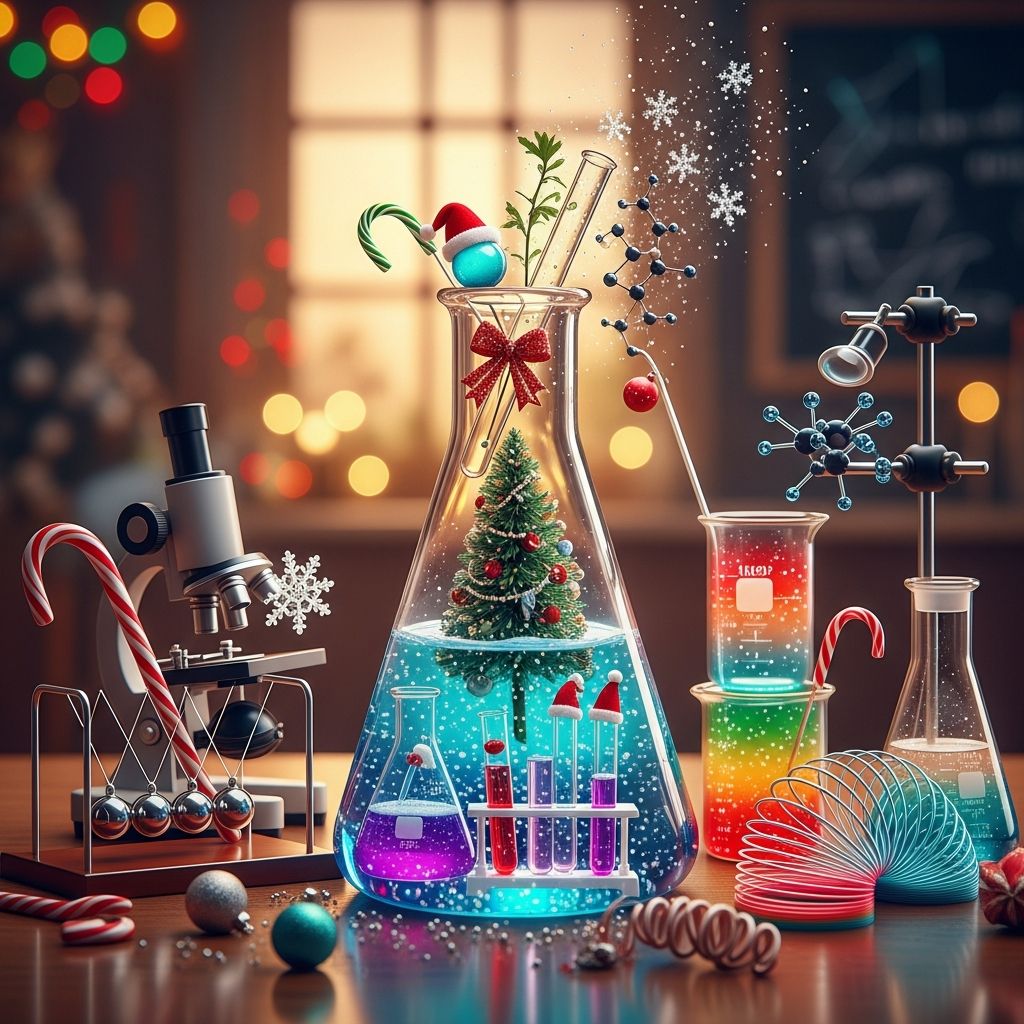
Bring the magic of science to your holiday celebrations with these captivating experiments designed to ignite curiosity and reinforce key STEM concepts. Using common household items infused with Christmas themes, these activities make learning fun and memorable for children during the busy season.
Why Integrate Science into Holiday Fun?
Holidays offer a unique opportunity to engage young minds when excitement runs high. Science experiments themed around Christmas not only maintain focus but also teach fundamental principles like chemical reactions, density, magnetism, and states of matter. These hands-on projects require minimal preparation, promote critical thinking, and create lasting holiday memories.
From fizzing eruptions mimicking snowy volcanoes to static-charged decorations that dance, each activity aligns with educational standards while celebrating the season. Parents and teachers can adapt them for various age groups, ensuring accessibility and safety.
Chemical Reactions: Fizzing Holiday Wonders
Chemical reactions provide spectacular visuals that captivate kids. Start with a classic acid-base reaction using baking soda and vinegar, shaped into festive forms.
Baking Soda Snow Globes
Create mini snow globes on a tray lined with foil. Place holiday-shaped molds (like stars or trees) filled with baking soda. Add colored vinegar using droppers for controlled fizzing eruptions. Children observe gas production as carbon dioxide bubbles form, simulating a snowy explosion. Discuss how acids and bases neutralize to produce gas.
- Materials: Baking soda, vinegar (food-colored), plastic molds, tray, droppers.
- Science Concept: Acid-base reaction producing CO2 gas.
- Extensions: Vary vinegar temperature to compare reaction speeds.
Candy Cane Dissolution Challenge
Explore solubility by submerging candy canes in different liquids. Test room-temperature water, hot water, and saltwater. Time how long each takes to dissolve and measure remnants. Hot water accelerates dissolution due to increased molecular movement.
| Liquid Type | Average Dissolution Time | Observation |
|---|---|---|
| Cold Water | 45 minutes | Slow, even dissolving |
| Hot Water | 15 minutes | Rapid breakdown |
| Saltwater | 60+ minutes | Inhibited by salt |
This experiment introduces variables, hypotheses, and data collection, perfect for applying the scientific method.
Physics in Play: Motion and Forces
Physics comes alive with motion-based activities that demonstrate Newton’s laws in a holiday context.
Santa’s Balloon Sleigh Launch
Attach a Santa figure to a balloon-powered sleigh on a string. Inflate the balloon and release to propel it across the room. Measure distance traveled and discuss propulsion from escaping air (Newton’s third law).
- Variations: Add weight with mini reindeer to test force vs. mass.
- Learning Outcome: Action-reaction pairs in motion.
Jingle Bell Magnet Lift-Off
Use magnetic wands to lift containers with increasing jingle bells. Predict the number needed before the container rises. This reveals magnetic field strength through non-contact force. Students record predictions vs. results, fostering prediction skills.
States of Matter: Magical Transformations
Investigate solids, liquids, and gases with festive flair.
Milk Plastic Holiday Ornaments
Heat milk and add vinegar to curdle it into casein plastic. Mold into ornaments, dye, and dry. This demonstrates protein denaturation and polymerization, creating biodegradable decor.
- Heat 1 cup milk to near-boil.
- Stir in 4 tsp vinegar; watch curds separate.
- Strain, knead with dye, shape, and dry overnight.
Hang on a classroom tree for a sustainable twist on traditions.
Oil and Water Blizzard Jar
Layer oil, water, glitter, and glycerin in a jar. Shake for a swirling snowstorm effect. Alka-Seltzer tabs create fizzing “blizzard” bubbles, showing density layers and gas production.
Static Electricity: Dancing Decorations
Harness static to make holiday shapes levitate. Rub balloons on hair or wool to charge them, then hover over tissue paper cutouts of trees or stars. The shapes “dance” due to electrostatic attraction.
- Safety Tip: Use tape on shapes to control movement.
- Concept: Like charges repel, opposites attract.
Tinsel Jumping Surprise
Charge a balloon and bring it near tinsel strands. Watch them leap toward it, illustrating charge induction.
Density and Buoyancy: Sink or Float Festivities
Fill a basin with water and test Christmas items like ornaments, cranberries, bells, and bows. Predict and observe buoyancy based on density. Surprises like floating gumdrops teach material properties.
| Item | Prediction | Result | Reason |
|---|---|---|---|
| Candy Cane | Sink | Sink | Dense sugar structure |
| Ping Pong Ball (Ornament Proxy) | Float | Float | Low density plastic |
| Cranberry | Sink | Float initially, then sink | Air pockets escape |
Color Mixing and Surface Tension Magic
Magic Milk Fireworks: Pour milk in a dish, add food coloring drops, and touch with soapy cotton swabs. Colors swirl dramatically due to surfactant breaking surface tension. Predict color blends first.
Skittles Rainbow Diffusion
Arrange Christmas-colored Skittles in a circle on a plate. Add warm water center; colors bleed outward without mixing immediately, demonstrating diffusion and polarity.
Engineering Challenges: Build and Test
Gumdrop Tower Contest
Teams build tallest stable towers using gumdrops and toothpicks in 15 minutes. Measure heights and discuss structural integrity, gravity, and load distribution.
Jingle Bell Mazes
Draw mazes on plates with crayons; guide bells through using underside magnets. Explores magnetism through barriers.
Frequently Asked Questions (FAQs)
What age groups are these experiments suitable for?
Most suit ages 4-12, with supervision. Simplify predictions for younger kids; add data analysis for older ones.
Are these experiments safe and mess-free?
Yes, using food-grade items. Use trays for containment; supervise vinegar and heat steps.
How can I tie these to curriculum standards?
Aligns with NGSS on matter, forces, and engineering. Use recording sheets for scientific method practice.
What if I lack specific holiday items?
Substitute with generics; focus on science principles over theme.
Can these be done in a classroom setting?
Absolutely—group stations work well for 20-30 students.
Enhancing Learning with Technology
Incorporate apps for digital recording: Snap photos of reactions, create timelines in PicCollage, or log data in Seesaw. This builds tech skills alongside science.
These experiments prove holidays enhance education, turning passive cheer into active discovery. Encourage experimentation beyond recipes for true inquiry-based learning.
References
- Christmas Science Experiments & STEM Challenges — Lessons for Little Ones. 2023. https://lessons4littleones.com/christmas-science-experiments/
- 25 Fun Christmas Science Experiments — Little Bins for Little Hands. 2023. https://littlebinsforlittlehands.com/christmas-science-activities-kids-top-10-christmas-ideas-kids/
- Six Christmas Science Experiments Junior High and High School Teachers Love — Science from the South. 2023. https://www.sciencefromthesouth.com/post/six-christmas-science-experiments-junior-high-and-high-school-teachers-love
- Easy Christmas Candy Experiments — Science Sparks. 2023. https://www.science-sparks.com/christmas-candy-experiments/
- 5 Amazing Christmas Science Experiments Your Kids Will Love — TheDadLab (YouTube). 2022-12-01. https://www.youtube.com/watch?v=jI6IkEBV4UQ
- Christmas Science: Dissolve a Candy Cane with the Scientific Method — Science is Fun (Teachers Pay Teachers). 2023. https://www.teacherspayteachers.com/browse?search=christmas+science

Medha Deb is an editor with a master's degree in Applied Linguistics from the University of Hyderabad. She believes that her qualification has helped her develop a deep understanding of language and its application in various contexts. Medha specializes in the areas of beauty, health, sports, and wellness and is committed to ensuring that the content on the website is…