
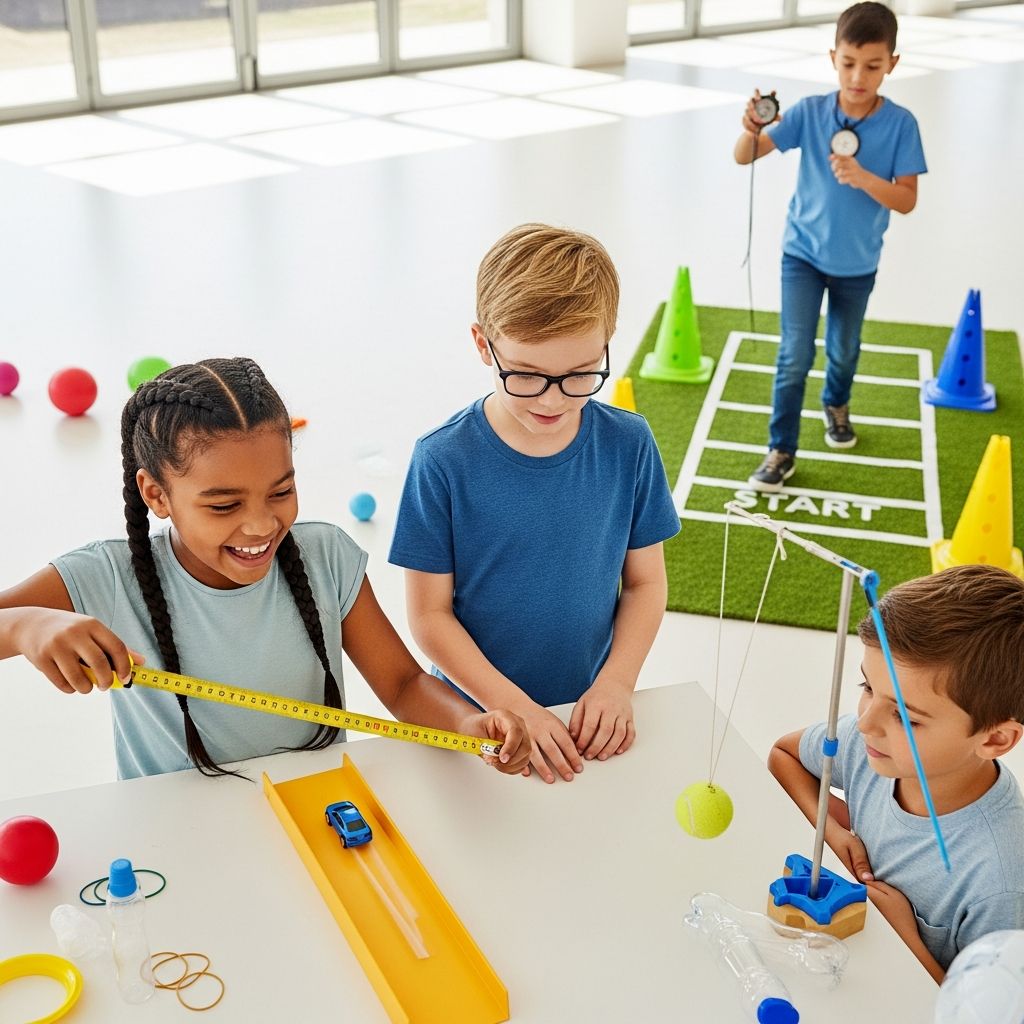
Bringing science to life through sports captivates young minds by turning playground favorites into laboratories of discovery. These experiments reveal the hidden physics in everyday athletic actions, from the arc of a soccer kick to the rebound of a basketball. Designed for children, students, and curious families, the activities use simple household items to demonstrate core concepts like force, friction, gravity, and human physiology. By participating, learners not only grasp scientific principles but also develop critical thinking and problem-solving skills applicable to real-world sports.
Why Sports Science Matters for Education
Sports science bridges the gap between abstract theory and tangible fun, making physics accessible. According to the National Science Teaching Association, hands-on experiments boost retention by up to 75% compared to lectures alone. In sports contexts, kids observe how Newton’s laws govern a ball’s trajectory or how muscles convert chemical energy into motion. These insights foster STEM interest, with studies from the American Association for the Advancement of Science showing that early exposure increases pursuit of science careers. Parents and teachers can adapt these for various ages, scaling complexity from basic observations for preschoolers to data analysis for middle schoolers.
Experiment 1: Supercharged Ball Bounce Energy Transfer
This classic demonstration showcases kinetic energy transfer using two balls of different sizes. It illustrates conservation of momentum and elasticity in collisions, key to understanding sports like basketball or tennis.
- Materials: Basketball (or large heavy ball), tennis ball (or small light ball), open outdoor space.
- Steps:
- Hold the tennis ball atop the basketball, gripping both securely.
- Drop them simultaneously from chest height onto a hard surface.
- Observe the tennis ball’s dramatic launch upward.
- Repeat 3-5 times, measuring the small ball’s peak height each time.
- What Happens: Upon ground impact, the basketball compresses and transfers most of its kinetic energy to the tennis ball via elastic collision, propelling it higher than a solo drop.
- Science Insight: Energy isn’t created or destroyed but shifts forms—potential to kinetic and back. Discuss: Why doesn’t the basketball bounce as high afterward?
Extensions: Test with other ball pairs (soccer and golf ball) and graph results in a table.
| Ball Pair | Solo Small Bounce (cm) | Stacked Bounce (cm) | Energy Gain (%) |
|---|---|---|---|
| Basketball + Tennis | 120 | 450 | 275 |
| Soccer + Golf | 30 | 200 | 567 |
Experiment 2: Friction’s Grip on Rolling Sports Balls
Explore how surface texture affects ball travel distance, mimicking soccer fields versus turf or basketball courts.
- Materials: Soccer ball, basketball, tennis ball, measuring tape, chalk, grass and concrete surfaces.
- Steps:
- Mark a 2-meter drop line perpendicular to each surface.
- Roll each ball with consistent force from the line.
- Measure stopping distance; average three trials.
- Switch surfaces and compare.
- Science Insight: Friction opposes motion; rough grass creates more drag than smooth concrete.
This reveals why athletes prefer certain pitches and trains observation skills. Variation: Add ramps for incline effects on acceleration.
Experiment 3: Build a Mini Catapult for Projectile Motion
Engineer a launcher from popsicle sticks to study parabolas and launch angles, akin to shot puts or javelin throws.
- Materials: 10 popsicle sticks, rubber bands, plastic spoon, small objects (pom-poms), protractor.
- Steps:
- Stack and bind sticks into a frame, attaching spoon as launcher.
- Pull back spoon, release at 30°, 45°, 60° angles.
- Measure projectile distance; plot trajectories.
- Science Insight: Optimal 45° angle maximizes range due to balanced horizontal/vertical velocity components.
Kids compete for longest throws, learning iteration through redesigns.
Experiment 4: Hockey Puck Speed and Surface Science
- Materials: DIY puck (bottle cap weighted), straws or rulers for mallet, smooth table, sandpaper patches.
- Steps:
- Build a mini rink; test puck speed across surfaces.
- Time travel over fixed distance; calculate velocity.
- Modify surfaces for friction variation.
- Science Insight: Low-friction ice enables high speeds in hockey; air cushions mimic this.
Experiment 5: Heart Rate Response to Exercise Intensity
Measure cardiovascular changes during sports-like activities to link biology with athletics.
- Materials: Stopwatch, heart rate monitor or pulse check, jump rope or dribble ball.
- Steps:
- Rest baseline pulse for 30 seconds.
- Dribble basketball vigorously for 2 minutes; recheck pulse.
- Rest, repeat with jumping jacks.
- Graph intensity vs. heart rate.
- Science Insight: Exercise boosts oxygen demand, elevating heart rate via aerobic respiration.
Experiment 6: Temperature’s Effect on Ball Performance
Test how cold alters football grip and bounce, relevant to outdoor sports.
- Materials: Football, ice bath, room-temp water, tape measure.
- Steps:
- Kick/pass room-temp ball 10 times, average distance.
- Chill ball 30 minutes; repeat.
- Compare accuracy and distance.
- Science Insight: Cold reduces air pressure inside, decreasing bounce and flight.
Experiment 7: Reaction Time and Sports Reflexes
Quantify how quickly athletes respond, vital for baseball swings or goalie saves.
- Materials: Ruler, partner, online reaction timer app.
- Steps:
- Drop ruler; catch it—distance correlates to time.
- Test pre/post exercise.
- Average 10 trials.
- Science Insight: Neural pathways and practice shave milliseconds off responses.
| Activity | Avg Reaction Time (ms) |
|---|---|
| Rest | 250 |
| Post-Sprint | 220 |
Experiment 8: Parachute Drag in Aerial Sports
Simulate skydiving or gliding with tissue parachutes to study air resistance.
- Materials: Tissue paper, string, washer, tape.
- Steps:
- Assemble varying sizes; drop from height.
- Time descent; note stability.
- Science Insight: Larger area increases drag force balancing gravity.
Experiment 9: Foot Size vs. Kicking Power
Investigate if larger feet generate more punt distance in football.
- Materials: Volunteers, football, tape measure, shoe size chart.
- Steps:
- Record shoe sizes; each punts 5 times.
- Correlate size with average distance.
- Science Insight: Longer levers amplify force, though technique matters more.
Experiment 10: Spin Dynamics with Tops or Beyblades
Analyze angular momentum in spinning toys akin to curveballs.
- Materials: Spinning tops/Beyblades, timer, varied surfaces.
- Steps:
- Spin each; time duration.
- Test surfaces; rank longevity.
- Science Insight: Friction dissipates rotational energy over time.
Frequently Asked Questions (FAQs)
What age group are these experiments best for?
Ideal for ages 6-14, with supervision for younger kids. Simplify measurements for beginners, add data analysis for older students.
Do I need special equipment?
No—most use household items like balls, tape, and timers. Substitutes work fine.
How can teachers integrate this into curriculum?
Align with physics units on motion/energy; assign reports graphing results.
Are these safe for indoor use?
Most yes, but use soft surfaces outdoors for drops/kicks to avoid damage.
Can we adapt for group settings?
Absolutely—rotate stations for classes, fostering teamwork in data collection.
References
- Guide to Sports Science for Children — Science Explorers. 2023-05-15. https://scienceexplorers.com/guide-to-sports-science-for-children/
- Football Science Fair Projects — Study.com Academy. 2024-02-10. https://study.com/academy/lesson/video/football-science-fair-projects.html
- 8 Fun and Exciting Sports Science Experiments — Education Corner. 2023-11-20. https://www.educationcorner.com/sports-science-experiments/
- Backyard Physics Experiments for Kids Who Love Sports — DIY.org. 2024-01-08. https://www.diy.org/blogs/backyard-sports-science-physics-experiments-kids
- 20 Sporty Science Activity Ideas for Kids — Science Sparks. 2023-07-12. https://www.science-sparks.com/sports-science/
- 12 Sports Science Research Projects Ideas — Polygence. 2024-03-05. https://www.polygence.org/blog/sports-science-project-ideas-for-high-school-students

- Integrated M.A. in Applied Linguistics, University of Hyderabad
- 5+ years in editorial, instructional, SEO, and research-based writing
Sneha is a relationships and lifestyle writer with a strong foundation in applied linguistics and certified training in relationship coaching. She brings over five years of writing experience to theskillvault, crafting thoughtful, research-driven content that empowers readers to build healthier relationships, boost emotional well-being, and embrace holistic living. Her writing and insights reflect the belief that beauty, happiness, and wellness…