
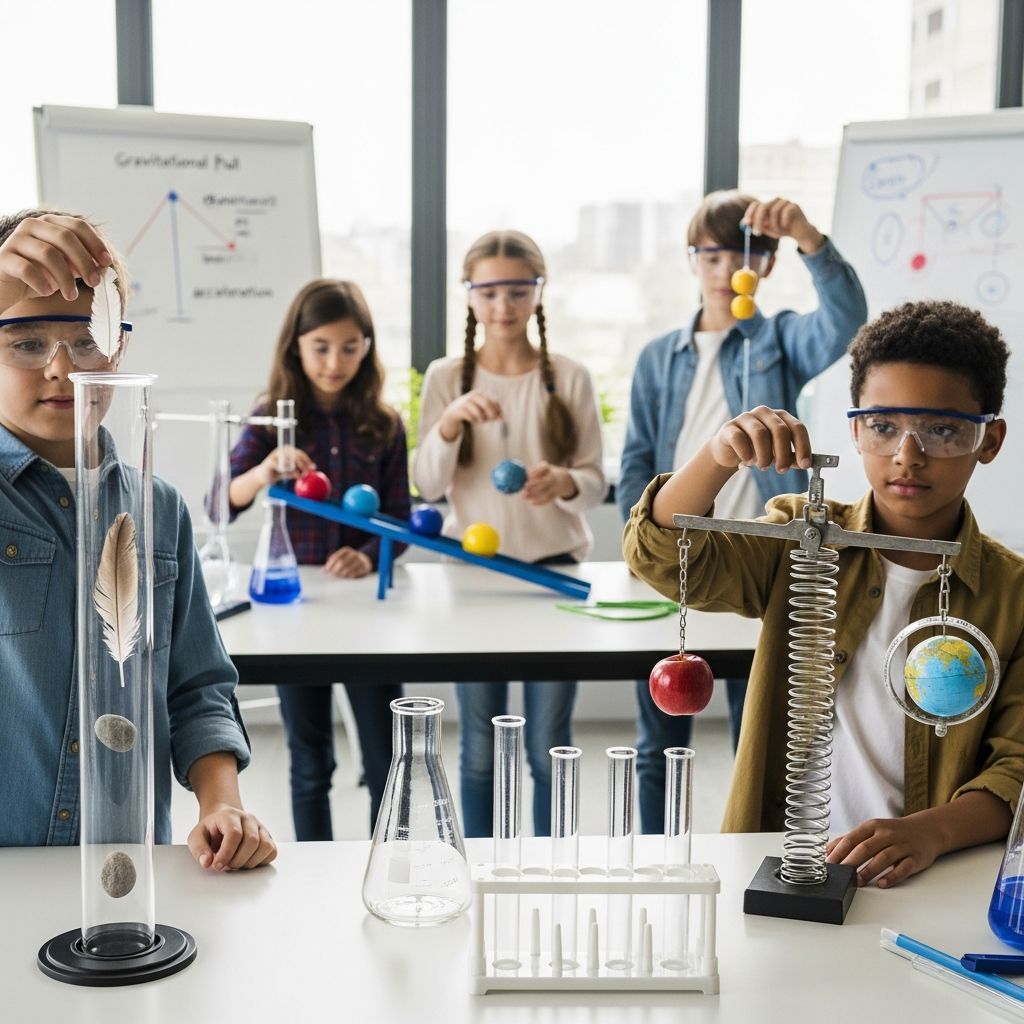
Introducing Gravity: The Force That Shapes Our World
Gravity is one of the most fundamental forces in physics, yet it remains invisible to the naked eye. Every object experiences its pull, from the smallest pebble to the largest celestial body. Understanding gravity requires more than reading definitions in textbooks; it demands observation, experimentation, and direct engagement with physical phenomena. When students participate in hands-on activities exploring gravitational forces, they develop intuitive comprehension that transcends memorization. These practical investigations transform abstract concepts into concrete experiences, allowing learners to witness gravity’s effects firsthand and develop genuine scientific curiosity about the natural world.
Why Physical Experimentation Matters in Science Education
Traditional classroom instruction often relies on lectures and diagrams to convey complex physics concepts. However, research in science education demonstrates that kinesthetic and visual learning experiences create stronger neural pathways for concept retention. When students manipulate objects, observe outcomes, and form hypotheses before testing them, they engage multiple learning modalities simultaneously. This multisensory approach proves particularly effective for younger learners who benefit from concrete demonstrations before abstract theoretical understanding. Experimentation also cultivates critical thinking skills, as students learn to question observations, identify variables, and draw evidence-based conclusions. Furthermore, hands-on activities maintain student engagement and motivation, transforming what might seem like intimidating physics into enjoyable discovery.
The Classic Demonstration: Simultaneous Falling Objects
One of history’s most important physics experiments involves comparing how objects of different masses fall. This investigation requires minimal materials: two objects with noticeably different weights, such as a small ball and a larger book, plus a safe elevated surface like a sturdy chair or step stool. The procedure is straightforward: hold both objects at identical heights and release them simultaneously. Students observe whether the lighter and heavier objects reach the ground at the same moment or if one falls faster than the other.
This experiment directly contradicts intuitive assumptions many students hold. Before conducting the experiment, most predict that the heavier object will fall faster. However, observation reveals that both objects strike the ground simultaneously, regardless of their mass differences. This discovery connects to fundamental principles established by Galileo and later formalized by Isaac Newton. The experiment demonstrates that gravity accelerates all objects toward Earth’s surface at the same rate, assuming air resistance effects are negligible. This counterintuitive finding becomes memorable precisely because it challenges students’ preconceptions and requires them to revise their understanding of how physics actually works.
Investigating Motion and Trajectory Through Projectiles
Another engaging category of gravity experiments involves launching objects at various angles and observing their flight paths. Paper airplanes provide an accessible entry point into this investigation. Students can construct airplanes using different designs—some with narrow wings, others with broad surfaces, and some with varied tail configurations. Launching these designs and observing how each follows a distinct trajectory reveals that gravity’s influence extends beyond simple vertical falling. The shape and weight distribution of an object affect how gravity pulls it downward while forward momentum carries it horizontally.
Similarly, straw rockets offer controlled projectile experimentation. By adjusting launch angles while keeping other variables constant, students discover that certain angles produce different flight distances. This hands-on experience introduces concepts of optimal trajectory and the relationship between angle, force, and gravitational pull. Students develop intuitive understanding of how gravity constantly acts on moving objects, continuously altering their paths from the moment of release until they return to Earth’s surface.
Exploring Impact and Protective Systems
The egg drop challenge represents a sophisticated gravity experiment that combines physics understanding with engineering design thinking. Students receive a raw egg and various construction materials including straws, rubber bands, tape, and newspaper. Their mission involves creating a protective container that will allow the egg to survive a drop from a specified height. This activity requires students to understand how gravity accelerates falling objects and how protective systems can distribute impact forces over extended time periods.
Successful egg containers typically incorporate cushioning materials that slow the egg’s descent and absorb impact force gradually rather than instantaneously. Students discover through experimentation that surface area matters—larger parachutes or cushioning systems slow descent more effectively than compact designs. This investigation demonstrates practical applications of gravitational principles and introduces students to force distribution and energy absorption concepts. The competitive nature of the challenge also motivates engagement, as students test their designs and learn from both successes and failures.
Analyzing Speed and Acceleration on Inclined Planes
Racing experiments conducted on ramps constructed from boards or stacked books provide insights into how gravity influences acceleration. By releasing different objects—marbles, toy cars, or other rolling items—from the top of an incline, students observe variations in speed and arrival times. Objects with different masses may reach the bottom at different times despite gravity’s constant acceleration, due to factors like friction and air resistance. Students can vary the ramp’s angle, surface texture, or object properties to investigate how each factor influences results.
This experimental category directly engages students in controlled variable testing. By holding some factors constant while deliberately changing others, learners develop scientific methodology skills alongside physics understanding. They learn that gravity works in concert with other forces and that comprehensive understanding requires considering multiple variables simultaneously. Recording data and creating visual representations like graphs helps students identify patterns and relationships between variables.
Deceleration and Air Resistance Through Parachute Design
Parachutes represent an elegant way to investigate how objects can manipulate gravity’s effects through air resistance. Students can construct simple parachutes using tissue paper, coffee filters, or fabric scraps attached to small weights via strings. Dropping these creations from elevated positions reveals how parachute surface area affects descent speed. Larger parachutes catch more air and descend more slowly, while smaller versions fall more rapidly.
This experimentation connects gravitational physics to real-world applications in skydiving, spacecraft recovery, and emergency safety systems. Students develop appreciation for how scientific understanding enables technological innovation. The visual drama of watching parachutes deploy and gently descend maintains student engagement while reinforcing concepts about force, resistance, and acceleration. Students can modify parachute designs and test variables systematically, discovering which design elements most effectively slow descent.
Center of Mass and Balance Investigations
Gravity experiments need not involve falling or motion; they can also investigate equilibrium and balance. By suspending various objects from support structures and adding weights at different positions, students explore center of mass concepts. Activities involving balancing objects on fingers, creating hanging sculptures, or constructing balance beam demonstrations reveal that gravity acts through a specific point on each object called the center of mass or center of gravity.
Understanding center of mass connects abstract gravitational concepts to tangible physical phenomena students can observe and manipulate directly. Students discover that objects balance differently depending on their mass distribution and that gravitational force effectively acts through the center of mass point. This investigation develops spatial reasoning alongside physics understanding and demonstrates why certain objects balance easily while others seem unstable.
Classroom Implementation Strategies
Effective gravity experimentation requires thoughtful classroom setup and management. Teachers should ensure all activities prioritize student safety, particularly when working at heights or with delicate materials. Organizing students into small groups allows multiple teams to conduct simultaneous experiments, maximizing engagement and observation opportunities. Providing structured recording sheets helps students document observations systematically and develop data analysis skills. Pre-experiment discussions where students make predictions create cognitive investment in outcomes, while post-experiment discussions help students interpret results and connect observations to broader physics principles.
Differentiating activities to match student ability levels ensures all learners remain appropriately challenged. Advanced students might design modified experiments or investigate additional variables, while students requiring support benefit from simplified procedures or additional guidance. Connecting experimental discoveries to real-world applications helps students appreciate physics relevance beyond classroom contexts.
Materials and Resource Considerations
Most effective gravity experiments utilize everyday materials readily available in classrooms, homes, or through inexpensive purchases. Common items serving as experiment materials include:
- Balls of various sizes and materials
- Books and paper products
- Wooden boards and ramps
- String, rubber bands, and tape
- Containers and household items
- Timing devices for measurement
- Recording materials for data collection
This accessibility ensures that budget constraints need not limit experimental opportunities. Teachers can prepare materials in advance or involve students in gathering supplies, which itself becomes part of the learning experience. Digital tools including video recording capabilities and slow-motion playback enhance observation precision, allowing students to capture and review rapid phenomena more carefully than possible with naked-eye observation alone.
Connecting Experiments to Broader Physics Concepts
Individual gravity experiments gain power when teachers help students connect findings to larger physics frameworks. Observations about falling objects relate to Newton’s laws of motion, concepts about mass and force, and mathematical relationships between acceleration and time. Trajectory experiments demonstrate how gravity acts perpendicular to an object’s horizontal motion. Air resistance investigations introduce concepts about friction and drag forces. Center of mass explorations connect to equilibrium and stability principles. When students see how individual experiments represent applications of unified physics principles, their understanding deepens and becomes more organized.
Assessment Approaches for Gravity Learning
Teachers can assess gravity understanding through multiple approaches beyond traditional written tests. Observing student predictions before experiments and comparing them to actual results reveals developing conceptual understanding. Student explanations of why certain experimental outcomes occurred demonstrate reasoning capacity. Designing modifications to existing experiments or predicting results of novel situations indicates transferable understanding. Group discussions about experimental results reveal both individual comprehension and collaborative problem-solving abilities. Documentation through drawings, written descriptions, or verbal explanations accommodates diverse learning preferences and communication strengths.
Frequently Asked Questions About Gravity Experiments
Q: Why do different objects fall at the same speed if gravity pulls harder on heavier things?
A: Gravity pulls harder on heavier objects, but they also have more mass to accelerate. These effects exactly balance, resulting in identical acceleration rates regardless of mass. This principle, discovered by Galileo and formalized by Newton, represents one of physics’ most elegant findings.
Q: How can parachutes slow falling objects if gravity continues pulling downward?
A: Parachutes don’t counteract gravity; instead, they increase air resistance. The larger surface area catches air, creating an upward force that opposes gravity’s downward pull. When air resistance nearly balances gravitational force, objects descend slowly but still continue falling.
Q: What’s the difference between mass and weight in gravity experiments?
A: Mass describes the amount of material in an object, while weight describes the gravitational force acting on that mass. On Earth, weight = mass × gravitational acceleration. This distinction becomes significant when comparing gravity’s effects across different contexts.
Q: Can gravity experiments conducted indoors differ from outdoor experiments?
A: Yes, significantly. Indoor environments minimize wind effects and air movement variations, while outdoor settings introduce these variables. Controlled indoor experiments often produce more consistent results, though outdoor experiments demonstrate how gravity operates within real-world complexity.
Q: How do gravity experiments prepare students for higher physics courses?
A: Hands-on gravity investigations build intuitive understanding of forces, acceleration, and mathematical relationships. This foundation proves essential for understanding more advanced concepts including energy, momentum, and orbital mechanics in subsequent physics courses.
References
- Easy Gravity Experiments For Kids — Little Bins for Little Hands. 2024. https://littlebinsforlittlehands.com/gravity-experiments/
- Gravity Experiments for Kids – Galileo and Isaac Newton — Science Sparks. 2022. https://www.science-sparks.com/gravity-experiments-for-kids-galileo/
- 5 Ideas for Teaching Gravity in 3rd, 4th, and 5th Grade — The Science Penguin. 2023. https://thesciencepenguin.com/2023/08/5-ideas-for-teaching-gravity.html
- Gravity Lesson Plans – Science Lessons That Rock — Science Lessons That Rock. 2024. https://sciencelessonsthatrock.com/gravity-lesson-plans/
- Gravity and Falling Objects — PBS LearningMedia. 2024. https://www.pbslearningmedia.org/resource/phy03.sci.phys.mfe.lp_gravity/gravity-and-falling-objects/

Medha Deb is an editor with a master's degree in Applied Linguistics from the University of Hyderabad. She believes that her qualification has helped her develop a deep understanding of language and its application in various contexts. Medha specializes in the areas of beauty, health, sports, and wellness and is committed to ensuring that the content on the website is…