
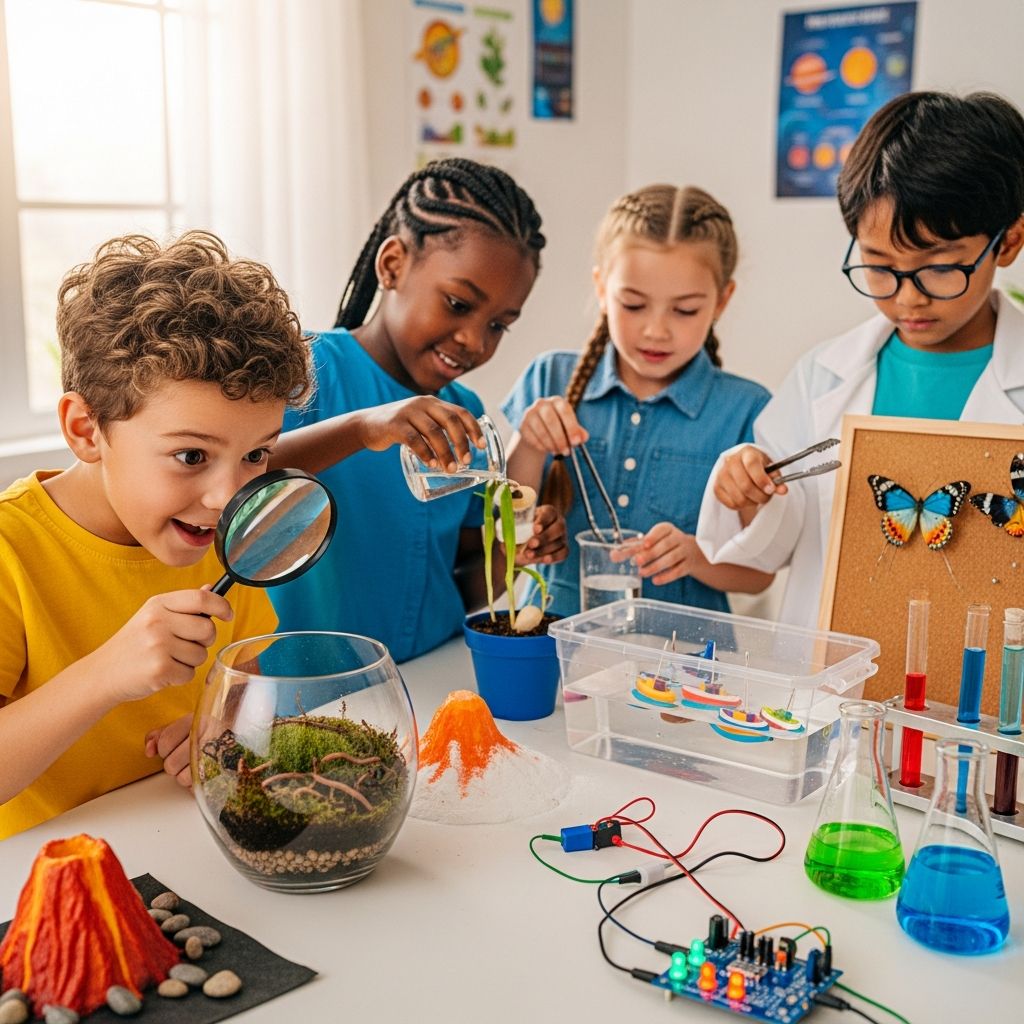
Building Scientific Foundations in Early Childhood
Science education doesn’t have to begin in elementary school. Young children are naturally curious about the world around them, and preschool provides the ideal setting to nurture that inquisitiveness through purposeful, age-appropriate activities. Research consistently shows that early exposure to scientific thinking helps children develop critical observation skills, problem-solving abilities, and a genuine enthusiasm for discovery that extends throughout their educational journey.
When science activities are designed for preschoolers, the focus shifts from memorizing facts to experiencing concepts through direct interaction. This play-based approach allows children to explore cause-and-effect relationships, test predictions, and make meaningful observations—all while having fun. By incorporating simple experiments into the classroom or home environment, educators and parents can create rich learning opportunities that align with how young children naturally learn: through hands-on exploration and sensory engagement.
The Science Behind Density and Buoyancy Investigations
Understanding how and why objects behave differently in water is one of the most accessible introductions to physical science for preschoolers. When children predict whether an object will sink or float, they engage in the scientific method without formal instruction. This classic investigation requires minimal preparation: simply gather various household items—plastic toys, wooden blocks, metal utensils, rubber balls—and a clear container of water.
Before introducing any object to the water, ask children to make predictions. This step is crucial because it encourages them to think critically and make observations based on their prior experience. As each item enters the water, children witness the outcome and have the opportunity to revise their understanding. Through repeated trials, they begin to recognize patterns: heavier items don’t always sink, and shape sometimes matters more than weight.
An extension of this fundamental concept involves exploring floating eggs through density variation. By preparing several glasses filled with different solutions—plain tap water, saltwater, and sugar water—children observe that the same egg behaves differently depending on the water’s density. This visual demonstration makes an abstract concept concrete and memorable, establishing foundational understanding for more advanced physics concepts encountered later.
Exploring Chemical Reactions Through Color and Transformation
Chemical reactions fascinate preschoolers because they produce immediate, visible changes. The combination of baking soda and vinegar creates dramatic fizzing and foaming that captures attention while introducing the concept of acid-base reactions in the simplest possible terms.
One engaging variation involves filling muffin tins with different food coloring drops and covering each with baking soda. When children squirt vinegar onto each cup, the reaction creates colorful, foamy reactions that shift their understanding from “stuff just happens” to “my actions cause specific results.” This cause-and-effect learning is foundational to scientific thinking.
Another visually stimulating activity involves observing how food coloring diffuses through water. Using simple materials like Skittles candy arranged on a plate with warm water poured in the center, children watch colors bloom and merge. This demonstrates diffusion principles while creating an artistic outcome that reinforces their engagement. The combination of science and art appeals to young learners’ multiple intelligences and keeps their attention sustained.
Surface Tension and Molecular Interactions Made Visible
The behavior of liquids offers rich opportunities for exploration and wonder. The classic “magic milk” experiment combines milk, food coloring, and dish soap to create swirling, colorful patterns that seem almost magical to young observers. The experiment works because dish soap reduces the surface tension of milk, causing the food coloring to move rapidly across the surface.
Children don’t need to understand the molecular explanation to benefit from this activity. What matters is that they observe the phenomenon, make predictions about what will happen next, and discuss their observations with peers and adults. Over time, repeated exposure to such activities builds intuitive understanding of how liquids behave.
The oil-and-water experiment provides another accessible exploration of immiscibility and density. When oil and water are combined in a jar and shaken, they initially mix but quickly separate, with oil rising above the water. This demonstration helps children understand that not all liquids blend together and introduces the concept of density differences without formal instruction.
Observing Life Cycles and Biological Processes
Living systems captivate preschoolers, and simple activities involving plants and organisms provide windows into biological science. Growing seeds in clear containers allows children to observe roots developing downward and shoots reaching upward—direct evidence of plant growth that children can witness over days and weeks.
Similarly, observing insects and birds in natural settings connects children to ecology and animal behavior. Building simple bird feeders from recycled materials and observing visiting species teaches about habitats, adaptation, and the interconnectedness of organisms. These observations ground scientific concepts in children’s direct experience of the natural world.
Hatching-themed activities, such as the “dinosaur egg” experiment using baking soda and vinegar, combine paleontology interest with chemical reaction demonstrations. Children use pipettes to apply vinegar to baking soda “eggs,” observing the reaction while retrieving small hidden objects—making the experiment both scientifically engaging and playfully imaginative.
Capillary Action and Water Movement Demonstrations
The “walking rainbow” experiment showcases capillary action in a way that’s both beautiful and comprehensible to young learners. By connecting paper towels between glasses of colored water, children observe as colors travel along the paper towels and begin mixing. This visual demonstration of water’s movement through materials introduces fundamental concepts in plant biology—how plants draw water from soil through their roots and up to leaves and flowers.
This activity requires only paper towels, water, and food coloring, making it accessible in any setting. The extended timeline (several hours or overnight) allows children to check progress periodically, building anticipation and sustaining engagement over time.
Absorption and Material Properties Investigation
Understanding different material properties—which items absorb water, which repel it, which dissolve—builds children’s recognition that materials behave differently. Experiments exploring absorption can use everyday items like sponges, paper towels, cloth, and plastic. By placing water on different materials and observing how quickly it’s absorbed or repelled, children make direct observations about material properties.
Advanced variations might involve exploring super-absorbent polymers, such as those found in diapers, which can absorb many times their weight in liquid. When water is added to these crystals, they expand dramatically, transforming from a small crystal to a gel-like substance. This dramatic transformation maintains children’s interest while introducing polymer chemistry at an accessible level.
Sound, Light, and Energy Exploration
Preschool science extends beyond traditional chemistry and biology into physics concepts involving sound and light. Creating simple musical instruments from household items—filling bottles with different water levels to create different pitches—demonstrates how vibration creates sound and how different frequencies produce different tones.
Light exploration can include using prisms to create rainbows, observing shadows, or exploring fluorescence with glow-sticks or highlighter-ink solutions under black light. These activities make energy concepts visible and tangible, helping young learners recognize that light and sound are phenomena they can observe and manipulate.
Creating a Supportive Environment for Scientific Inquiry
The success of preschool science activities depends significantly on the learning environment. Adults should approach these experiences with genuine curiosity, asking open-ended questions rather than providing immediate answers. Questions like “What do you notice?” “What happens if we try this differently?” and “What do you think will happen next?” encourage children to observe carefully and think critically.
Materials should be accessible, allowing children to repeat experiments and try variations independently. Documentation through photos or drawings helps children reflect on their observations and creates records of their scientific thinking over time.
Connecting Experiments to Everyday Observations
The most powerful science education connects laboratory activities to children’s everyday experiences. A sink-or-float experiment connects to bath time. An exploration of color diffusion connects to painting and food preparation. By helping children recognize that scientific principles operate constantly in their daily lives, educators deepen understanding and foster appreciation for science as a lens for understanding the world rather than something separate from real life.
Frequently Asked Questions
Q: Are these experiments safe for preschool-aged children?
A: Most experiments recommended for preschoolers use common household materials and are inherently safe. However, adult supervision is essential, and certain precautions should be taken—for example, wearing eye protection during vinegar-and-baking-soda reactions, ensuring small objects are too large to be choking hazards, and preventing accidental ingestion of materials.
Q: How long should a typical preschool science activity last?
A: Most preschoolers maintain engaged focus for 10–20 minutes on a single activity. Many experiments naturally align with this timeframe. However, some activities like seed germination or the walking rainbow benefit from extended observation periods spread across days, maintaining engagement through periodic check-ins rather than continuous focus.
Q: What if children don’t seem interested in the planned experiment?
A: Children’s interests vary, and flexibility is important. If an experiment isn’t capturing attention, it’s acceptable to pause and try something different. Sometimes returning to an activity at a later time results in greater engagement. The goal is fostering curiosity, not forcing compliance.
Q: Can these activities be modified for children with different developmental levels?
A: Absolutely. Most experiments can be simplified or extended. For younger preschoolers, focus on sensory observation. For older preschoolers approaching kindergarten, introduce vocabulary and encourage more detailed predictions and discussions. The core concept remains the same while the complexity of engagement adjusts.
Q: How do I document children’s learning during these activities?
A: Documentation can include photographs, video clips, drawings by children, or written observations by adults. These records help children reflect on their discoveries and provide valuable assessment information showing how scientific thinking develops over time.
References
- 20 Science Activities for Preschoolers — Bright Horizons. 2024. https://www.brighthorizons.com/article/education/science-for-preschoolers
- Preschool Science Experiments for Play-Based Learning — Accelerate Learning. 2024. https://blog.acceleratelearning.com/7-easy-science-experiments-for-preschoolers
- 25 Fun, Easy and Engaging Science Activities for Preschoolers — STEAM Powered Family. 2024. https://www.steampoweredfamily.com/preschool-science/
- 21 Easy Preschool Science Activities and Experiments [2026 Guide] — My Bright Wheel. 2026. https://mybrightwheel.com/blog/science-activities-for-preschoolers
- 58 Easy and Fun Science Activities for Preschool — We Are Teachers. 2024. https://www.weareteachers.com/preschool-science/
- 9 Preschool Science Activities and Experiments — Famly. 2024. https://www.famly.co/us/blog/preschool-science-activities-and-experiments

- Integrated M.A. in Applied Linguistics, University of Hyderabad
- 5+ years in editorial, instructional, SEO, and research-based writing
Sneha is a relationships and lifestyle writer with a strong foundation in applied linguistics and certified training in relationship coaching. She brings over five years of writing experience to theskillvault, crafting thoughtful, research-driven content that empowers readers to build healthier relationships, boost emotional well-being, and embrace holistic living. Her writing and insights reflect the belief that beauty, happiness, and wellness…