
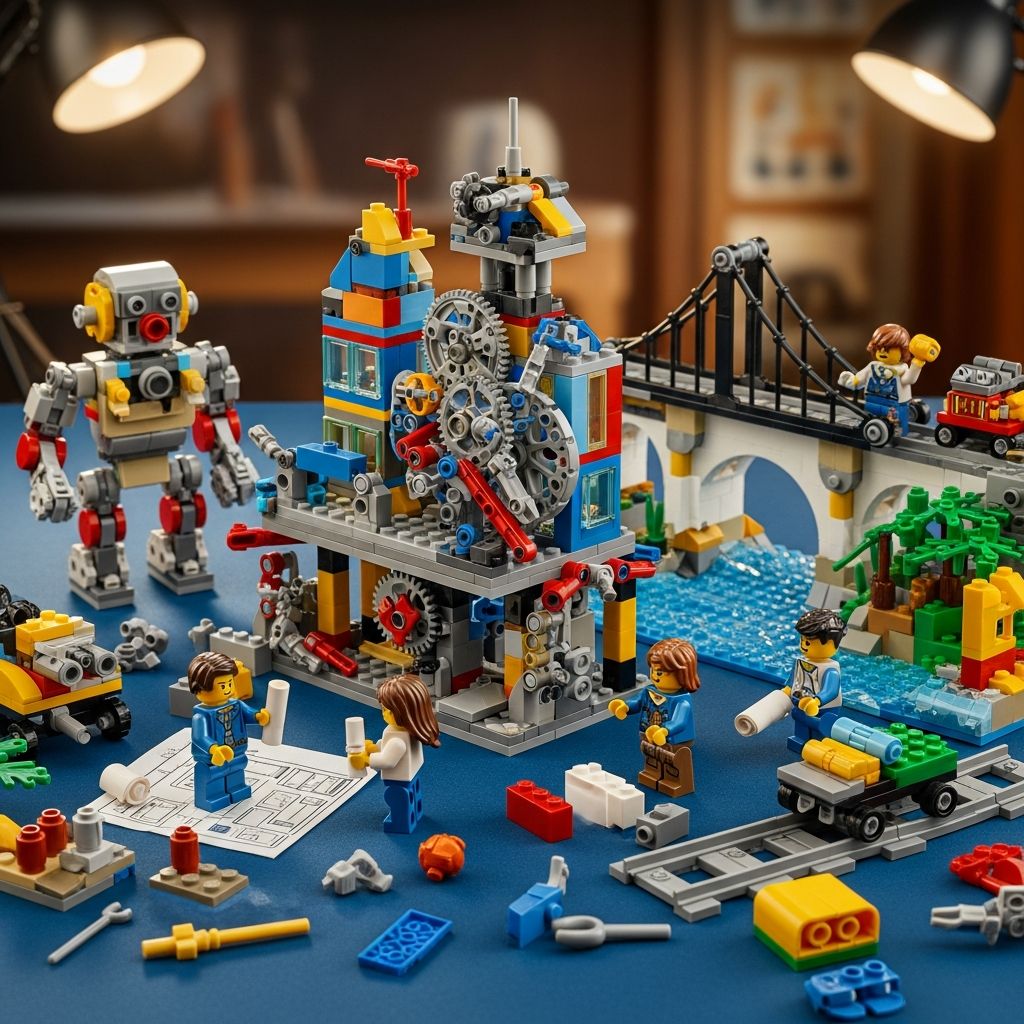
LEGO bricks have evolved far beyond simple toys, becoming instrumental in cultivating vital cognitive abilities. Hands-on construction with these versatile blocks encourages children to experiment, iterate, and innovate, laying the groundwork for advanced thinking skills essential in today’s dynamic world.
The Science Behind LEGO’s Cognitive Boost
Engaging with LEGO stimulates multiple brain regions simultaneously. Building requires planning, visualization, and adjustment, which activate areas responsible for executive function and spatial reasoning. Research shows that such tactile activities enhance neural connections, improving overall mental agility.
For young minds, this play translates into tangible gains. Preschoolers develop critical thinking by predicting outcomes and testing hypotheses with bricks, while school-aged children refine logical reasoning through structured challenges. Even adults benefit, as LEGO Serious Play methodologies promote flexible thinking and break mental rigidities.
Mastering Problem-Solving Through Trial and Iteration
At the heart of LEGO’s value lies its promotion of iterative problem-solving. Children encounter failures—like unstable towers or mismatched pieces—and learn to diagnose issues and redesign. This mirrors real-world engineering, where resilience is key.
- Planning Phase: Kids sketch mental blueprints, fostering foresight.
- Execution and Testing: Structures are built and stress-tested for stability.
- Refinement: Adjustments based on feedback build perseverance.
Camps and workshops amplify this by introducing constraints, such as limited bricks, compelling creative resourcefulness. Participants report heightened confidence in tackling complex tasks after repeated successes born from persistence.
Spatial Intelligence: Building a 3D Worldview
LEGO demands three-dimensional thinking, sharpening spatial awareness crucial for fields like architecture and engineering. Manipulating pieces to achieve balance and proportion intuitively teaches geometry and physics principles without formal instruction.
| Skill Developed | LEGO Activity Example | Real-World Application |
|---|---|---|
| Symmetry and Balance | Constructing bridges or vehicles | Structural engineering |
| Proportions and Scale | Replicating cityscapes | Architectural design |
| Connectivity | Assembling mechanisms with gears | Mechanical systems |
These experiences cultivate an innate understanding of how elements interconnect, proven to boost performance in STEM subjects.
Fueling Imagination with Open-Ended Exploration
Unlike rigid puzzles, LEGO’s modularity invites boundless creativity. Children invent worlds, from alien planets to historical reenactments, weaving narratives that demand inventive solutions. Role-playing with minifigures enhances empathy and scenario planning.
This freedom nurtures divergent thinking—the ability to generate novel ideas. Educators note that students exposed to such play excel in brainstorming sessions, approaching challenges with fresh perspectives.
Teamwork and Communication in Collaborative Builds
Group activities elevate LEGO’s impact, transforming solitary play into social learning. Teams negotiate designs, delegate roles, and resolve conflicts, honing interpersonal skills vital for professional success.
In LEGO Serious Play sessions, individuals first model personal ideas before merging them collectively, ensuring diverse voices contribute to unified solutions. This method, used in business training, builds consensus and innovative synergy.
Age-Specific Benefits: From Toddlers to Teens
Early Years: Foundations of Fine Motor and Logic
Toddlers with DUPLO sets grasp cause-and-effect, sorting bricks by shape and color while strengthening hand-eye coordination. Simple stacking introduces basic physics, sparking curiosity about motion.
School Age: Engineering and Strategy
Elementary students tackle guided challenges like pulley systems, embedding engineering concepts playfully. Summer camps emphasize redesign cycles, ingraining grit.
Teens and Beyond: Professional Skill-Building
High schoolers apply LEGO to entrepreneurship simulations, modeling business models and pitching ideas. Adults use it for stress relief and ideation in corporate workshops.
Practical Activities to Try at Home or School
- Brick Limitation Challenge: Use 25 pieces to create a functional vehicle. Discuss trade-offs and innovations.
- Story Build Relay: Groups add one element per turn to a shared narrative structure, promoting adaptability.
- Engineering Quest: Design a tower withstand 10-story height with household weights atop.
- Future City Planning: Collaborate on sustainable urban models incorporating green tech.
These exercises require minimal setup, yielding profound developmental returns.
Evidence from Educational Programs
Programs like brickLAB camps demonstrate measurable improvements in analytical and research skills post-participation. University instructors integrate LEGO Serious Play to enhance graduate-level collaboration. Official LEGO resources advocate these methods for holistic growth.
Frequently Asked Questions
Can LEGO help shy children develop social skills?
Yes, collaborative builds provide low-pressure interaction venues, gradually building confidence through shared successes.
Is LEGO beneficial for children with learning differences?
Absolutely; its multisensory approach aids focus and comprehension, adaptable to individual paces.
How much time should be dedicated to LEGO play weekly?
Aim for 1-2 hours, balancing structured challenges with free exploration for optimal skill development.
Does LEGO play translate to better academic performance?
Studies link it to gains in math, science, and critical thinking, with participants showing improved test scores.
Are there adult LEGO programs for professional growth?
LEGO Serious Play certifications offer workshops for teams seeking innovation boosts.
Overcoming Common Challenges in LEGO Learning
Parents may worry about mess; storage solutions and designated zones mitigate this. For frustration, guide without dictating, emphasizing process over perfection. Sourcing bricks affordably via second-hand markets expands access.
In classrooms, time management ensures inclusivity. Differentiate by offering varied complexity levels, keeping all engaged.
The Long-Term Impact: Lifelong Innovators
LEGO alumni often pursue creative careers, crediting early play for their adaptability. By embedding perseverance and ingenuity young, it equips generations for uncertainty.
Incorporate LEGO routinely to unlock potential. Its simplicity belies profound influence on thinkers and doers alike.
References
- Unlock Creativity and Problem-Solving with LEGO® Serious Play — EI Exchange. 2023. https://eiexchange.com/content/unlock-creativity-and-problem-solving-with-lego-serious-plan
- How LEGO Creative Play Builds Engineering Skills in Kids — brickLAB. 2023. https://mybricklab.com/how-lego-creative-play-builds-engineering-skills-in-kids/
- How LEGO Camps Improve Problem-Solving Skills in Children — Super Science for Kids. 2023. https://www.superscienceforkids.com/lego-camps-improve-children-problem-solving-skills/
- How LEGO® Can Inspire Creativity, Ingenuity, and a Passion for Architecture — Higginson Architects. 2023. https://www.higginsonarchitects.com/post/how-lego-can-inspire-creativity-ingenuity-and-a-passion-for-architecture
- How Imaginative Play Helps Your Child Learn and Grow — LEGO.com. 2023. https://www.lego.com/en-de/preschool/article/learn-and-grow-with-imaginative-play
- Improving Kids’ Problem-Solving Skills — LEGO.com. 2023. https://www.lego.com/en-us/themes/duplo/article/improving-kids-problem-solving-skills
- U of A experts discuss LEGO’s impact on adults — University of Arizona News. 2023. https://news.arizona.edu/employee-news/building-flexible-and-creative-mindset-u-experts-discuss-legos-impact-adults

- Integrated M.A. in Applied Linguistics, University of Hyderabad
- 5+ years in editorial, instructional, SEO, and research-based writing
Sneha is a relationships and lifestyle writer with a strong foundation in applied linguistics and certified training in relationship coaching. She brings over five years of writing experience to theskillvault, crafting thoughtful, research-driven content that empowers readers to build healthier relationships, boost emotional well-being, and embrace holistic living. Her writing and insights reflect the belief that beauty, happiness, and wellness…