
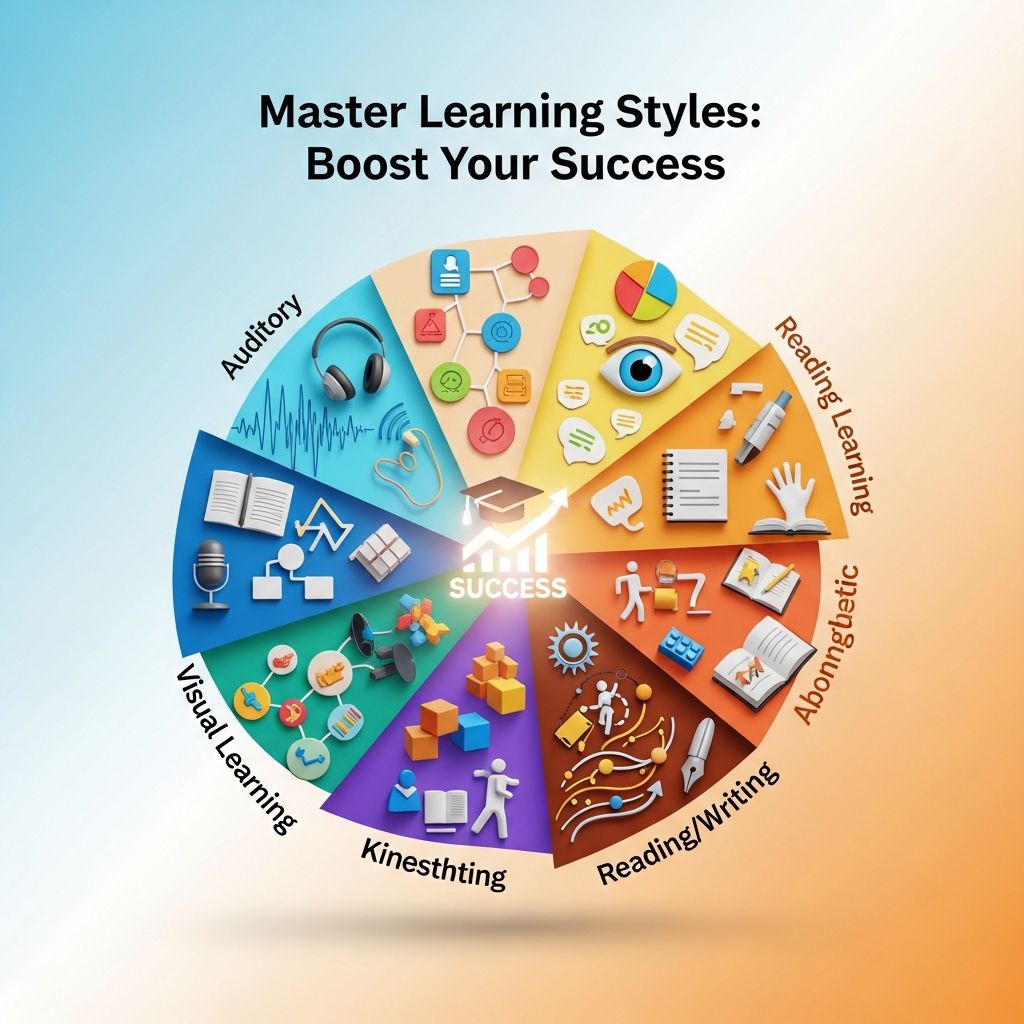
Understanding how you best absorb and process information can transform your educational journey and personal development. Learning styles refer to the preferred methods individuals use to take in new knowledge, such as through sight, sound, reading, or physical activity. By identifying your dominant style, you can adopt targeted strategies that make studying more efficient and enjoyable.
Research shows that aligning study techniques with personal preferences enhances comprehension and long-term retention, though experts emphasize flexibility across styles for optimal results. This guide delves into the primary learning styles, offers practical tips, and explores advanced applications to help you thrive in any learning environment.
Core Learning Styles Explained
The VARK model, developed by Neil Fleming, categorizes learners into four main types: Visual, Aural (Auditory), Read/Write, and Kinesthetic. Most people exhibit a blend, known as multimodal, requiring a combination of approaches. Recognizing these helps educators and self-learners customize methods effectively.
- Visual Learners: Thrive on images, diagrams, and spatial arrangements. They grasp concepts faster when information is presented graphically.
- Auditory Learners: Excel through listening, discussions, and verbal repetition. Sound-based input solidifies their understanding.
- Read/Write Learners: Favor text-based materials, note-taking, and written summaries. Interacting with words on paper or screens suits them best.
- Kinesthetic Learners: Learn optimally via hands-on experiences, movement, and practical application. Physical engagement drives their retention.
These categories aren’t rigid; preferences can shift with context, age, or subject matter. For instance, chemistry might demand kinesthetic experiments regardless of preference.
Identifying Your Personal Learning Style
Self-awareness is the first step. Free online quizzes based on VARK or tools like Kolb’s Learning Style Inventory or the Solomon-Felder Index provide quick insights. Observe your habits: Do you doodle during lectures (visual)? Recall podcasts verbatim (auditory)? Prefer rewriting notes (read/write)? Or fidget to focus (kinesthetic)?
Reflect on past successes. A student excelling in art classes but struggling with rote memorization might lean visual. Track performance across methods—experiment with varied techniques and note what yields better recall. Teachers can use progress reports to spot patterns in class.
| Learning Style | Common Indicators | Quick Test Activity |
|---|---|---|
| Visual | Remembers faces over names; sketches ideas | Create a mind map of a recent lesson |
| Auditory | Sings along to remember lyrics; talks through problems | Record and replay your explanations |
| Read/Write | Loves lists and bullet points; underlines texts | Summarize a chapter in your own words |
| Kinesthetic | Learns by doing; paces while thinking | Build a model or role-play the concept |
This table offers a starting point for diagnosis. Combine results from multiple assessments for accuracy, as individuals often blend styles.
Tailored Strategies for Visual Learners
Visual learners, comprising about 65% of the population, benefit from graphical tools. Use highlighters, flowcharts, and videos to organize data. Color-coding notes draws attention to key points, while concept maps link ideas visually.
In practice, watch educational YouTube channels or TED Talks with subtitles. For exams, convert formulas into infographics. Apps like Canva or MindMeister facilitate custom visuals. Avoid dense text; pair it with images for reinforcement.
- Flashcards with pictures on one side.
- Diagrams for processes like the water cycle.
- Virtual tours or simulations for history/geography.
These methods leverage the brain’s strength in pattern recognition, boosting memory by up to 40% in studies.
Effective Techniques for Auditory Learners
Auditory learners process information through ears. Engage podcasts, audiobooks, and group discussions. Repeat concepts aloud or teach peers to solidify knowledge. Record lectures for playback during commutes.
Rhythms aid recall—turn facts into songs or rhymes. Join study groups for verbal debates. Tools like Otter.ai transcribe talks while preserving audio. Minimize silent reading; narrate texts instead.
- Listen to mnemonic jingles for dates/formulas.
- Debate topics in forums or with voice notes.
- Use language apps with speech recognition.
Such approaches enhance verbal processing, ideal for languages or public speaking.
Optimizing for Read/Write Learners
These learners excel with written words. Take detailed notes, rewrite summaries, and create lists. Dictionaries and glossaries are allies; outline essays before drafting.
Print handouts for annotations. Use planners for structured review. Blogs or journaling processes ideas deeply. Convert audio to text via apps like Rev for hybrid use.
- Bullet-point study guides.
- Written reflections post-lecture.
- Quizzes with self-written questions.
This style suits law or literature, emphasizing precision through writing.
Hands-On Success for Kinesthetic Learners
Kinesthetic types need action. Build models, role-play scenarios, or use manipulatives. Study while walking or squeezing stress balls to maintain focus.
Labs, field trips, and simulations engage them. Apps like Merge Cube offer tactile AR. Teach by demonstrating—kinesthetics retain 75% more via practice.
- Flashcards handled physically.
- Group projects with building tasks.
- Standing desks for movement.
Pair with timers for short, active bursts to combat distraction.
Embracing Multimodal Learning Approaches
Most are multimodal, blending 2+ styles. Combine methods: Visual-auditory via captioned videos; read/write-kinesthetic through annotated models. Balance prevents over-reliance on one mode.
Educators should vary lessons—lectures with visuals, discussions with activities—to address all. Felder notes optimal instruction mixes preferences, building weaker skills.
Practical Applications in Classrooms and Workplaces
Teachers experiment with methods, assessing via quizzes. Differentiated instruction uses tech aids and groups. Workplaces apply this in training: Videos for visuals, workshops for kinesthetics.
Online courses benefit—platforms like Coursera offer multimodal content. Adults adapt for career growth, like auditory podcasts for commuters.
Debunking Myths and Scientific Perspectives
The ‘meshing hypothesis’—matching style to instruction boosts outcomes—lacks strong evidence. Rogowsky et al. found no comprehension edge from matching. Universal strategies often outperform style-specific ones.
Still, preferences guide engagement. Focus on evidence-based practices: Spaced repetition, active recall, regardless of style.
Frequently Asked Questions
What if I’m a mix of learning styles?
Multimodal learners should experiment with combinations, prioritizing top preferences while developing others for versatility.
Can learning styles change over time?
Yes, experiences and contexts influence shifts; reassess periodically.
Do learning styles apply only to students?
No, professionals use them for training, skill-building, and self-improvement.
How do teachers implement this?
Via diverse activities, assessments tracking engagement, and tools like VARK quizzes.
Are there free tools to test my style?
Yes, VARK questionnaire and similar online inventories are accessible.
Building Lifelong Learning Habits
Integrate styles into routines: Weekly reviews mixing methods. Track progress in a journal. Stay engaged—gamify studies with apps. Adapt to challenges, like using visuals for auditory-weak subjects.
Ultimately, flexibility trumps fixation. Blend styles, leverage strengths, and cultivate growth mindset for enduring success.
References
- Teaching different types of learning styles & how to teach to them — Lynn University Online. 2023-10-15. https://online.lynn.edu/resources/education/teaching-different-learning-styles
- Understanding Learning Styles in Education — Tulane University. 2024-02-20. https://masterofed-sopa.tulane.edu/articles/learning-styles-in-education/
- Study More Effectively by Understanding Your Learning Style — Penn State World Campus. 2023-05-10. https://student.worldcampus.psu.edu/blog/study-more-effectively-by-understanding-your-learning-style
- Understanding Learning Styles — University of Waterloo Centre for Teaching Excellence. 2020-09-01. https://uwaterloo.ca/centre-for-teaching-excellence/catalogs/tip-sheets/understanding-your-learning-style
- Exploring The 4 Most Common Learning Styles — Washington Tech. 2024-01-12. https://www.washingtontech.edu/the-science-of-learning-exploring-the-4-most-common-learning-styles/

- Integrated M.A. in Applied Linguistics, University of Hyderabad
- 5+ years in editorial, instructional, SEO, and research-based writing
Sneha is a relationships and lifestyle writer with a strong foundation in applied linguistics and certified training in relationship coaching. She brings over five years of writing experience to theskillvault, crafting thoughtful, research-driven content that empowers readers to build healthier relationships, boost emotional well-being, and embrace holistic living. Her writing and insights reflect the belief that beauty, happiness, and wellness…