
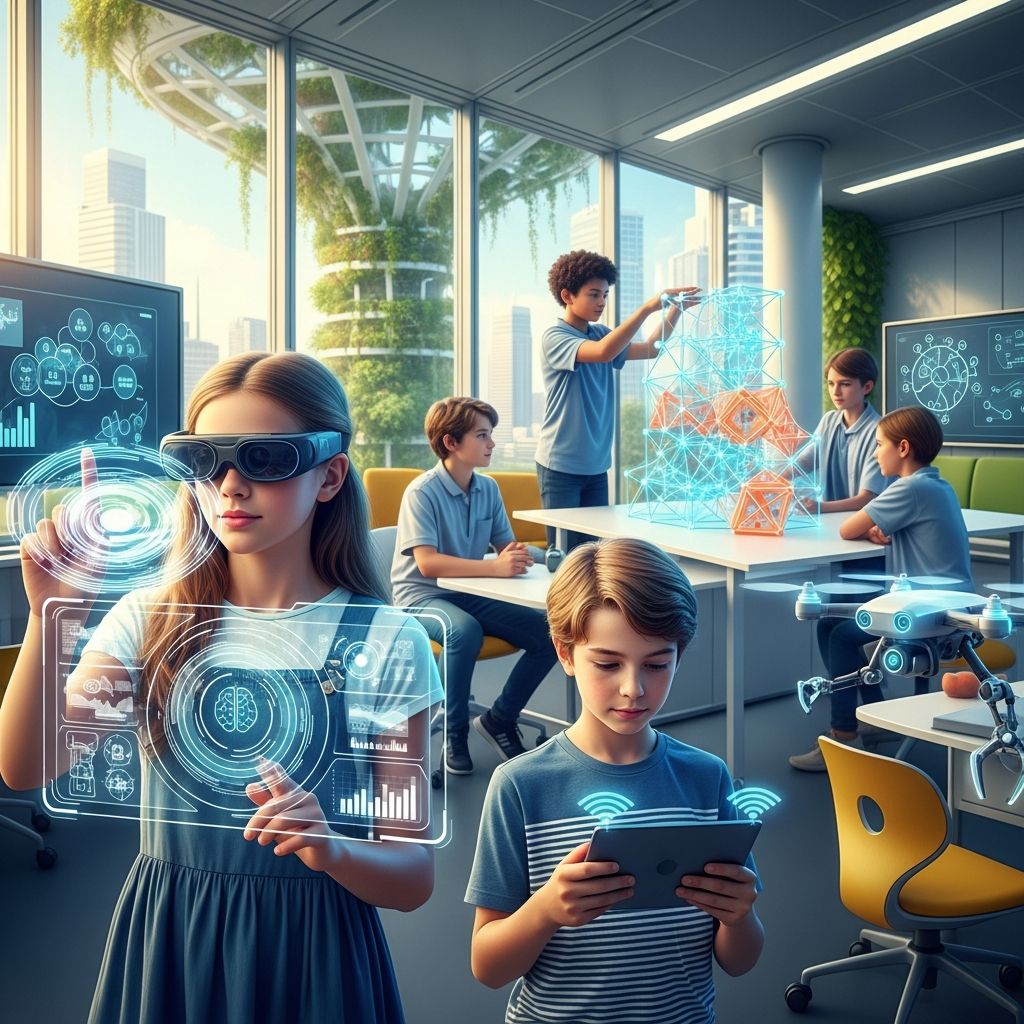
In a world accelerating toward 2030, education must evolve beyond rote memorization to foster adaptable, innovative thinkers. Children today will enter a job market dominated by artificial intelligence, automation, and unprecedented global challenges, demanding a blend of technical prowess and human-centered abilities. This article outlines critical competencies, teaching strategies, and parental roles to ensure young learners not only survive but lead in this transformative era.
Why Traditional Education Falls Short
Conventional schooling, focused on standardized tests and factual recall, prepares students for predictable roles that AI is rapidly automating. The OECD emphasizes equipping youth for unforeseen jobs, societal issues, and emerging technologies through holistic competencies. Jobs requiring routine tasks will diminish, while demand surges for those blending analytical rigor with creativity and empathy.
By 2030, over 85% of roles may involve AI interaction, shifting emphasis from knowledge retention to mental agility and ethical judgment. Parents and educators must pivot to skill-building that endures technological shifts, promoting lifelong learning and resilience.
Core Cognitive Skills for the AI Era
Analytical thinking tops future skill lists, enabling data dissection and informed decisions amid information floods. Coupled with cognitive flexibility, it allows pivoting between ideas and contexts seamlessly.
- Critical Analysis: Evaluate AI outputs, spotting biases and gaps in machine-generated insights.
- Systems Thinking: Understand interconnected systems, from ecosystems to global economies, for holistic problem-solving.
- Questioning Proficiency: Formulate precise queries, as asking the right question outpaces quick answers in AI environments.
These skills ensure children question rather than accept AI blindly, fostering independent intellect.
Human Skills That Machines Can’t Replicate
While AI excels at computation, uniquely human traits like empathy and originality remain irreplaceable. Emotional intelligence—self-awareness, relationship management—builds collaborative leaders.
| Skill | Why Essential | 2030 Application |
|---|---|---|
| Creative Thinking | Generates novel solutions | Innovation in AI-human teams |
| Resilience & Agility | Adapts to disruption | Navigating job market volatility |
| Empathy & Social Influence | Fosters teamwork | Cross-cultural leadership |
| Ethical Decision-Making | Guides responsible AI use | Addressing tech dilemmas |
World Economic Forum projections highlight these as top employability drivers, outpacing technical skills alone.
Digital and Technological Mastery
AI and big data literacy are non-negotiable, with cybersecurity and tech fluency in high demand. Children must master multiple devices—from touchscreens to voice interfaces—building intuitive tech adaptation.
- Hands-on AI tools from early grades for practical exposure.
- Data analysis to interpret trends and predictions.
- Ethical tech guidelines to use innovations responsibly.
Interdisciplinary integration, like merging coding with environmental science, mirrors real-world applications.
Cultivating Adaptability and Lifelong Curiosity
Adaptability ensures relevance amid flux, paired with curiosity driving continuous exploration. A curious mindset fuels divergent thinking and resilience against setbacks.
Project-based learning simulates authentic challenges: empathize, define issues, ideate, prototype, test—building practical prowess. Nature-based curricula enhance systems understanding, preparing for complex global problems.
Interdisciplinary and Global Mindsets
Siloed subjects yield to fluid, connected learning: physics informs ethics, math sparks art. This holistic approach tackles multifaceted issues like climate change or pandemics.
Global citizenship demands diverse perspective appreciation, respectful interaction, and sustainable action. Programs emphasizing cultural collaboration prepare contributors to worldwide dialogues, not mere consumers.
Practical Strategies for Parents and Schools
Parents can nurture these at home through open discussions, real-world projects, and tech exploration. Schools should adopt personalized, competency-based models: tailor paths to mastery, not grades.
- Industry partnerships for internships and hackathons build experiential resilience.
- Faculty training in emerging tech ensures relevant instruction.
- AI-customized learning scales individual support.
Early childhood investments yield long-term health and success, addressing access disparities.
Frequently Asked Questions (FAQs)
What are the top skills for 2030 jobs?
Analytical thinking, creative problem-solving, AI literacy, resilience, and emotional intelligence lead, per OECD and WEF insights.
How can parents build adaptability at home?
Encourage curiosity via experiments, diverse experiences, and failure-positive discussions to foster flexibility.
Is AI replacing teachers?
No, AI augments personalization; human elements like empathy remain vital.
When to start tech education?
Early, with age-appropriate tools emphasizing ethics and creativity over screens alone.
How does interdisciplinary learning benefit kids?
It mirrors real challenges, enhancing holistic thinking and innovation.
Shaping Tomorrow’s Leaders Today
Reimagining education as a collaborative effort among educators, parents, and communities empowers children with agency. By prioritizing these skills, we build not just survivors, but architects of a thriving future. Invest now in curiosity, capability, and character for enduring success.
References
- Future of Education and Skills 2030/2040 — OECD. 2023. https://www.oecd.org/en/about/projects/future-of-education-and-skills-2030.html
- The future of education: Skills for 2030 and beyond in an AI-driven world — Times of India. 2025-01-15. https://timesofindia.indiatimes.com/life-style/parenting/teen/the-future-of-education-skills-for-2030-and-beyond-in-an-ai-driven-world/articleshow/129940642.cms
- Future-Proofing Students — ASCD. 2020. https://www.ascd.org/el/articles/future-proofing-students
- Futureproof Your Students with These Essential Skills for 2030 — Getting Smart. 2019-09-20. https://www.gettingsmart.com/2019/09/20/futureproof-your-students-with-these-essential-skills-for-2030/
- Early Childhood Development and Education — ODPHP Healthy People 2030. 2020. https://odphp.health.gov/healthypeople/priority-areas/social-determinants-health/literature-summaries/early-childhood-development-and-education

Medha Deb is an editor with a master's degree in Applied Linguistics from the University of Hyderabad. She believes that her qualification has helped her develop a deep understanding of language and its application in various contexts. Medha specializes in the areas of beauty, health, sports, and wellness and is committed to ensuring that the content on the website is…