
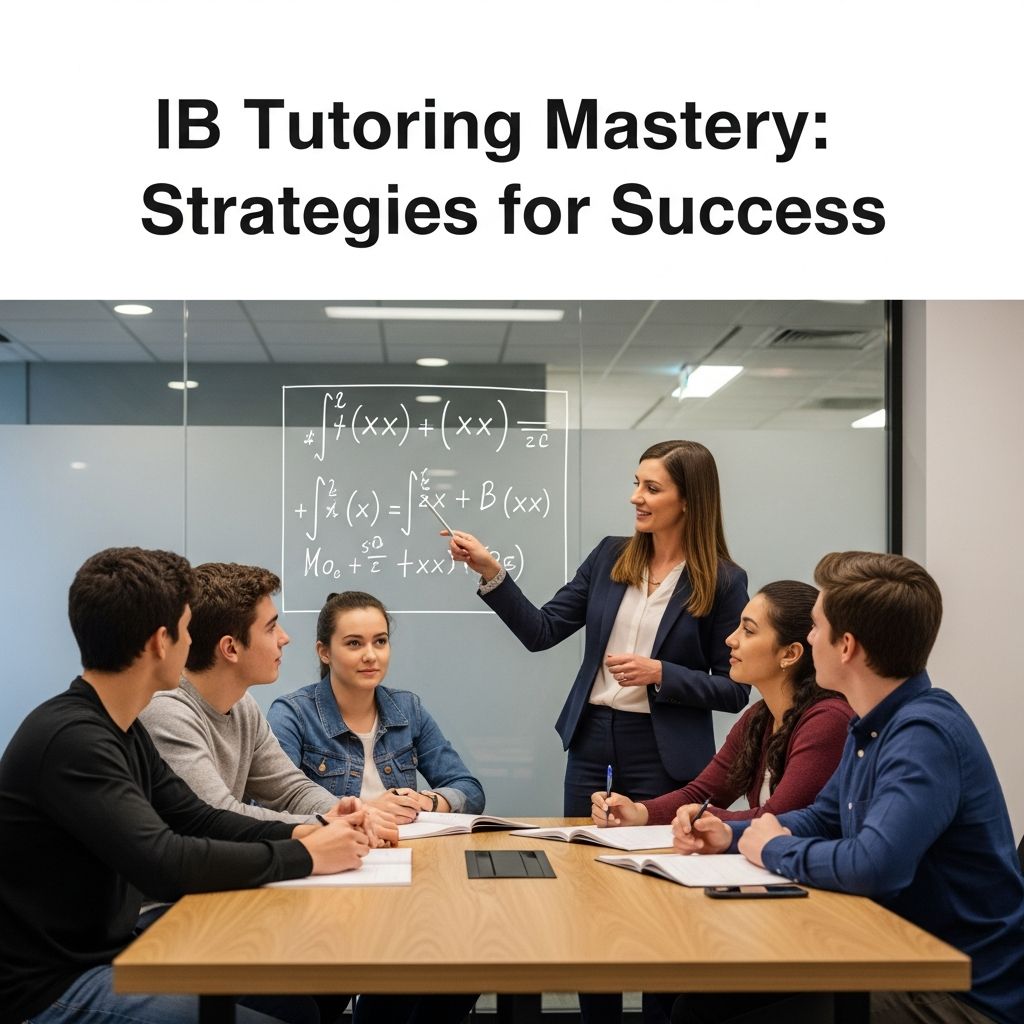
The International Baccalaureate Diploma Programme stands as one of the most demanding high school curricula worldwide, fostering skills like critical analysis, global awareness, and independent inquiry. For students navigating its complexities, targeted tutoring emerges as a game-changer, offering customized guidance to elevate performance and build lasting academic confidence.
Why IB Students Need Specialized Tutoring Support
IB learners face a multifaceted curriculum that spans six subjects, three core elements—Theory of Knowledge (TOK), Extended Essay (EE), and Creativity, Activity, Service (CAS)—and rigorous internal and external assessments. This structure demands not just knowledge retention but also sophisticated application across disciplines.
Tutoring addresses unique hurdles by providing one-on-one focus. Unlike crowded classrooms, tutors pinpoint gaps in understanding, such as struggles with higher-level math proofs or TOK philosophical debates, and deliver precise interventions. Research from educational bodies highlights how personalized instruction correlates with higher IB scores, particularly in subjects requiring deep conceptual grasp.
- Customized Pace: Tutors adjust lessons to match individual learning speeds, preventing overwhelm from the program’s accelerated timeline.
- Holistic Skill Building: Beyond facts, emphasis on essay structuring, data analysis, and interdisciplinary links prepares students for university-level work.
- Confidence Boost: Regular progress checks foster resilience against the self-doubt common in high-stakes programs like IB.
Core Challenges in the IB Programme and Tutoring Solutions
From juggling multiple deadlines to mastering abstract concepts, IB students encounter obstacles that can derail progress. Tutors deploy proven methods to dismantle these barriers effectively.
| Challenge | Tutoring Solution | Expected Outcome |
|---|---|---|
| Heavy Workload | Priority-based scheduling tools and weekly planners | Balanced routine with reduced burnout |
| Complex Assessments | Practice with rubrics and mock IAs | 7+ scores on internals |
| Writing Demands | Structured feedback on drafts for EE and TOK | Coherent arguments and higher marks |
| Stress Accumulation | Mindfulness integration and goal-setting sessions | Improved focus and mental health |
These interventions ensure comprehensive coverage, turning potential pitfalls into strengths. For instance, in sciences, tutors break down experimental design protocols, while in humanities, they refine source evaluation skills critical for Paper 2 essays.
Building Unshakable Time Management Foundations
Effective time allocation separates thriving IB students from those who falter. Tutors introduce frameworks like the Eisenhower Matrix for task prioritization and Pomodoro techniques for sustained focus sessions.
Start with a master calendar integrating CAS commitments, IA deadlines, and revision blocks. Tutors review this weekly, adjusting for unforeseen disruptions. Digital apps such as Notion or Google Calendar sync across devices, enabling real-time updates. Students report 30% productivity gains from such systems, backed by studies on adolescent executive function development.
- Break projects into micro-tasks: EE research becomes daily 25-minute literature reviews.
- Incorporate buffer times: 15% of weekly hours for unexpected revisions.
- Weekly reflections: Log what worked to refine future plans.
Advanced Exam Preparation Techniques with Tutors
IB exams test breadth and depth, with Papers 1-3 varying by subject. Tutors simulate exam conditions using archived papers from official IB resources, honing timing and question dissection.
Key strategies include:
- Question Mapping: Categorize past queries by command terms (e.g., ‘evaluate’ vs. ‘discuss’) to predict patterns.
- Active Recall: Flashcard drills for formulas and key theorists, spaced over increasing intervals.
- Error Analysis: Post-mock reviews to classify mistakes—conceptual, careless, or strategic.
For internals, tutors co-create portfolios, ensuring alignment with subject-specific criteria. In Math AA HL, this means rigorous proof practice; in English A, nuanced text analysis.
Sharpening Critical Thinking and Inquiry Skills
IB’s hallmark is inquiry-driven learning, where students question assumptions and synthesize viewpoints. Tutors cultivate this through Socratic seminars, debating real-world issues tied to syllabus topics.
Techniques like mind mapping link TOK concepts to subjects, e.g., connecting epistemology in History IAs. Group simulations via online platforms extend this to global perspectives, mirroring CAS’s internationalism.
Selecting the Ideal IB Tutor: Essential Qualities
Not every educator suits IB’s demands. Prioritize these traits:
- Programme Familiarity: Examiners or former IB teachers versed in latest syllabus updates.
- Subject Mastery: Advanced degrees or 5+ years in HL/SL teaching.
- Adaptability: Shifts methods from visual aids for visual learners to discussions for verbal ones.
- Empathy: Recognizes burnout signs, weaving in wellness check-ins.
- Results Track Record: Verified testimonials or score improvements from past students.
Platforms offering matched pairings based on diagnostics streamline selection. Initial sessions assess fit, with contracts outlining goals and progress metrics.
Online vs. In-Person Tutoring: Comparing Options
| Aspect | Online | In-Person |
|---|---|---|
| Flexibility | High; schedule anytime globally | Fixed locations and times |
| Cost | Lower overheads, often cheaper | Higher due to travel |
| Tech Integration | Seamless with interactive whiteboards | Limited to physical tools |
| Personal Connection | Builds via video; may take longer | Immediate rapport |
Hybrid models combine strengths, ideal for busy families.
Lifestyle Balance: Tutors as Wellness Coaches
Sustained success requires sleep (8+ hours), nutrition, and movement. Tutors model this by ending sessions with stretch breaks and recommend apps for habit tracking.
Incorporate reflection journals to process stressors, aligning with IB’s reflective practitioner ethos.
Frequently Asked Questions (FAQs)
When should IB students start tutoring?
Ideally in Year 1 for foundational support, or mid-Year 2 for exam crunch. Early intervention prevents backlog.
How many tutoring hours per week?
2-4 hours, focused on weak areas, plus self-study. Quality trumps quantity.
Can tutoring guarantee a 45-score?
No guarantees, but consistent effort with expert guidance maximizes potential, often yielding 38+.
What if my child resists tutoring?
Begin with low-pressure intro sessions emphasizing tutor as ally, not enforcer.
Are group tutoring sessions effective for IB?
Yes for peer learning in TOK or group IAs, but one-on-one excels for personalized depth.
Long-Term Gains from IB Tutoring Investments
Beyond diplomas, IB tutoring hones transferable skills like resilience and adaptability, prized by top universities. Alumni credit tutors for not just scores but lifelong learning mindsets.
Parents investing early witness transformed study habits persisting into higher education. Track ROI via grade trajectories and reduced anxiety metrics.
References
- International Baccalaureate (IB) Tutoring: Tips, Tricks and Advice — Greenhouse Learning. 2023. https://greenhouselearning.co.uk/international-baccalaureate-ib-tutoring-tips-tricks-and-advice/
- Effective IB Exam Prep: Top Strategies for Success — TutorBright. 2024-01-15. https://www.tutorbright.com/blog/effective-ib-exam-prep-top-strategies-for-success
- Mastering IB Teaching: Tips, Techniques & Insights — CASIE. 2023-05-20. https://www.casieonline.org/post/mastering-ib-teaching-tips-techniques-insights/
- The Ultimate Guide to IB Tutoring for High School Students — Maryville University. 2022-11-10. https://www.maryville.edu/marketing/wp-content/uploads/sites/35/formidable/7/The-Ultimate-Guide-to-IB-Tutoring-for-High-School-Students.pdf
- The Comprehensive Guide to IB Tutoring: Subjects, Online Help — My Engineering Buddy. 2024-03-05. https://www.myengineeringbuddy.com/blog/the-comprehensive-guide-to-ib-tutoring-subjects-online-help-and-homework-support/

- Integrated M.A. in Applied Linguistics, University of Hyderabad
- 5+ years in editorial, instructional, SEO, and research-based writing
Sneha is a relationships and lifestyle writer with a strong foundation in applied linguistics and certified training in relationship coaching. She brings over five years of writing experience to theskillvault, crafting thoughtful, research-driven content that empowers readers to build healthier relationships, boost emotional well-being, and embrace holistic living. Her writing and insights reflect the belief that beauty, happiness, and wellness…