
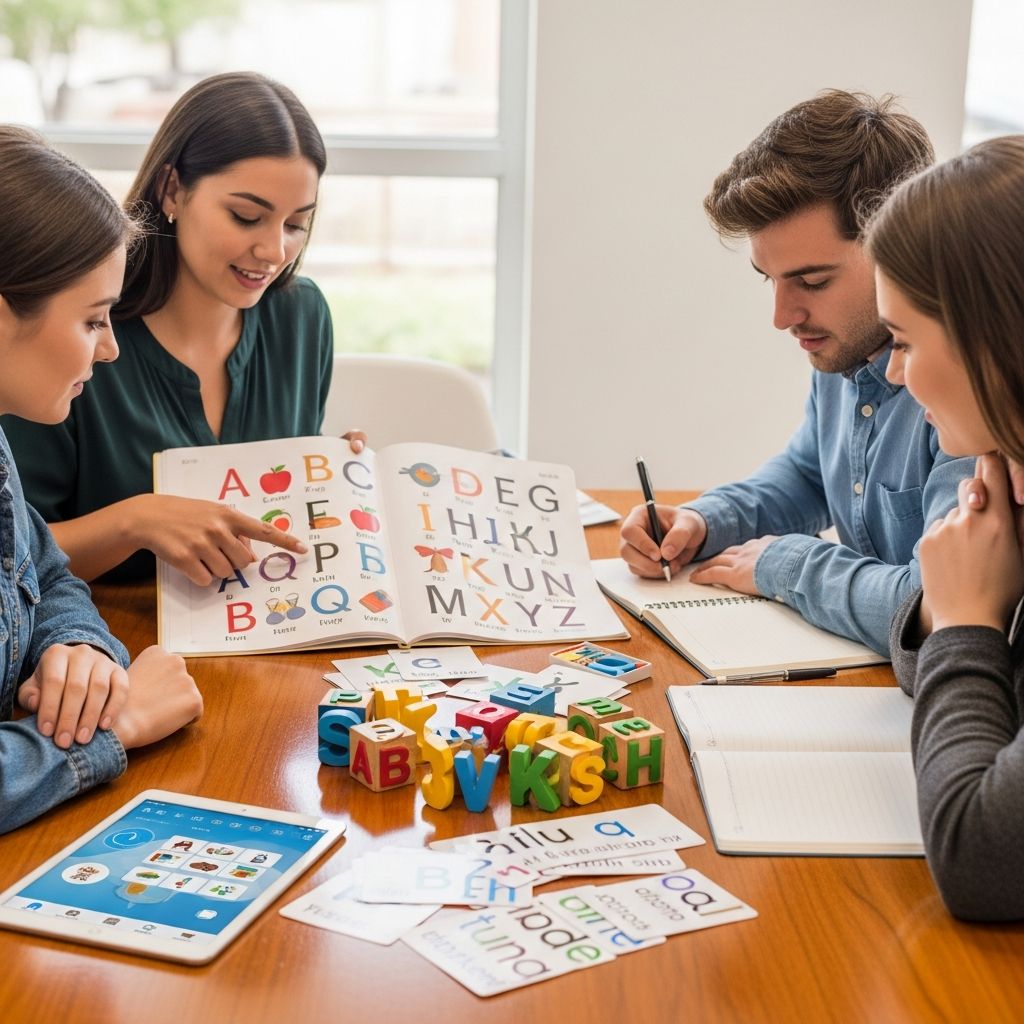
Teaching the English alphabet to ESL students requires more than rote memorization; it demands creative, multisensory approaches that connect letters to sounds, words, and everyday language use. This comprehensive guide explores practical methods to build strong foundational skills, ensuring learners not only recognize letters but also apply them confidently in reading and speaking.
Building a Strong Foundation: Why Context Matters in Alphabet Instruction
For ESL learners, the 26-letter English alphabet can feel foreign, especially when their native languages use different scripts or phonemes. Effective teaching starts by embedding letters within meaningful contexts, such as familiar vocabulary and simple sentences, rather than isolated drills. This method accelerates retention by linking abstract symbols to concrete ideas.
Research from educational linguistics emphasizes phonics integration from the outset. Students who associate letters with sounds— like /æ/ for ‘A’ in ‘apple’—develop decoding skills essential for reading. According to the U.S. Department of Education’s guidelines on early literacy, phonemic awareness activities improve letter-sound correspondence by 30-50% in non-native speakers.
Begin with high-frequency letters like A, B, M, S, and T, which appear often in basic words. Pair each with visuals: show an apple for A, a ball for B. Have students chant, “A says /æ/, apple!” This repetition reinforces both name and sound.
Phonics-First: Unlocking Sounds Before Names
A phonics-based curriculum prioritizes sounds over letter names, mirroring how native speakers internalize language. For ESL students, this counters confusion from irregular English pronunciation, such as silent letters or digraphs.
Introduce sounds through minimal pairs: /b/ in ‘bat’ versus /p/ in ‘pat’. Use audio resources or apps with clear enunciation. The British Council’s teaching framework recommends starting with short vowels and consonants, blending them into CVC words (consonant-vowel-consonant) like ‘cat’ or ‘dog’.
| Letter | Sound | Example Word | Activity Idea |
|---|---|---|---|
| A | /æ/ | Apple | Point to red fruit image |
| B | /b/ | Ball | Bounce a ball while chanting |
| S | /s/ | Snake | Slither motion with arms |
| T | /t/ | Tree | Trace tall trunk shape |
This table outlines starter letters, promoting quick wins. Practice blending: sound out ‘m-a-t’ to form ‘mat’, building confidence.
Interactive Movement: Kinesthetic Learning for Retention
Young ESL learners thrive on physical engagement. Kinesthetic activities transform passive recognition into active recall, engaging motor skills alongside cognition.
- Body Letter Formation: Students pose to mimic letter shapes—arms outstretched for ‘T’, curved for ‘C’. Guess the letter as a class.
- Scavenger Hunts: Hide letter cards around the room; students find and shout a starting word, e.g., ‘D for dog!’
- Alphabet Walk: Lay letters on the floor; call one out, and students jump to it while pronouncing the sound.
These align with multiple intelligences theory, benefiting visual, auditory, and tactile learners. Studies from the National Institute for Literacy show movement boosts memory by 20% in language acquisition.
Gamifying Lessons: Boosting Motivation Through Play
Games reduce anxiety and extend attention spans, crucial for ESL beginners prone to frustration. Incorporate daily 10-minute game segments to review letters dynamically.
- Bingo Blitz: Distribute cards with letters; call sounds or words. First to complete a row wins a sticker.
- Letter Relay: Teams race to collect scattered letters in alphabetical order.
- Flashcard Flash: Hold up a card; students race to name it or a word starting with it.
For adults, adapt with vocabulary-building: brainstorm nouns per letter, compiling a class list for reference.
Navigating Uppercase and Lowercase: A Gradual Approach
Overloading beginners with both cases leads to confusion. Focus on uppercase first for their distinct shapes, then transition via environmental print like labels and books.
Matching Exercises: Pair ‘A’ with ‘a’ using magnets or cards. Read simple texts highlighting lowercase in context: ‘The cat is on the mat.’
Real-world exposure—street signs, packaging—reinforces naturally. The Colorín Colorado resource advocates name-based personalization: use a student’s name to highlight relevant letters.
Sensory and Multisensory Techniques for Deeper Learning
Engage senses to forge neural pathways. Sensory bins with sand or rice let students trace letters tactilely. Finger painting uppercase ‘O’s or playdough ‘S’s builds fine motor skills alongside recognition.
Audio integration is vital: play alphabet songs repeatedly, pausing for echo practice. Tools like YouTube phonics videos provide modeled pronunciation. For Spanish-speakers, target tricky pairs like /b/ and /v/.
Daily Routines: Repetition for Mastery
Consistency is key. Establish a 5-minute morning routine: recite A-Z, review sounds, sing a chant. Vary slightly weekly to prevent boredom.
Track progress with checklists: color a star per mastered letter. Celebrate milestones to foster growth mindset.
Adapting for Age Groups: Tailored Strategies
Young Children (Ages 4-7)
Emphasize songs, puppets, and props. ‘A is for alligator’ with a toy snapper.
School-Age (8-12)
Incorporate reading: highlight letters in stories. Word hunts in texts.
Adults
Link to practical needs: spelling names, filling forms. Group recitation builds confidence.
Common Challenges and Solutions
| Challenge | Solution |
|---|---|
| Sound Confusion (e.g., B/V) | Minimal pair drills with pictures |
| Lack of Interest | Rotate games weekly |
| Script Interference | Contrast with native alphabet visually |
| Irregular Spellings | Introduce post-basics, via sight words |
Frequently Asked Questions (FAQs)
What is the best order to teach letters to ESL students?
Start with high-frequency, easy-sound letters like S, A, T, P, I, N for quick word formation.
How long does it take ESL kids to learn the alphabet?
Typically 4-8 weeks with daily 15-minute sessions, varying by exposure and native language.
Should I teach letter names or sounds first?
Sounds first for reading foundation; names follow naturally through songs.
Are alphabet songs effective for non-native speakers?
Yes, rhythmic repetition aids pronunciation and sequence memory across ages.
How to help adults overcome embarrassment?
Frame as skill-building for real-life; use private practice then group fun.
Integrating Technology and Resources
Leverage free apps like ABC Mouse or Duolingo Kids for interactive drills. Project phonics videos for class modeling. Printable worksheets for homework tracing reinforce classroom learning.
Parental involvement: send home letter charts with daily recitation tips.
References
- Put Reading First: The Research Building Blocks for Teaching Children to Read — National Institute for Literacy, U.S. Department of Education. 2006. https://www.nichd.nih.gov/sites/default/files/publications/pubs/documents/put_reading_first.pdf
- TeachingEnglish: Phonics Toolkit — British Council. 2023. https://www.teachingenglish.org.uk/teaching-resources/teaching-primary/activities/level-1/phonics-toolkit
- Developing Early Literacy: Report of the National Early Literacy Panel — National Institute for Literacy. 2008. https://www.nichd.nih.gov/sites/default/files/publications/pubs/documents/NELPReport09.pdf
- ESL Literacy Network: Adult Alphabet Instruction — Government of Canada, Employment and Social Development. 2022. https://www.esl-literacy.ca/resources/adult-alphabet-instruction
- Phonemic Awareness and English Language Learners — Colorín Colorado. 2024. https://www.colorincolorado.org/article/phonemic-awareness-english-language-learners

- Integrated M.A. in Applied Linguistics, University of Hyderabad
- 5+ years in editorial, instructional, SEO, and research-based writing
Sneha is a relationships and lifestyle writer with a strong foundation in applied linguistics and certified training in relationship coaching. She brings over five years of writing experience to theskillvault, crafting thoughtful, research-driven content that empowers readers to build healthier relationships, boost emotional well-being, and embrace holistic living. Her writing and insights reflect the belief that beauty, happiness, and wellness…