
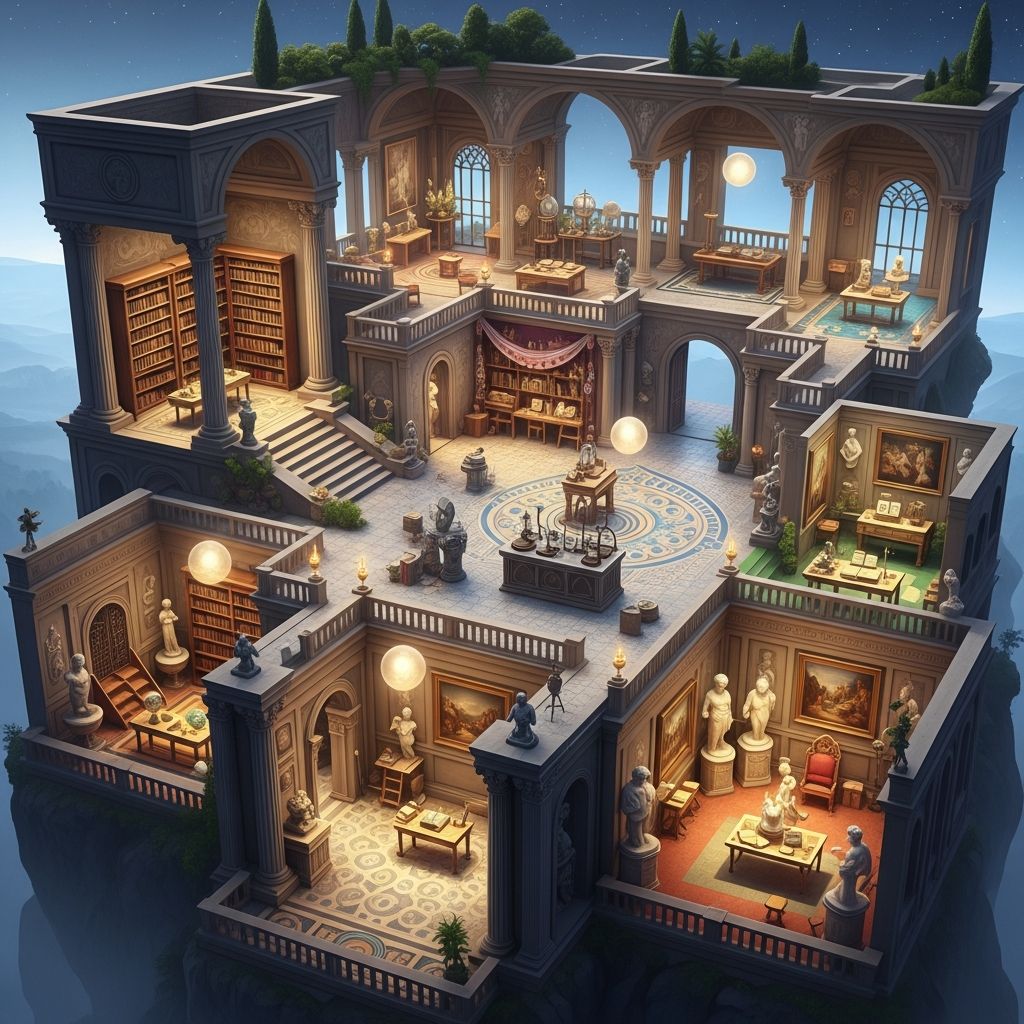
The memory palace technique, rooted in ancient mnemonic practices, transforms abstract information into vivid, spatially anchored memories that stick effortlessly. This method leverages your brain’s natural aptitude for spatial navigation to encode and retrieve data with remarkable accuracy.
Origins and Scientific Foundation of Spatial Mnemonics
Tracing back over 2,500 years, the memory palace emerged from a legendary event involving the Greek poet Simonides of Ceos. After a tragic banquet hall collapse, he identified victims by mentally reconstructing their positions, birthing the ‘method of loci’—Latin for ‘places.’ Modern neuroscience validates this: the hippocampus, key to spatial memory, activates during palace navigation, enhancing retention far beyond rote repetition.
Studies show visual-spatial encoding outperforms textual memorization because humans process images 60,000 times faster than words. By linking facts to familiar locations, you engage multiple memory systems—visual, spatial, and associative—for durable recall.
Core Principles Behind Effective Memory Palaces
At its heart, a memory palace is a mental construct where information resides in fixed ‘loci’—distinct spots along a familiar route. Success hinges on three pillars:
- Vivid Imagery: Exaggerate images to absurdity—giant, colorful, dynamic scenes burn into memory.
- Spatial Anchoring: Use real or imagined places you know intimately, ensuring loci are sequential and unchanging.
- Association: Fuse items with loci through interaction, motion, or emotion for unbreakable bonds.
This synergy exploits your innate ‘cognitive map,’ making recall as intuitive as walking home.
Selecting the Perfect Foundation for Your Palace
Begin with familiarity: your home, workplace, or daily commute offers reliable loci. Avoid overly complex spaces initially; a single room suffices for beginners.
| Palace Type | Best For | Example Loci |
|---|---|---|
| Single Room | Short lists (5-10 items) | Door, desk, chair, window, shelf |
| Full House | Medium lists (20-50 items) | Entry hall, kitchen counter, bedroom pillow, bathroom sink |
| Journey Route | Long sequences | Bus stop, park bench, coffee shop counter, office door |
| Multi-Palace Network | Complex subjects | Separate palaces per chapter or topic |
Pro tip: Mentally rehearse the route eyes-closed, forward and backward, to solidify it.
Step-by-Step Blueprint to Construct Your First Palace
Define Your Route: Sketch 10-20 loci in order. For a kitchen palace: 1. Fridge door, 2. Sink faucet, 3. Stove burner, etc. Number them mentally or on paper.
Prepare Content: Break material into chunks—names, dates, concepts. Convert abstracts to concrete images: ‘photosynthesis’ becomes a leafy plant snapping selfies.
Populate Loci: Assign one image per locus. At fridge door, envision a colossal carrot wrestling the handle open, juice squirting everywhere.
Amplify Senses: Add sounds (screeching carrot), smells (earthy freshness), feelings (sticky juice). Multisensory depth cements images.
Review Journey: Traverse mentally 3-5 times immediately, then spaced intervals (1 hour, 1 day later).
Real-World Applications Across Disciplines
Students: Palace-ize vocabulary: French words at bedroom loci—a giant ‘chat’ (cat) claws the bedpost. Medical terms: ‘hypothalamus’ as a tiny throne in your hall hypothalamus (hypo-throne-amus).
Professionals: Speeches via story palaces—key points as escalating absurdities along a conference route.
Everyday Use: Grocery lists (produce exploding on porch), names/faces (new acquaintance’s feature fused with home spot).
Advanced Strategies for Power Users
Scale up with ‘palace chains’: Link multiple palaces via portals (e.g., bedroom door leads to virtual library). Use ‘bicameral palaces’—one for input, mirror for review.
Employ personification: Animate concepts with characters (Einstein juggling equations). Layer palaces thematically: history timeline along a lifelong journey.
For massive data, micro-loci: subdivide spots (fridge: handle, shelf, crisper). Track via spreadsheets: columns for locus #, image description, target info.
Practical Example: Memorizing the Periodic Table’s First 10 Elements
Route: Living room clockwise.
- 1. Door (Hydrogen): Hydrogen H-bomb blasts door off hinges.
- 2. Couch (Helium): Helium balloon elephant floats couch skyward.
- 3. TV (Lithium): Lit fuse (Lithium) sparks TV into fireworks.
- 4. Lamp (Beryllium): Berrylium berries swarm lamp, staining it purple.
- 5. Bookshelf (Boron): Boring (Boron) bore drills through shelf.
- 6. Window (Carbon): Carbon copy clones shatter glass.
- 7. Rug (Nitrogen): Knight-rogen (Nitrogen) jousts rug fringes.
- 8. Coffee Table (Oxygen): Oxygen oxy-tank explodes table.
- 9. Fireplace (Fluorine): Flu (Fluorine) victim coughs flames.
- 10. Wall (Neon): Neon sign buzzes ‘NO!’ on wall.
Rehearse: Recall explodes effortlessly. Adapt for any list.
Common Pitfalls and How to Overcome Them
- Fading Images: Insufficient vividness—always exaggerate to grotesque levels.
- Route Confusion: Unfamiliar path—stick to hyper-familiar spots.
- Overloading Loci: One image per spot; use journeys for volume.
- Neglect Review: Daily mental walks prevent decay; spaced repetition amplifies.
Frequently Asked Questions (FAQs)
Can anyone build a memory palace?
Yes, with practice. Start small; even 5 loci yield quick wins. No innate talent required—spatial memory is universal.
How long until proficiency?
Basics in 15 minutes; mastery via consistent use over weeks. Champion memorizers train years.
Does it work for abstract info like numbers?
Absolutely—phonetic systems (Major System) convert numbers to images, then palace them.
Virtual vs. Real Palaces?
Real first for solidity; virtual scales infinitely for pros.
Tools to Aid Building?
Apps simulate palaces; paper mapping works too. Core is mental discipline.
Long-Term Integration for Lifelong Recall
Embed palaces in routines: pre-sleep reviews, morning traversals. Combine with active recall—quiz sans notes. Track progress: memorize 20 items daily, test weekly.
Evidence from memory athletes: world records (e.g., 1000+ digits) stem from loci mastery. Students report 3x retention gains. Integrate gradually: one list daily builds neural pathways.
Ultimately, memory palaces rewire cognition, turning forgetfulness into a superpower. Experiment, iterate, and watch recall soar.
References
- How to Build a Memory Palace — Art of Memory. 2023. https://artofmemory.com/blog/how-to-build-a-memory-palace/
- How to Use the Memory Palace Technique — The Craft of Memory (Substack). 2023. https://thecraftofmemory.substack.com/p/how-to-use-the-memory-palace-technique
- How to Build a Memory Palace for Studying [+ Examples] — Lecturio. 2023. https://www.lecturio.com/blog/how-to-build-a-memory-palace-for-studying-examples/
- Improve Your Memory by Building a Memory Palace — Coursera. 2023. https://www.coursera.org/articles/memory-palace
- MEMORY PALACE A POWERFUL MNEMONIC DEVICE — University of St Andrews (Academic PDF). 2020-04-01. https://paulgardner.wp.st-andrews.ac.uk/files/2020/04/MemoryPalace8to14.pdf
- How to build a memory palace to store and revisit information — Psyche. 2023. https://psyche.co/guides/how-to-build-a-memory-palace-to-store-and-revisit-information

Medha Deb is an editor with a master's degree in Applied Linguistics from the University of Hyderabad. She believes that her qualification has helped her develop a deep understanding of language and its application in various contexts. Medha specializes in the areas of beauty, health, sports, and wellness and is committed to ensuring that the content on the website is…