
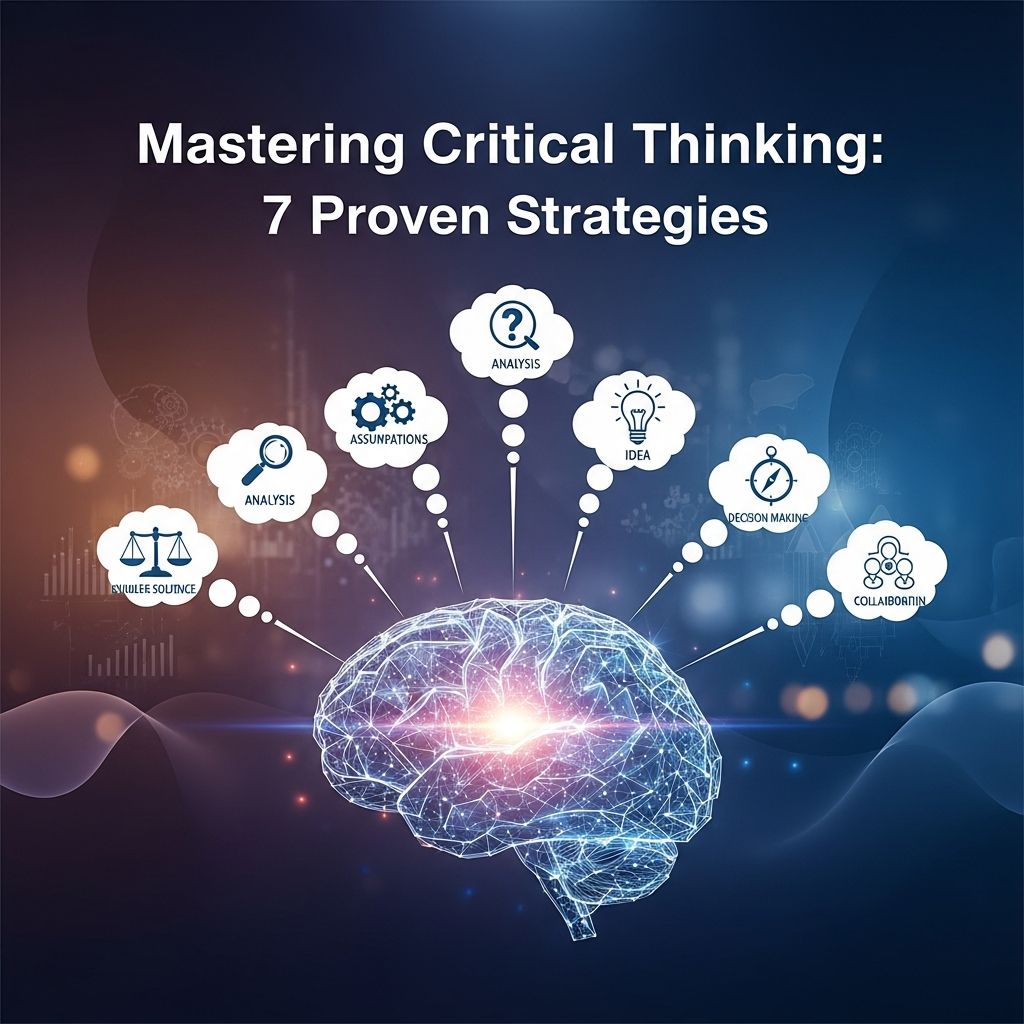
Critical thinking stands as a cornerstone of intellectual development, empowering individuals to navigate complex information landscapes, make reasoned decisions, and solve problems efficiently. In an era flooded with data, the ability to discern truth from noise, question assumptions, and synthesize insights is invaluable. This article explores seven transformative strategies drawn from established educational frameworks to cultivate these skills, applicable across academic, professional, and personal spheres.
Understanding the Foundations of Critical Thinking
At its core, critical thinking transcends mere memorization or rote learning. It involves actively analyzing information, evaluating evidence, and drawing logical conclusions. According to educational experts, it encompasses raising precise questions, assessing data objectively, and considering alternative viewpoints. This disciplined approach fosters resilience against biases and enhances adaptability in dynamic environments.
Why prioritize critical thinking? Research from academic institutions highlights its role in higher-order cognition, moving beyond basic recall to application and synthesis. Students employing these skills outperform peers in problem-solving tasks, while professionals leverage them for innovation and leadership. The strategies outlined below build on this foundation, offering practical tools for immediate implementation.
Strategy 1: Pinpointing the Core Issue with Precision
The first step in any analytical process is defining the problem clearly. Vague issues lead to scattered efforts, whereas precise identification narrows focus and accelerates solutions. Begin by articulating the challenge: What exactly is at stake? Who is affected? What outcomes are desired?.
For instance, instead of broadly stating “I’m struggling with time management,” refine it to “I lose two hours daily to unproductive social media scrolling during work hours.” This specificity guides subsequent actions. Educational resources emphasize that precise problem definition prevents misdirected energy and sets the stage for data-driven exploration.
- Break down broad concerns into measurable components.
- Use open-ended questions like “What triggers this issue?” to uncover root causes.
- Document the refined problem statement for reference.
Strategy 2: Collecting Diverse and Reliable Information
Once the problem is defined, gather comprehensive data from multiple angles. Critical thinkers seek varied perspectives—facts, opinions, statistics—to build a robust knowledge base. Prioritize reputable sources such as academic papers, government reports, and peer-reviewed studies over anecdotal evidence.
Conduct interviews, surveys, or literature reviews to capture nuances. Ask: What evidence supports or contradicts my initial views? This phase mitigates blind spots and enriches understanding. In learning contexts, students who diversify sources develop deeper comprehension and avoid echo chambers.
| Information Type | Source Examples | Evaluation Criteria |
|---|---|---|
| Primary Data | Surveys, Experiments | Sample Size, Methodology |
| Secondary Data | Journals, Reports | Author Credentials, Recency |
| Opinions | Expert Interviews | Potential Biases |
Strategy 3: Scrutinizing Data for Relevance and Bias
Raw information is overwhelming; analysis separates wheat from chaff. Evaluate sources for credibility: Are they unbiased? Timely? Relevant? Cross-check facts against multiple outlets to detect distortions.
Identify personal biases—confirmation bias, where we favor aligning data, is common. Tools like SWOT analysis (Strengths, Weaknesses, Opportunities, Threats) aid objective dissection. University teaching centers advocate this scrutiny to foster intellectual humility and accurate interpretations.
- Question source motivations: Who benefits from this narrative?
- Quantify where possible: Use statistics to validate qualitative claims.
- Seek disconfirming evidence to challenge assumptions.
Strategy 4: Embracing Multiple Perspectives Open-Mindedly
Effective thinkers explore alternative viewpoints, recognizing assumptions’ implications. This strategy counters egocentrism by deliberately considering opposing arguments. Techniques like devil’s advocate—arguing against your position—build flexibility.
In group settings, cooperative learning amplifies this: Diverse teams generate innovative solutions through dialogue. Socratic questioning, probing “What if the opposite were true?”, uncovers hidden flaws and enriches conclusions.
Strategy 5: Synthesizing Insights into Logical Conclusions
With analyzed data in hand, connect causes to effects and weigh options. Formulate hypotheses, test against criteria like feasibility and impact, then select the strongest. Avoid oversimplification; tolerate ambiguity until evidence clarifies.
This synthesis mirrors scientific reasoning: Hypothesize, deduce, verify. In everyday life, it transforms indecision into action, as seen in structured decision matrices.
| Option | Pros | Cons | Score (1-10) |
|---|---|---|---|
| Option A | Low Cost | High Risk | 7 |
| Option B | Proven Track Record | Time-Intensive | 9 |
Strategy 6: Communicating Findings Effectively
Conclusions gain value when shared. Present solutions clearly, supporting with evidence and anticipating counterarguments. Tailor delivery—reports for formal settings, discussions for collaborative ones.
Visual aids like charts enhance persuasion. Feedback loops, inviting critique, refine ideas further. Writing assignments, arguing multiple sides, hone this skill per pedagogical research.
Strategy 7: Reflecting and Iterating for Continuous Improvement
Post-implementation review cements growth. Assess: Did the solution work? What unforeseen issues arose? Journaling tracks patterns, turning experiences into wisdom.
Incorporate daily practices: Tackle one problem systematically, internalize standards like clarity and fairness. Over time, this reshapes thinking habits, embedding critical analysis into routine. Classroom techniques like minute papers reinforce reflection.
Practical Applications in Learning and Work
Integrate these strategies into study routines: Use mind maps for Strategy 2, debates for Strategy 4. Professionals apply them in project management, risk assessment, and innovation. Case studies demonstrate superior outcomes—teams using structured thinking resolve issues 30% faster, per training insights.
Bloom’s Taxonomy guides progression: From remembering to creating, critical thinking elevates all levels.
Frequently Asked Questions (FAQs)
What is the biggest barrier to critical thinking?
Cognitive biases and emotional reasoning often hinder objectivity. Overcoming them requires deliberate practice in questioning assumptions.
How long does it take to develop strong critical thinking skills?
Consistent application over months yields noticeable improvements. Daily reflection accelerates progress.
Can critical thinking be taught to children?
Yes, through age-appropriate questioning and games that encourage analysis and perspective-taking.
Is critical thinking the same as being negative or skeptical?
No, it’s constructive inquiry aimed at truth, balancing skepticism with open-mindedness.
How do I practice these strategies daily?
Set aside time for one problem analysis, journal insights, and discuss ideas with others.
Conclusion: Empower Your Mind Today
Adopting these seven strategies equips you for intellectual mastery. Start small, persist, and watch your learning and problem-solving transform.
References
- Solving Problems Through Critical Thinking — Duke University. 2023-05-08. https://sites.duke.edu/lodtraininghub/2023/05/08/solving-problems-through-critical-thinking/
- How to Develop Your Critical Thinking Skills — University of Wisconsin Extension. N/A. https://uwex.wisconsin.edu/stories-news/how-to-develop-your-critical-thinking-skills/
- Critical Thinking and Problem-Solving — University of Tennessee at Chattanooga. N/A. https://www.utc.edu/academic-affairs/walker-center-for-teaching-and-learning/teaching-resources/pedagogical-strategies-and-techniques/ct-ps
- Critical Thinking and other Higher-Order Thinking Skills — University of Connecticut CETL. N/A. https://cetl.uconn.edu/resources/design-your-course/teaching-and-learning-techniques/critical-thinking-and-other-higher-order-thinking-skills/
- Critical Thinking Skills: A Guide for Problem-Solving — Training Express. N/A. https://trainingexpress.org.uk/critical-thinking-skills-problem-solving/
- Critical Thinking in Everyday Life: 9 Strategies — Foundation for Critical Thinking. N/A. https://www.criticalthinking.org/pages/critical-thinking-in-everyday-life-9-strategies/512

- Integrated M.A. in Applied Linguistics, University of Hyderabad
- 5+ years in editorial, instructional, SEO, and research-based writing
Sneha is a relationships and lifestyle writer with a strong foundation in applied linguistics and certified training in relationship coaching. She brings over five years of writing experience to theskillvault, crafting thoughtful, research-driven content that empowers readers to build healthier relationships, boost emotional well-being, and embrace holistic living. Her writing and insights reflect the belief that beauty, happiness, and wellness…