
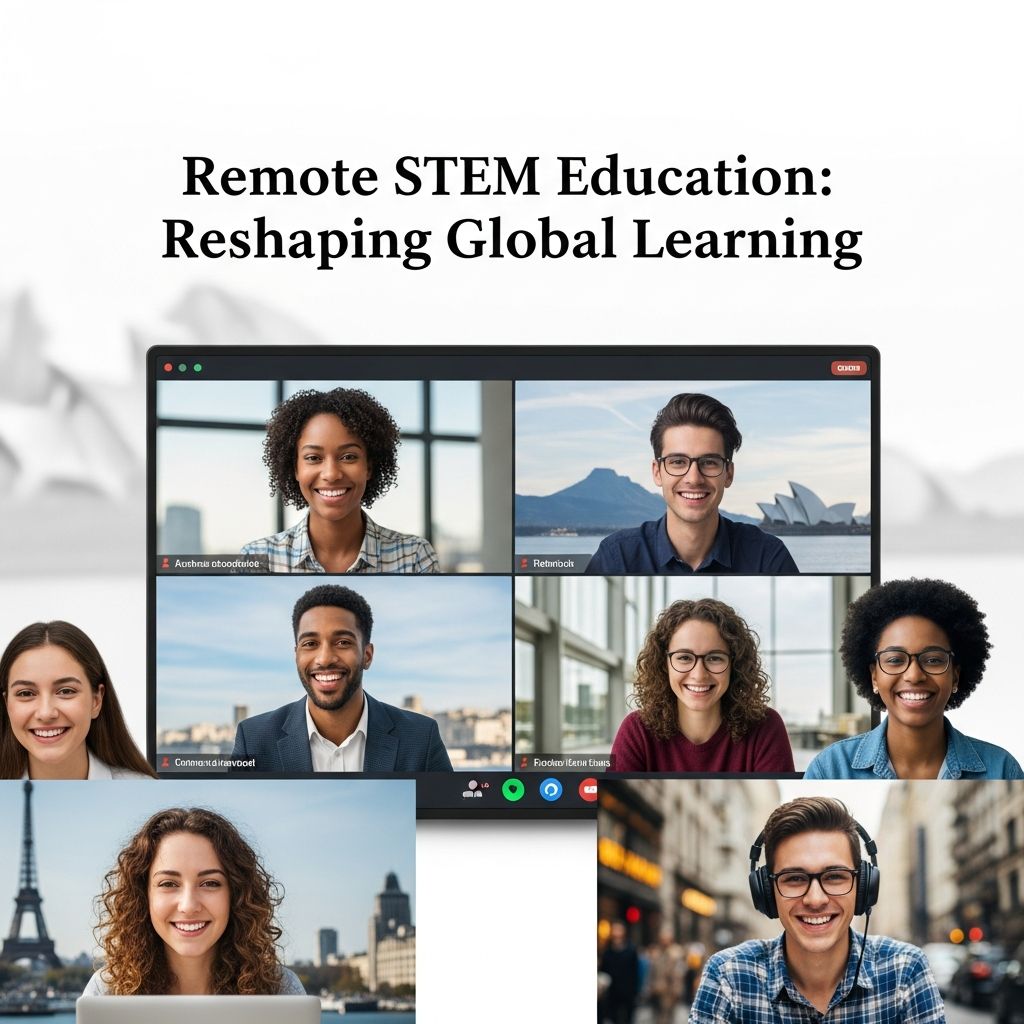
Remote education has emerged as a powerful catalyst for transforming STEM (Science, Technology, Engineering, and Mathematics) instruction, offering unprecedented access to interactive resources and personalized pathways that traditional classrooms often cannot match. By leveraging digital platforms, educators worldwide are fostering deeper engagement and practical skill development in students of all ages.
Overcoming Traditional Barriers in STEM Instruction
Conventional STEM teaching frequently encounters hurdles such as limited lab facilities, geographical isolation, and rigid scheduling, which restrict hands-on experimentation and real-time collaboration. Remote platforms dismantle these obstacles by delivering virtual simulations, global connectivity, and flexible pacing, enabling learners in rural or under-resourced areas to explore complex concepts like molecular structures or coding algorithms without physical constraints.
For instance, students grappling with financial limitations or disabilities find empowerment through free open-source tools and adaptive technologies that cater to diverse needs, including text-to-speech and multimedia formats. This shift not only broadens participation but also cultivates essential digital literacy skills vital for future careers in tech-driven industries.
Interactive Digital Tools Driving STEM Innovation
At the heart of remote STEM’s success are advanced digital tools like virtual labs, gamified simulations, and AI-powered analytics, which replicate and often surpass in-person experiences. These resources allow learners to conduct experiments—such as chemical reactions or physics trajectories—in immersive 3D environments, adjusting variables in real-time to observe outcomes.
- Virtual Laboratories: Enable safe, repeatable trials without equipment costs or safety risks, supporting open-ended inquiries previously limited by lab schedules.
- Gamification Elements: Incorporate challenges, badges, and leaderboards to boost motivation and retention in topics like calculus or robotics.
- Coding Platforms: Provide instant feedback loops for programming exercises, accelerating mastery of languages like Python or JavaScript.
Research confirms these tools yield equivalent or superior learning gains; a study of over 300 STEM students found online formats matched classroom results at 80% lower cost per student.
Personalization: Tailoring STEM to Individual Learners
Remote STEM education excels in customization, using adaptive algorithms to assess progress and recommend content aligned with each student’s pace and style. Visual learners dive into animations of planetary orbits, while kinesthetic ones engage in drag-and-drop engineering simulations.
This approach empowers self-directed study, where students revisit challenging modules—like differential equations—indefinitely, fostering self-motivation and discipline. Platforms track metrics such as completion rates and quiz scores, enabling educators to intervene precisely, thus enhancing outcomes in hybrid settings where online modules complement in-person discussions.
Hybrid Models: The Optimal Blend for STEM Mastery
Combining remote and traditional methods in hybrid classrooms maximizes flexibility and depth. Online lectures free classroom time for collaborative problem-solving, such as group robotics projects, while analytics inform differentiated instruction.
| Aspect | Traditional STEM | Remote STEM | Hybrid STEM |
|---|---|---|---|
| Cost Efficiency | High (labs, materials) | 80% lower | 20% reduction |
| Accessibility | Location-bound | Global reach | Balanced flexibility |
| Engagement | Variable | High via interactivity | Optimal integration |
| Learning Outcomes | Standard | Equivalent | Enhanced retention |
Hybrid setups particularly shine in promoting project-based learning, where students apply concepts to real-world issues like sustainable energy designs, drawing on virtual internships and expert webinars.
Equity and Inclusion in Digital STEM Spaces
Remote learning addresses longstanding inequities in STEM by connecting underserved students to elite resources and mentors. During disruptions like pandemics, online platforms ensured continuity, with hands-on modules—such as virtual DNA extractions—maintaining excitement for theoretical subjects.
Global communities form via forums and live collaborations, exposing learners to diverse perspectives and career paths. This inclusivity prepares a broader talent pool for innovation, countering historical underrepresentation.
Skill Development Beyond Academics
Beyond core STEM competencies, remote education hones transferable skills like time management, virtual teamwork, and critical analysis. Proficiency in tools such as collaborative software mirrors workplace demands, giving students an edge in competitive fields.
Student-centered designs encourage active participation through discussions and multimedia projects, deepening comprehension and sparking creativity across disciplines.
Challenges and Proven Solutions in Remote STEM
While promising, remote STEM faces issues like digital divides and motivation dips. Solutions include device-lending programs, offline-accessible content, and structured check-ins. Studies affirm that with proper implementation, online labs meet or exceed outcomes, even for complex inquiries.
Educators adapt by curating low-bandwidth simulations and fostering peer networks, ensuring resilience against disruptions.
Frequently Asked Questions
Can remote STEM learning match hands-on lab experiences?
Yes, virtual labs provide immersive, repeatable experiments with equivalent learning outcomes, as shown in studies of college-level courses.
How does remote education improve STEM accessibility?
It eliminates geographic and cost barriers via free platforms and adaptive tools, reaching diverse learners globally.
What tools are best for K-12 remote STEM teaching?
Gamified apps, coding sites, and virtual reality simulations enhance engagement and practical application.
Does hybrid learning benefit STEM students most?
Hybrid models reduce costs by 20% while blending flexibility with interaction, optimizing results.
How can teachers maintain student motivation online?
Through personalization, gamification, and real-world projects that build self-discipline and relevance.
Future Directions for Remote STEM Evolution
Looking ahead, AI integration promises hyper-personalized curricula, while VR/AR will simulate hyper-realistic labs. Policymakers must prioritize infrastructure to sustain equity. Ultimately, remote STEM is not a replacement but an evolution, equipping generations for a tech-centric world.
References
- Transforming STEM Education Through eLearning: A Guide for K12 Educators — MITR Media. 2023. https://www.mitrmedia.com/resources/blogs/transforming-stem-education-through-elearning-a-guide-for-k12-educators/
- The Benefits of Distance Learning: Transforming Education and Empowering Learners — American InterContinental University (AIU). 2023. https://www.aiu.edu/blog/the-benefits-of-distance-learning-transforming-education-and-empowering-learners/
- STEM students learn as well online as in classrooms — Cornell Chronicle (Cornell University). 2020-04-08. https://news.cornell.edu/stories/2020/04/stem-students-learn-well-online-classrooms
- Distance Learning, STEM Education, and Equity — ecrLife. 2020. https://ecrlife.org/distance-learning-stem-education-and-equity/
- The Editors’ Perspectives on Adjusting STEM Education to the “New Normal” — National Center for Biotechnology Information (PMC, peer-reviewed). 2021. https://pmc.ncbi.nlm.nih.gov/articles/PMC8046650/
- Going the Distance: Why Online Learning Works — Harvard Extension School. 2023. https://extension.harvard.edu/blog/going-the-distance-why-online-learning-works/
- 5 Ways for Teachers to Continue STEM Education during Distance Learning — DyKnow. 2020. https://www.dyknow.com/blog/5-ways-for-teachers-to-continue-stem-education-during-distance-learning/

- Integrated M.A. in Applied Linguistics, University of Hyderabad
- 5+ years in editorial, instructional, SEO, and research-based writing
Sneha is a relationships and lifestyle writer with a strong foundation in applied linguistics and certified training in relationship coaching. She brings over five years of writing experience to theskillvault, crafting thoughtful, research-driven content that empowers readers to build healthier relationships, boost emotional well-being, and embrace holistic living. Her writing and insights reflect the belief that beauty, happiness, and wellness…