
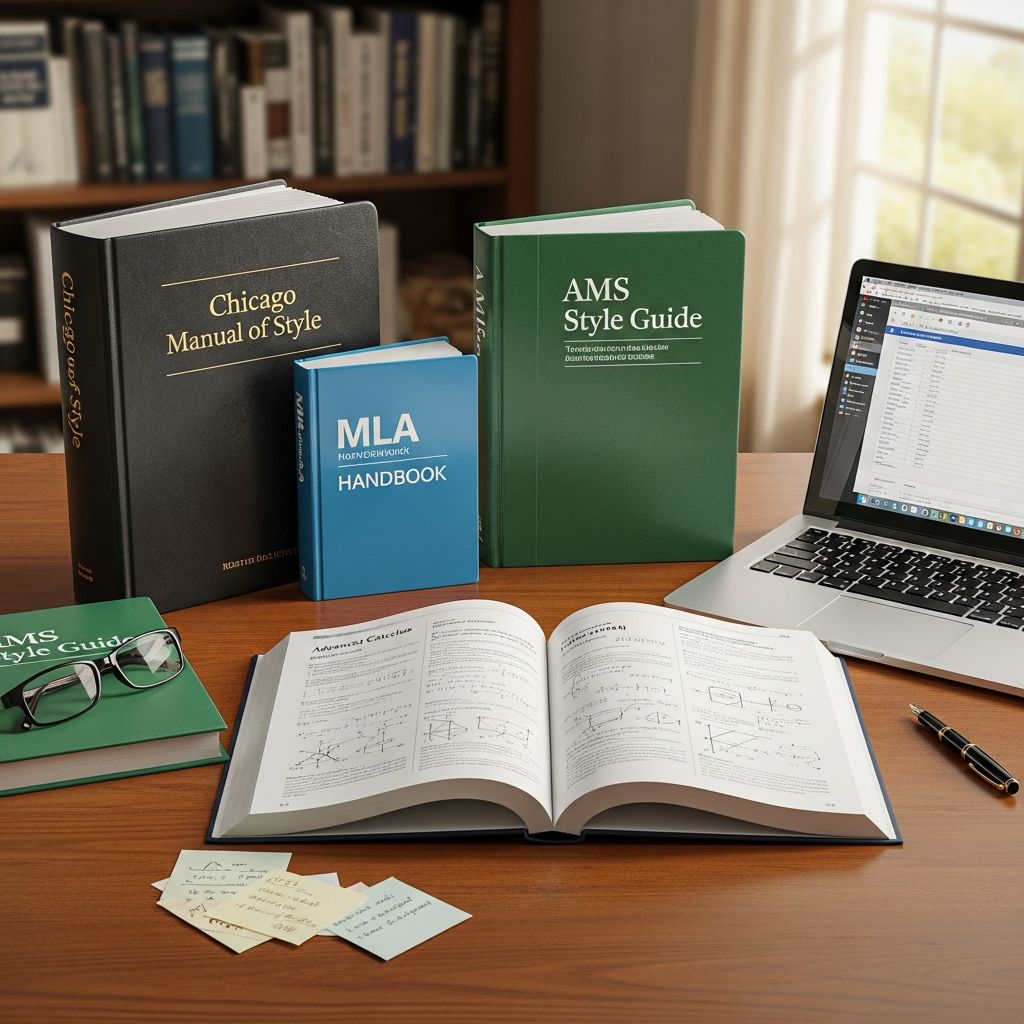
Accurate referencing forms the backbone of scholarly work in mathematics, where precision in crediting sources upholds academic standards and facilitates verification. Unlike fields with rigid conventions, mathematics embraces flexibility in citation practices, often dictated by journals, professors, or institutional guidelines. This comprehensive guide examines the most effective citation styles for math bibliographies, providing in-depth explanations, examples, and tools to streamline your workflow.
Why Citation Matters in Mathematical Research
In mathematics, citations not only attribute theorems, proofs, and datasets but also enable readers to trace intellectual lineages across papers. Proper formatting prevents plagiarism accusations and enhances paper credibility. Key benefits include standardized navigation for complex topics like algebraic geometry or number theory, where cross-references abound. Always confirm requirements upfront—many math departments favor styles mirroring prominent journals such as those from the American Mathematical Society (AMS).
- Consistency: Uniform style across a document aids readability amid dense equations.
- Adaptability: Math papers often integrate LaTeX, where packages like amsrefs automate formatting.
- Journal Compliance: Publishers like Springer or Elsevier specify styles in author guidelines.
American Mathematical Society (AMS) Style: The Gold Standard
AMS style dominates mathematical publishing, outlined in the AMS Style Guide’s Chapter 10. It supports three in-text methods: numerical brackets, author-year, or alphanumeric codes, offering versatility for different document types.
In-Text Citation Options
- Numerical Brackets: Sequential numbering, e.g., “Markov chains optimize data centers .” Reuses original numbers for repeats.
- Author-Year: Parenthetical, e.g., “Efficiency gains via Markov chains (Smith 2019).”
- Alphanumeric: Abbreviated, e.g., “[S19] details Markov applications.”
Bibliography Formats
For numerical in-text, list entries by appearance order. Alphabetical for author-year or alphanumeric.
| Type | Format | Example |
|---|---|---|
| Print Book | [#] Author. Title. Publisher, City, Year. MR number. | A. Author. Algebraic Structures. AMS, Providence, 2020. MR1234567. |
| Journal Article | [#] Author. “Article Title.” Journal Abbrev. Vol (Year), no. X, pages. DOI. MR. | J. Denef and F. Loeser. “Germs of Arcs.” Invent. Math. 135 (1999), 201–232. DOI 10.1007/s002220050284. MR1664700. |
LaTeX users leverage \usepackage{amsrefs} for seamless integration, as detailed in the AMS Author Handbook.
Chicago Manual of Style: Versatile for Math Papers
Chicago offers dual systems—notes-bibliography (ideal for humanities-influenced math history) and author-date (suited for sciences)—making it adaptable for theses or interdisciplinary work. Chapters 14-15 of the 17th edition guide math-specific applications.
Notes-Bibliography System
Footnotes/endnotes link to a bibliography. Example footnote: “See O’Connell, Public Health (New York: Queens Publishing, 2001), 72, table 5.” For figures: full item name post-page, e.g., fig. 6.
Author-Date System
In-text: (O’Connell 2007, 68, fig. 6). Alphabetized reference list.
- Handles non-standard items like maps or tables effectively in math contexts.
- Common in journals blending math with stats or applied fields.
APA Style: Structured for Empirical Math Studies
APA, from the American Psychological Association, excels in papers with statistical analysis or cognitive math research. In-text: (Author, Year, p. XX). References alphabetized, emphasizing DOIs.
| Element | Example |
|---|---|
| Journal | Author, A. A. (Year). Title. Journal Name, volume(issue), pages. https://doi.org/xx |
| Book | Author, A. A. (Year). Title. Publisher. |
Though less common in pure math, APA suits educational or experimental math papers.
IEEE Style: Precision for Computational Math
IEEE, prevalent in engineering-math crossovers, uses numerical citations , . References numbered sequentially, with standardized abbreviations.
- Journal: A. A. Author, “Title,” Abbrev. Journal, vol. x, no. x, pp. xxx-xxx, Month Year.
- Book: A. A. Author, Title of Book. City of Publisher, Country: Publisher, Year.
Ideal for algorithm-heavy papers; tools like IEEE Citation Machine automate.
CSE and Other Specialized Formats
Council of Science Editors (CSE) provides name-year, citation-sequence, or citation-name options, useful for biological math modeling. Example: Author (Year) or superscript numbers.
- Flexibility: Matches interdisciplinary needs.
- MLA: Less frequent but viable for math history essays; author-page in-text.
Math journals often tweak these (e.g., MAA house style). Check “Instructions for Authors.”
LaTeX and Citation Management Essentials
LaTeX dominates math writing; BibTeX/amsrefs handles bibliographies. Workflow: Create .bib file, use \bibliographystyle{amsplain}, run BibTeX.
- Tools: Zotero, Mendeley, JabRef for .bib generation; Overleaf for collaborative editing.
- amsrefs Package: Chapter 7 of AMS Author Handbook details setup.
Supports all styles above, ensuring equation-compatible output.
Choosing the Right Style for Your Math Project
Select based on context:
| Project Type | Recommended Style | Reason |
|---|---|---|
| Pure Math Journal | AMS | Industry standard, LaTeX-native. |
| Thesis/Interdisciplinary | Chicago | Flexible notes or author-date. |
| Applied/Stats Paper | APA or IEEE | Empirical focus, DOIs. |
Consult professors; mimic target journal styles.
Frequently Asked Questions (FAQs)
What is the most common citation style in mathematics?
AMS style is predominant, used in most math journals for its LaTeX compatibility and flexible in-text options.
Do math papers require DOIs in bibliographies?
Yes, especially in AMS and modern styles; include if available for accessibility.
How do I cite a figure in Chicago style for math?
Use (Author Year, page, fig. X) in author-date or full note in bibliography system.
Can I use Zotero for math citations?
Absolutely; it exports BibTeX files compatible with LaTeX and supports AMS/Chicago.
Is there a universal math citation style?
No consensus exists; follow journal or instructor preferences.
Best Practices for Error-Free Math Bibliographies
Verify MR numbers via MathSciNet; use DOIs; alphabetize consistently; abbreviate journals per standards. Proofread for italicized titles and proper punctuation. Tools like JabRef validate entries.
References
- Most Common Citation Styles – Mathematics — Koç University Library. Accessed 2026. https://libguides.ku.edu.tr/maths/citation_styles
- A Guide to Mathematics Resources: Citations — Washington University Libraries. 2023-09-05. https://libguides.wustl.edu/math/citations
- Science & Engineering Citation Style Guide: American Mathematical Society (AMS) — USC Libraries. Accessed 2026. https://libguides.usc.edu/c.php?g=974981&p=7048536
- Citations – Mathematics & Statistics — Tri-College Libraries. Accessed 2026. https://guides.tricolib.brynmawr.edu/c.php?g=285071&p=1899518
- Citation Styles for Mathematics — Bates College Library. Accessed 2026. https://libguides.bates.edu/c.php?g=273459&p=10452122
- Mathematics: Citing Sources — Western Carolina University Library. Accessed 2026. https://researchguides.wcu.edu/mathematics/citing

- Integrated M.A. in Applied Linguistics, University of Hyderabad
- 5+ years in editorial, instructional, SEO, and research-based writing
Sneha is a relationships and lifestyle writer with a strong foundation in applied linguistics and certified training in relationship coaching. She brings over five years of writing experience to theskillvault, crafting thoughtful, research-driven content that empowers readers to build healthier relationships, boost emotional well-being, and embrace holistic living. Her writing and insights reflect the belief that beauty, happiness, and wellness…