
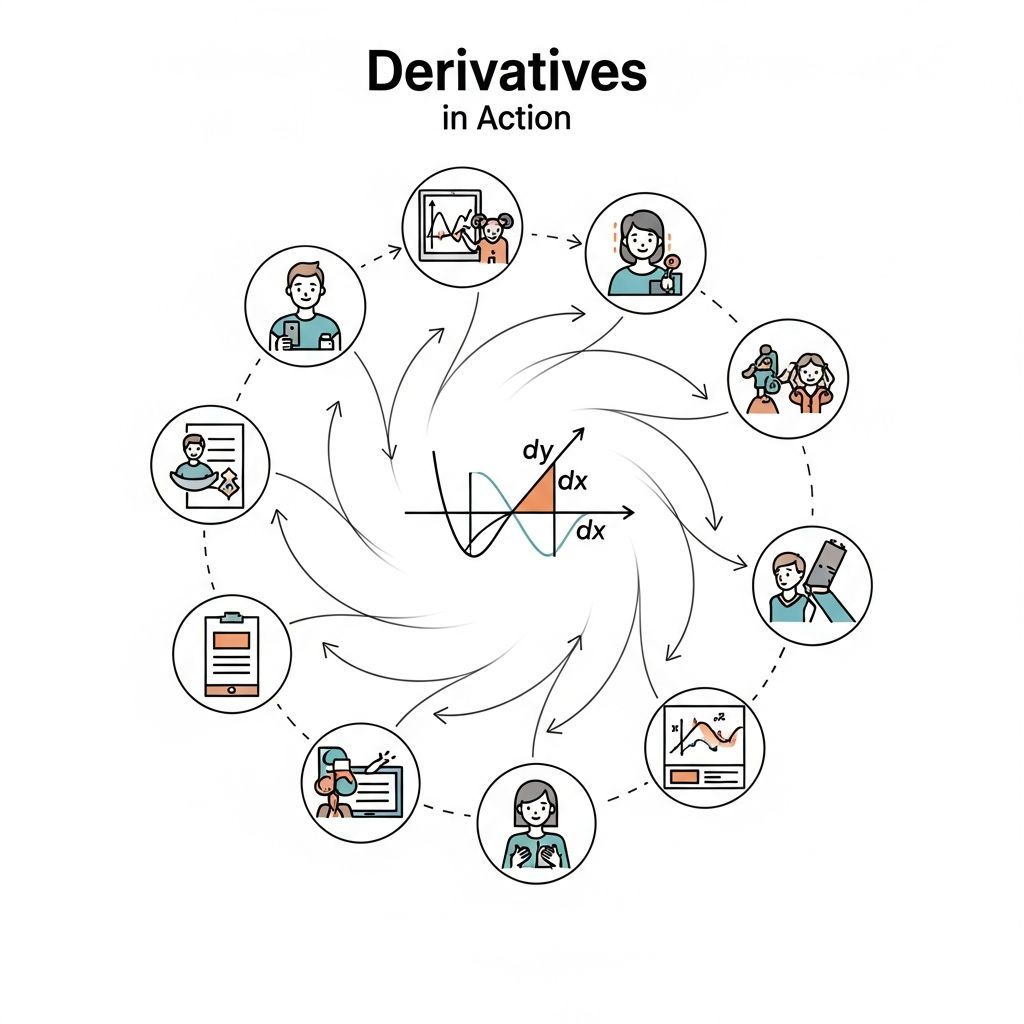
Derivatives, a cornerstone of calculus, quantify how functions change, revealing rates of change like velocity from position or marginal cost from total expenses. Far from abstract theory, they underpin decisions across disciplines, from optimizing profits to modeling biological growth.
Understanding the Essence of Derivatives
The derivative of a function f(x), denoted f'(x) or df/dx, measures the instantaneous rate of change at a point. Geometrically, it represents the slope of the tangent line to the curve. In practice, this tool predicts variations in dynamic systems.
For instance, if position s(t) = 5t² meters describes a car’s path, velocity v(t) = ds/dt = 10t m/s emerges directly from differentiation. This foundational concept extends to complex scenarios in science and commerce.
1. Tracking Motion in Physics and Engineering
In physics, derivatives describe kinematics: velocity as the first derivative of position, acceleration as the second. Engineers apply this to design vehicles and structures.
- A rocket’s altitude h(t) = 100t – 5t² yields velocity h'(t) = 100 – 10t, peaking at t=5 seconds before descent.
- Bridges use derivatives to analyze stress variations under wind loads, ensuring safety.
These calculations prevent failures, as seen in aerospace where trajectory optimization relies on derivative-based simulations.
2. Optimizing Business Profits and Costs
Economics leverages derivatives for marginal analysis. Marginal revenue, dR/dx, guides pricing; marginal cost, dC/dx, informs production levels.
Consider revenue R(x) = 50x – 0.5x². Then MR(x) = 50 – x. At x=40 units, MR=10, signaling if extra sales boost income.
| Units (x) | Total Revenue | Marginal Revenue |
|---|---|---|
| 30 | 1125 | 20 |
| 40 | 1200 | 10 |
| 50 | 1250 | 0 |
Profit maximization sets dP/dx=0, often at production peaks like x=100 for P(x)=-2x²+400x-500.
3. Modeling Drug Dynamics in Medicine
Pharmacokinetics uses derivatives to track drug concentrations. For C(t)=100e^{-0.1t}, the elimination rate dC/dt=-10e^{-0.1t} helps dose timing.
Physicians predict peak levels and decay, minimizing side effects. In epidemiology, derivatives model infection rates, aiding outbreak control.
4. Population Growth in Biology
Biological models like logistic growth dP/dt = rP(1-P/K) use derivatives for population forecasts. Ecologists predict carrying capacities.
- Bacteria growth: dN/dt = kN reveals exponential phases.
- Endangered species management optimizes intervention via growth rate analysis.
These insights support conservation strategies.
5. Economic Forecasting and Investments
Financial analysts use derivatives for sensitivity: how stock prices react to interest rates. Gradient descent in algorithms minimizes portfolio risk.
For cost J(θ)=θ²+3θ+2, J'(θ)=2θ+3=0 yields θ=-1.5, the minimum.
6. Chemical Reaction Rates
Chemistry applies derivatives to reaction kinetics. Rate laws like d[C]/dt = -k[C] predict reactant depletion.
In catalysis design, engineers optimize conditions for maximum yield, using derivative extrema.
7. Temperature and Environmental Monitoring
Meteorology tracks dT/dt for weather patterns. Seismology uses derivatives for earthquake magnitude ranges.
Climate models differentiate CO2 levels over time to forecast warming rates.
8. Efficient Shipping and Logistics
Shipping minimizes costs via derivatives. For a 6000km voyage, total cost C(v)=a/v + bv² (fuel + time). Minimize by dC/dv=0.
This balances speed and economy, as in container ships optimizing velocity.
9. Machine Learning and Optimization
AI training employs gradients: θ_new = θ – α∇J(θ). Derivatives drive backpropagation for accurate predictions.
From image recognition to recommendations, derivatives refine models iteratively.
Advanced Techniques: Approximations and Tangents
Derivatives enable linear approximations: f(x+Δx) ≈ f(x) + f'(x)Δx, useful for small changes in engineering tolerances.
Tangents and normals aid curve analysis in design.
Frequently Asked Questions
What is a derivative in simple terms?
A derivative measures how much a quantity changes per unit change in another, like speed from distance over time.
Why study derivatives if I don’t do math daily?
They empower data-driven decisions in careers from finance to healthcare.
Can derivatives predict the future?
They forecast trends based on current rates, as in population or market models.
Are derivatives used in smartphones?
Yes, in GPS for velocity, cameras for focus, and apps for optimization.
How do I start applying derivatives practically?
Practice with real data: graph sales and find profit maxima.
References
- Real-Life Applications of Differentiation — GeeksforGeeks. 2023-10-15. https://www.geeksforgeeks.org/maths/real-life-applications-of-differentiation/
- Applications of Derivatives in Maths — BYJU’S. 2024-01-20. https://byjus.com/maths/applications-of-derivatives/
- Derivatives and their real world applications — Thrive Global. 2022-05-10. https://community.thriveglobal.com/derivatives-and-their-real-world-applications/
- Derivatives: Real Life Applications #5 — YouTube (Why of Psi). 2021-06-12. https://www.youtube.com/watch?v=L84zvWHZE3o
- Applications of derivatives — Khan Academy. 2025-03-01. https://www.khanacademy.org/math/differential-calculus/dc-context-app

- Integrated M.A. in Applied Linguistics, University of Hyderabad
- 5+ years in editorial, instructional, SEO, and research-based writing
Sneha is a relationships and lifestyle writer with a strong foundation in applied linguistics and certified training in relationship coaching. She brings over five years of writing experience to theskillvault, crafting thoughtful, research-driven content that empowers readers to build healthier relationships, boost emotional well-being, and embrace holistic living. Her writing and insights reflect the belief that beauty, happiness, and wellness…