
Transforming Your Classroom with Seasonal Wall Displays
Bulletin boards serve as powerful visual teaching tools in educational environments, offering opportunities to celebrate holidays while reinforcing curriculum objectives. Easter presents an ideal occasion to refresh classroom aesthetics and create immersive learning experiences. Effective bulletin board design combines visual appeal with pedagogical purpose, allowing educators to celebrate the season while maintaining focus on academic and social-emotional learning goals.
Creating meaningful Easter displays requires thoughtful planning that balances artistic expression with practical classroom management. Teachers can leverage this seasonal opportunity to encourage student participation, practice fine motor skills, and integrate holiday themes into broader learning units. A well-executed bulletin board becomes more than decoration—it transforms into an interactive learning environment that fosters creativity and class community.
Bunny-Centered Designs for Early Elementary Learners
Easter bunnies captivate young learners’ imaginations and provide an engaging entry point for classroom displays. Bunny-themed bulletin boards work particularly well in primary grades where students respond enthusiastically to familiar holiday characters and can contribute their own artistic interpretations.
Literacy Integration Through Hopping Narratives
One effective approach combines reading promotion with Easter imagery by creating a board titled “Hop Into Engaging Stories” or similar literacy-focused phrases. Educators can construct a large bunny figure that appears to leap across rolling terrain scattered with colorful eggs. Each egg becomes a mini-book recommendation, featuring age-appropriate titles related to Easter, spring themes, or beloved rabbit characters. Students can participate by illustrating their favorite books, writing brief reviews, or creating predictions about stories not yet read. This approach naturally integrates literature circles, reading comprehension discussions, and peer recommendations into seasonal decoration.
Personalization Through Collaborative Egg Designs
Another strategy involves creating a welcoming environment where every student sees their contribution displayed prominently. The phrase “Welcome Every Learner” or “Our Classroom Community” frames a central Easter bunny surrounded by student-decorated egg cutouts. Students receive paper eggs to color, paint, or embellish using various art media. Adding each child’s name to their creation reinforces individual recognition while building class cohesion. This activity develops artistic skills while simultaneously creating a visually cohesive display that celebrates classroom diversity.
Three-Dimensional Paper Craft Construction
Creating dimensional bunny crafts engages students in hands-on activities while producing display-worthy artwork. Using paper plates as a foundation, students layer and construct Easter bunnies with moveable parts. By painting both large and small plates the same color and stapling them together, students create bunny heads and bodies. Cut construction paper pieces become ears, legs, and arms that students attach using glue or staples. Students complete their bunnies by drawing facial features and adding cotton ball tails. The creative element deepens when students write reflective paragraphs on white paper “tummies,” sharing personal Easter memories, favorite spring activities, or hopeful thoughts. Displaying these three-dimensional bunnies in clustered arrangements creates visual depth and texture that engages viewers at multiple eye levels.
Spring Transition Displays Combining Multiple Themes
Easter coincides with spring’s arrival, creating natural opportunities to blend seasonal themes. Displays that celebrate both renewal and specific holiday traditions resonate with students experiencing seasonal transitions in their local environments.
Comprehensive Spring Landscape Designs
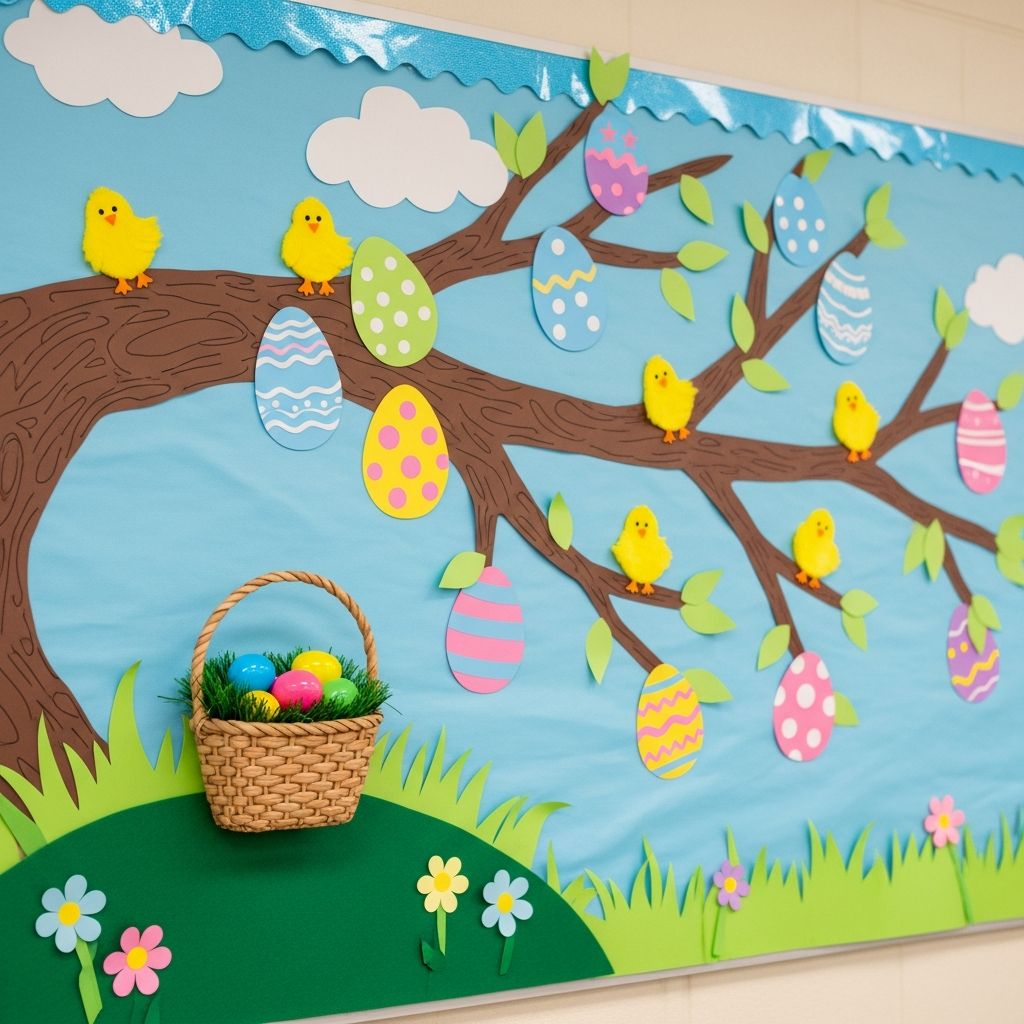
Creating a unified spring scene incorporates multiple seasonal elements beyond rabbits alone. A large tree with emerging green leaves provides a central focal point, complemented by sprouting flowers, awakening grass, and various spring animals. Bunnies, baby chicks, songbirds, and butterflies populate the landscape, creating visual interest throughout the display. Including the phrase “Spring Awakens” or “New Growth, New Beginnings” connects seasonal imagery to broader themes of renewal and transformation. This design opportunity naturally extends into science lessons about plant life cycles, animal adaptations, and ecosystem changes during spring months. Students can research specific animals and plants, creating informational labels that educate viewers while reinforcing research and writing skills.
Interactive Handprint Flower Gardens
Handprint-based displays create memorable keepsakes while building inclusive classroom culture where every student contributes equally. Beginning with green painted grass along the bulletin board’s lower edge, educators add flower stems and leaves as frameworks. Students dip their hands in washable paint and create flower petals by pressing onto the board, with each handprint representing a unique petal. Paint colors can vary by student or follow planned color patterns, creating rainbow effects or gradient displays. The finished flower garden typically includes additional elements like painted suns, clouds, butterflies, and strategically hidden Easter eggs within the grass. Phrases such as “Blossoming Together” or “Growing as Learners” reinforce positive classroom messages. This collaborative approach ensures even students with limited artistic confidence produce visible contributions to the final display.
Religious and Spiritual Perspectives in Easter Displays
For schools and classrooms where religious education comprises part of the curriculum, Easter bulletin boards can respectfully incorporate spiritual dimensions of the holiday while remaining inclusive of diverse family backgrounds.
Acrostic Message Designs
Creative wordplay allows educators to present meaningful messages in visually interesting formats. Arranging the word “EASTER” vertically, educators can pair each letter with significant phrases reflecting Easter’s religious significance. Starting with “E,” phrases might progress through “Entered into death,” “Arose on the third day,” “Salvation promised,” “Triumph over darkness,” “Eternal hope,” and “Redeemed through grace.” This acrostic approach encourages students to read carefully, understand sequencing, and engage with complex concepts developmentally appropriate to their grade level. Visual elements like crosses, lilies, stones, and dawn imagery support the narrative without overwhelming the text-based message.
Resurrection Symbolism in Nature-Based Displays
Spring imagery naturally symbolizes resurrection and renewal, allowing educators to weave spiritual themes through nature-centered designs. A blue paper backdrop representing sky frames a landscape showing a cross atop a hill surrounded by lilies and rolling terrain. Additional elements like rainbows, bright suns, and emerging flowers reinforce themes of hope and new life. Student-created sheep using black handprints with cotton ball accents add collaborative dimension. Phrases such as “New Life Emerges” or “Hope Restored” connect spiritual concepts to observable natural phenomena familiar to young learners. This approach integrates religious education with science and art, creating a holistic learning experience.
Practical Design Considerations for Maximum Impact
Successful bulletin boards balance aesthetic appeal with functional purpose, requiring thoughtful decision-making about materials, layout, and accessibility.
Material Selection and Durability
Choosing appropriate materials ensures displays withstand classroom conditions throughout display periods. Heavy construction paper resists tearing better than lightweight alternatives when handling student-created components. Laminating large background pieces or structural elements protects investments while extending reusability across multiple school years. Fabric backgrounds add visual interest while providing texture variation that plain paper lacks. Considering material costs helps educators maximize visual impact within budget constraints.
Color Coordination and Visual Balance
Limiting color palettes to three to five primary colors creates cohesive designs avoiding visual chaos. Spring and Easter naturally suggest pastels, but bright primary colors can work effectively depending on classroom aesthetic goals. Balancing color distribution ensures no single shade dominates, and using complementary colors creates visual interest. Strategic white space prevents overcrowding, allowing viewers’ eyes to rest and focus on specific elements.
Height Variation and Depth Creation
Displaying materials at multiple levels creates visual interest and accommodates various viewer heights. Layering paper cutouts, using three-dimensional crafts, and positioning elements at different depths transforms flat bulletin boards into engaging visual experiences. This variation ensures both adult visitors and students of different heights find content engaging and visible.
Assessment and Learning Integration
Effective bulletin boards extend beyond decoration to support measurable learning objectives.
Documenting Student Growth
Displaying student work at the beginning and end of thematic units allows families and administrators to observe learning progression. Comparing early sketches or written work to polished final products demonstrates growth over time. Including student reflections about their learning process adds metacognitive depth.
Curriculum Connection Framework
Successful displays connect seasonal themes to established curriculum standards. A spring science display might support standards related to life cycles, weather patterns, or animal habitats. Literacy-focused boards can reinforce comprehension skills, vocabulary development, or writing conventions. Math connections might involve measurement, symmetry, or counting activities integrated into the decorating process.
Frequently Asked Questions About Easter Bulletin Boards
Q: How far in advance should I begin planning Easter bulletin board displays?
A: Beginning planning two to three weeks before Easter allows time for gathering materials, creating larger components, and organizing student participation schedules. However, simple displays can be created with shorter preparation timelines if needed.
Q: What if my students have varying artistic abilities?
A: Collaborative displays where every student contributes identically-sized components ensure equitable visibility and confidence-building. Using templates, providing pre-cut shapes, and offering multiple creative approaches accommodates diverse skill levels while maintaining inclusive participation.
Q: Can Easter bulletin boards work in upper elementary or middle school classrooms?
A: Absolutely. Displays can be adapted through more complex designs, research integration, historical connections, or thematic depth appropriate to students’ cognitive development. Older students might research Easter traditions globally, analyze advertising related to the holiday, or create persuasive displays around chosen themes.
Q: How do I incorporate religious content respectfully in diverse classrooms?
A: Focus on factual information about religious significance while avoiding proselytizing. Offer alternative displays or assignment options for families with different traditions. Send advance communication to families about planned content, allowing informed participation choices.
Q: What materials are most cost-effective for Easter bulletin boards?
A: Construction paper, cardstock, student-created artwork, natural materials like branches and leaves, and recycled items provide affordable options. Many bulletin board elements can be reused across multiple years, spreading costs over time.
Q: How long should Easter displays remain posted?
A: Keep displays posted for at least two weeks following Easter to allow maximum visibility. Photographing displays before removal creates lasting documentation for portfolios and family sharing.
References
- Easter Bulletin Board Ideas — Study.com. Accessed 2026-04-04. https://study.com/academy/popular/easter-bulletin-board-ideas.html
- Spring Bulletin Board Ideas, Easter Crafts & Classroom Decor — Miss Jacob’s Little Learners. Accessed 2026-04-04. https://missjacobslittlelearners.com/collections/spring-easter-classroom-decorations
- Easter Bulletin Board Ideas — Twinkl. Accessed 2026-04-04. https://www.twinkl.com/blog/easter-bulletin-board-ideas

Medha Deb is an editor with a master's degree in Applied Linguistics from the University of Hyderabad. She believes that her qualification has helped her develop a deep understanding of language and its application in various contexts. Medha specializes in the areas of beauty, health, sports, and wellness and is committed to ensuring that the content on the website is…