
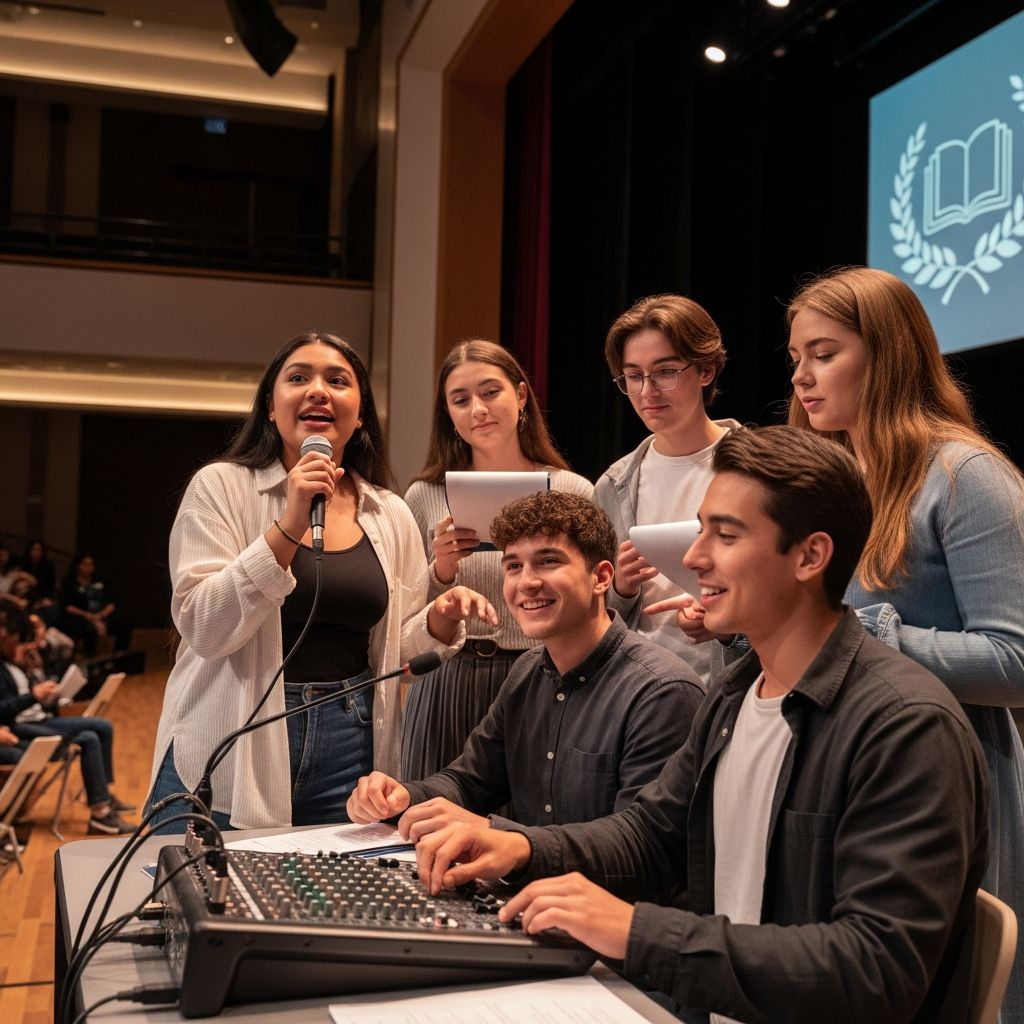
Shifting Focus: Why Student Leadership Matters in Daily Announcements
Morning announcements have long served as a mechanism for delivering administrative information to school communities. However, the traditional model—where adults control messaging and students passively listen—misses a significant opportunity to foster student agency and build genuine school connection. When schools reimagine announcements as platforms for student voices, they create spaces where learners develop communication skills, practice leadership, and feel genuinely valued as contributors to their school culture.
Research on student engagement and classroom climate consistently demonstrates that when students have meaningful roles in school operations, their sense of belonging increases, behavioral issues decrease, and academic motivation strengthens. Morning announcements represent one of the most accessible entry points for distributing leadership opportunities across diverse student populations, reaching virtually every learner in the building simultaneously.
Building a Culture of Student Ownership
The foundation of effective student-centered announcements lies in cultivating an organizational culture that genuinely values student input and decision-making. This begins with leadership teams—administrators, teachers, and counselors—explicitly communicating that student voices matter and that announcements serve as a vehicle for amplifying those voices rather than simply transmitting directives from above.
Schools that successfully implement student-led announcement programs typically establish clear structures and expectations. These include:
- Rotating student anchor positions across grade levels and demographic groups to ensure diverse representation
- Training sessions that teach students professional communication, pacing, and on-camera presence
- Collaborative planning processes where students help determine announcement content and format
- Regular feedback mechanisms allowing student announcers to reflect on their performance and grow
When students understand they have genuine agency in shaping these daily communications, they invest more thoughtfully in the quality and content of announcements, viewing them as extensions of their own leadership identity rather than adult-imposed obligations.
Structuring Announcements Around Student Voices
Traditional announcement formats typically follow a rigid template: opening greeting, pledge, lunch menu, calendar items, and closing. Student-centered announcements maintain necessary information delivery while intentionally weaving in student-created or student-selected content throughout the broadcast.
One effective approach involves designating specific segments for different student groups or clubs. Rather than having administrators announce club meetings, student leaders from each organization deliver their own promotional messages. This creates authentic communication—peers talking to peers—which research shows generates greater engagement than adult-delivered announcements.
Another strategy involves incorporating student-generated content creation. Some schools establish student media teams responsible for producing announcement segments covering topics like:
- Weekly spotlight features on student achievements, talents, or interesting backgrounds
- Student-conducted interviews with classmates, teachers, or guest speakers
- Collaborative projects where students report on classroom learning initiatives
- Student-created skits, music, or performances that reflect school culture and values
These approaches transform announcements from monologue to dialogue, creating genuine communication rather than one-directional information delivery.
Interactive Elements That Drive Real Engagement
Research on learning and attention demonstrates that interactive components significantly increase engagement compared to passive reception. Incorporating interactive elements into student-centered announcements leverages this finding while providing students with voice and choice.
Question-and-answer segments allow student announcers to pose questions to their peers—sometimes serious, sometimes whimsical—and share response highlights during announcements. This might include questions like “What’s one talent you wish you had?” or “If you could have lunch with any historical figure, who would it be?” Beyond the novelty factor, these segments create connection by revealing that classmates have diverse interests, experiences, and perspectives.
Interactive polls and trivia challenges encourage students to actively participate rather than passively listen. Some schools use digital tools allowing real-time student responses, turning announcements into game-like experiences. When announcements become something students actively anticipate rather than background noise, the entire school culture shifts.
Movement breaks integrated into announcements—led by student wellness ambassadors—serve dual purposes: they provide physical activity that enhances focus and learning, and they position student leaders as facilitators of collective school experiences.
Celebrating Student Achievement and Belonging
A cornerstone of student-centered announcements involves creating systematic opportunities to recognize and celebrate student contributions, achievements, and growth. When students’ accomplishments receive airtime during announcements, a powerful message transmits: your efforts matter, and this community acknowledges your value.
Effective recognition programs move beyond traditional honor rolls to celebrate diverse forms of achievement: perfect attendance, improved grades, helpful citizenship, artistic talents, athletic accomplishments, club leadership, and personal growth. By expanding the definition of what merits celebration, schools ensure that recognition reaches broader student populations rather than concentrating on traditionally high-achieving students.
Birthday acknowledgments—a seemingly simple practice—carry significant emotional weight. Students report that having their birthday announced creates a tangible sense of belonging and connection to their school community. Some schools incorporate this with student-created birthday videos or messages from classmates, further personalizing the recognition.
Character education initiatives delivered through student voices prove particularly impactful. When student leaders articulate values like respect, responsibility, kindness, and integrity—connecting these values to real school scenarios—their peer perspective carries weight that adult messages sometimes cannot match.
Addressing Equity and Inclusive Representation
Student-centered announcements only fulfill their potential when leadership opportunities genuinely reflect school diversity. Without intentional attention to representation, announcement teams may inadvertently reinforce existing hierarchies, with the same privileged students maintaining visibility while others remain invisible.
Schools committed to equitable student-centered announcements actively:
- Recruit announcers from all grade levels, not just upper grades
- Ensure gender, racial, and cultural representation among student leaders
- Include voices of students with different learning styles and abilities
- Provide support enabling students who initially lack confidence to develop communication skills
- Rotate positions regularly to distribute leadership opportunities widely
This intentionality transforms announcements from platforms controlled by the school’s social elite to genuinely inclusive spaces where diverse students exercise leadership and visibility.
Integration with Classroom Learning and Character Development
Maximum impact emerges when announcements connect to broader school initiatives and classroom curriculum. Announcements can reinforce literacy learning by featuring student writing, poetry, or book recommendations. They can highlight science discoveries students have made, showcase mathematical thinking, or feature social studies projects.
Many schools use announcements to support social-emotional learning and character development initiatives. Student leaders might share strategies for managing emotions, model inclusive behaviors, or lead discussions about topics like empathy, perseverance, or growth mindset. This integration creates consistency between announcements and what students experience in classrooms, reinforcing core values and learning objectives across multiple contexts.
Technical Considerations and Accessibility
Effective student-centered announcements require thoughtful attention to technical infrastructure and accessibility. Schools benefit from investing in user-friendly recording and broadcasting tools that don’t require extensive technical expertise, enabling more students to participate in production roles.
Closed captioning ensures that students who are deaf or hard of hearing, as well as those in noisy environments or with audio processing differences, can access announcement content. Video descriptions serve similar functions for students with visual impairments. Accessible design isn’t an afterthought—it’s fundamental to ensuring all students can meaningfully engage.
Schools also consider timing and format. Some students learn better with written summaries of announcement information; others benefit from visual presentation. Providing announcements in multiple formats ensures broader accessibility while accommodating diverse learning preferences.
Professional Development for Student Announcers
Supporting student announcers through structured professional development increases the quality of announcements and builds student capacity. Training might address:
- Microphone technique and vocal projection
- Pacing, pronunciation, and emphasis for clear communication
- On-camera presence and eye contact
- Scriptwriting and content organization
- Handling technical difficulties with professionalism
- Inclusive language and representation awareness
Peer mentoring models, where experienced student announcers help train newcomers, develop leadership capacity while maintaining program continuity and culture.
Measuring Impact and Continuous Improvement
Schools serious about student-centered announcements regularly assess impact through multiple measures. Student surveys provide insights into whether classmates feel genuinely engaged with announcements and whether representation feels inclusive. Behavior data may reveal whether student-led announcements contribute to positive school climate. Academic engagement metrics can illuminate connections between announcement participation and broader student motivation.
Feedback from student announcers themselves offers valuable perspective. Do they feel prepared? Do they experience growth in communication skills? Do they feel their voices matter? Regular debrief sessions help refine the program continuously.
Frequently Asked Questions
Q: How do I get started with student-centered announcements if our school currently has adult-led announcements?
A: Begin by introducing one student-led segment weekly, perhaps rotating between grade levels or clubs. Gradually expand student roles as comfort and capability increase. Partner with a teacher champion who can provide initial training and support.
Q: What if student announcers feel nervous or lack confidence initially?
A: Nervousness is normal and typically diminishes with practice. Provide supportive training, start with scripted content, offer recorded rather than live options initially, and celebrate effort alongside outcome. Many students’ confidence grows substantially over a few weeks.
Q: How do we ensure announcements remain appropriate and aligned with school values?
A: Establish clear guidelines about acceptable content, have teachers or administrators review scripts before airing, and provide guidance on professionalism and inclusivity. The goal is supportive structure, not censorship that undermines student voice.
Q: Can student-centered announcements work in large schools?
A: Yes. Larger schools simply need more student announcers and may use rotation systems where different grade levels or groups lead announcements on different days, ensuring broad participation opportunities.
Q: What if our school lacks the technology for video announcements?
A: Student-centered announcements can work with audio-only broadcasts over the PA system, providing written summaries, or using simple presentation slides. The key is student voice, not technology sophistication.
References
- Good Morning! A.M. Announcements Build School Community — Education World. Accessed 2026-04-04. https://www.educationworld.com/a_admin/admin/admin351.shtml
- Morning Announcement Ideas for Schools – Padcaster — Padcaster. Accessed 2026-04-04. https://padcaster.com/blogs/stories/8-creative-ideas-for-recurring-segments-to-add-to-school-morning-announcement
- 10 Fun Morning Announcement Ideas for Schools, Backed by Pedagogical Research — Kapwing. Accessed 2026-04-04. https://www.kapwing.com/resources/10-fun-morning-announcement-ideas-for-schools-backed-by-pedagogical-research/
- Morning Meeting Message Ideas — Responsive Classroom. Accessed 2026-04-04. https://www.responsiveclassroom.org/ideas-for-morning-meeting-messages/
- Morning Message Ideas for Preschool / Elementary Classrooms — Building Wings. Accessed 2026-04-04. https://www.buildingwings.com/blog/morning-message-ideas/
- Lions Quest Skills for Growing: Morning Announcements — Lions Quest. 2016. https://www.lions-quest.org/wp-content/uploads/2016/09/SFG-morningannouncements.pdf

Medha Deb is an editor with a master's degree in Applied Linguistics from the University of Hyderabad. She believes that her qualification has helped her develop a deep understanding of language and its application in various contexts. Medha specializes in the areas of beauty, health, sports, and wellness and is committed to ensuring that the content on the website is…