
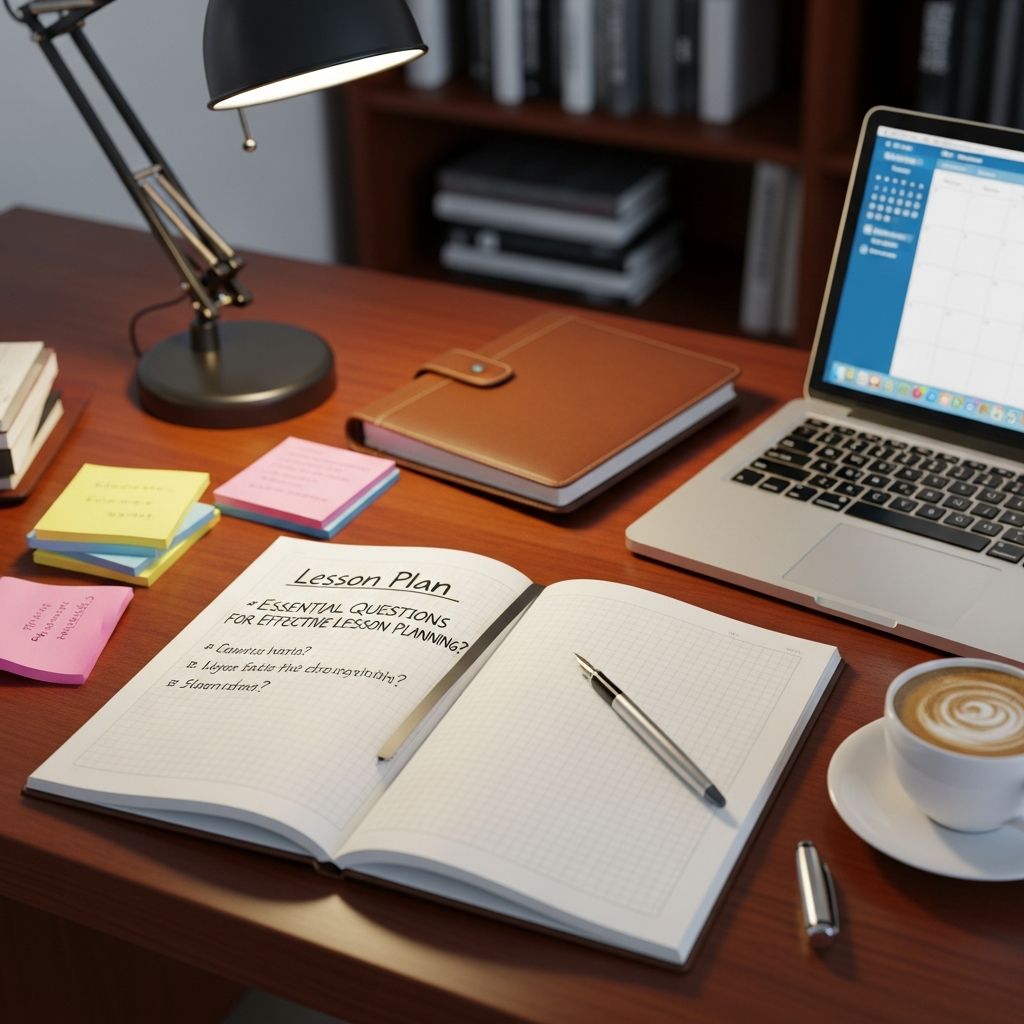
Effective teaching begins with thoughtful preparation. By systematically reflecting on key questions before designing lessons, educators can craft experiences that resonate with students, align with learning objectives, and foster deep understanding. This approach transforms routine planning into a strategic process that maximizes impact in the classroom.
Understanding Your Learners: The Foundation of Planning
Every lesson starts with the students. Recognizing their unique profiles—age, prior knowledge, learning styles, and interests—ensures relevance and accessibility. For instance, visual learners might thrive with diagrams, while kinesthetic students benefit from hands-on activities. Tailoring instruction to these differences prevents disengagement and promotes equity.
Consider diverse intelligences: some students excel in linguistic tasks, others in logical-mathematical reasoning. Surveys or quick assessments at the start of a unit reveal these preferences, allowing teachers to diversify methods. Age-appropriate content is crucial; younger learners need concrete examples, whereas adolescents handle abstract concepts better.
- Assess prior knowledge through pre-tests or discussions.
- Account for cultural backgrounds to build inclusive environments.
- Identify special needs for differentiated support.
This learner-centered focus, drawn from Universal Design for Learning (UDL) principles, provides multiple means of engagement, representation, and expression.
Defining Clear Learning Objectives
What should students know and be able to do by lesson’s end? Precise objectives guide every decision. Use action verbs like “analyze,” “compare,” or “create” from Bloom’s Taxonomy to specify outcomes. Vague goals lead to scattered activities; sharp ones streamline planning.
For example, instead of “learn about fractions,” aim for “Students will solve real-world problems using equivalent fractions.” This clarity helps select relevant resources and assessments. Objectives also inform success criteria, enabling students to self-monitor progress.
| Objective Level | Example Verb | Sample Objective |
|---|---|---|
| Remember | Identify | Identify key events in a historical timeline. |
| Understand | Explain | Explain photosynthesis in simple terms. |
| Apply | Solve | Solve equations using substitution. |
| Analyze | Compare | Compare economic systems. |
| Evaluate | Critique | Critique a peer’s argument. |
| Create | Design | Design an experiment. |
Aligning objectives with standards ensures curriculum fidelity while allowing flexibility for student interests.
Structuring Time for Optimal Flow
Time is a teacher’s scarcest resource. Estimate durations for each segment—warm-up, input, practice, closure—to fit the class period. Overruns disrupt momentum; underestimation leaves gaps. Build in buffers for transitions and unexpected questions.
A 60-minute lesson might allocate 10 minutes to activation, 20 to direct instruction, 20 to guided practice, and 10 to independent work. Pair or group activities save time while boosting collaboration. If short on time, prioritize core objectives; extras become extensions.
- Sequence activities logically: hook, teach, practice, reflect.
- Use timers to maintain pace.
- Adjust based on class energy levels.
Choosing and Adapting Resources Wisely
Materials must support objectives without overwhelming. Evaluate textbooks, videos, or tech tools for fit. Low-tech options like manipulatives often outperform flashy apps in engagement. Consider classroom setup: projector availability, space for movement, or internet reliability.
Adapt resources—simplify instructions, add visuals, or create handouts. Digital tools shine for interactivity but require backups for glitches. Prioritize effectiveness over novelty; a well-chosen chart beats an unused VR simulation.
Designing Classroom Logistics and Interactions
How will students interact? Plan groupings: whole class for modeling, pairs for discussion, individuals for reflection. Clear instructions prevent confusion—model them first. Circulate during group work to provide feedback and monitor progress.
Anticipate logistics: who starts, signal for attention, cleanup roles. Flexible seating enhances dynamics. This structure fosters ownership and reduces behavioral issues.
Integrating Purposeful Assessment Strategies
Assessments inform planning at every stage. Screening identifies baselines, diagnostics pinpoint gaps, progress monitoring tracks growth, and outcomes measure mastery. Embed formative checks like exit tickets or thumbs-up polls.
Purpose-driven questions guide selection: What data do I need? Is it reliable? Align with objectives to avoid redundancy. Data analysis refines future lessons, closing loops effectively.
| Assessment Type | Purpose | Frequency | Example |
|---|---|---|---|
| Screening | Baseline risk | Start of year/unit | Universal reading screener |
| Diagnostic | Strengths/weaknesses | As needed | Phonics inventory |
| Progress Monitoring | Growth tracking | Weekly/biweekly | Oral reading fluency |
| Outcome | Mastery evaluation | End of unit | Performance task |
Anticipating Challenges and Building Flexibility
Foresee hurdles: misconceptions, tech failures, absences. Plan contingencies—backup activities, reteaching scaffolds. Reflect post-lesson: What worked? Adjust for next time. Consistency builds student trust.
Incorporate UDL for resilience: options for engagement, comprehension, and expression. Promote sustained effort through choice and relevance.
Leveraging Questioning to Elevate Instruction
Strategic questions drive thinking. Prepare a mix: factual for recall, divergent for creativity. Scaffold from simple to complex, using wait time for deeper responses. This boosts motivation and higher-order skills.
- Plan questions tied to objectives.
- Use student responses to pivot.
- Encourage peer questioning.
Creating Cohesive Units Over Single Lessons
Zoom out to units: How does this lesson fit? Backward design from enduring understandings ensures progression. Link to broader goals for coherence.
Frequently Asked Questions (FAQs)
What if my students have vastly different needs?
Differentiate through tiered tasks, choice boards, and flexible grouping. UDL guidelines provide options for all.
How do I fit everything into limited time?
Prioritize essentials; use stations or flipped models for efficiency.
Should I always use technology?
Only if it enhances learning—choose based on access and goals.
How often should I assess?
Formatively daily, summatively per unit. Focus on actionable data.
What if a lesson flops?
Reflect immediately, reteach, and iterate. Growth comes from adaptation.
References
- 7 Questions to Ask Yourself Before Planning an English Lesson — Grade University. 2023. https://grade-university.com/blog/questions-to-ask-yourself-before-planning-lesson
- Key Questions to Consider When Planning Lessons — Oregon Department of Education (.gov). 2016. https://www.oregon.gov/ode/schools-and-districts/grants/mentoring/Documents/tchryr2session2_keyquestions.pdf
- 7 Questions To Guide Your PBL Implementation Plan — We Grow Teachers. 2023. https://wegrowteachers.com/7-questions-prepared-answer-pbl-implementation-plan/
- 7 Questions to Ask in Developing an Assessment Plan — The Learning Counsel. 2023. https://thelearningcounsel.com/articles/7-questions-ask-developing-assessment-plan/
- Standards-Based Strategy 7: Questioning Techniques — South Carolina Department of Education (.gov). 2023. https://www.ed.sc.gov/sites/scdoe/assets/file/agency/ccr/Standards-Learning/documents/Strategy7_QuestioningTechniques.pdf
- 7 Questions to Ask When Planning Standards-Based Literacy Instruction — Brookes Publishing. 2024. https://brookespublishing.com/wp-content/uploads/2024/03/7QuestionsStandards.Hougen.pdf

Medha Deb is an editor with a master's degree in Applied Linguistics from the University of Hyderabad. She believes that her qualification has helped her develop a deep understanding of language and its application in various contexts. Medha specializes in the areas of beauty, health, sports, and wellness and is committed to ensuring that the content on the website is…