
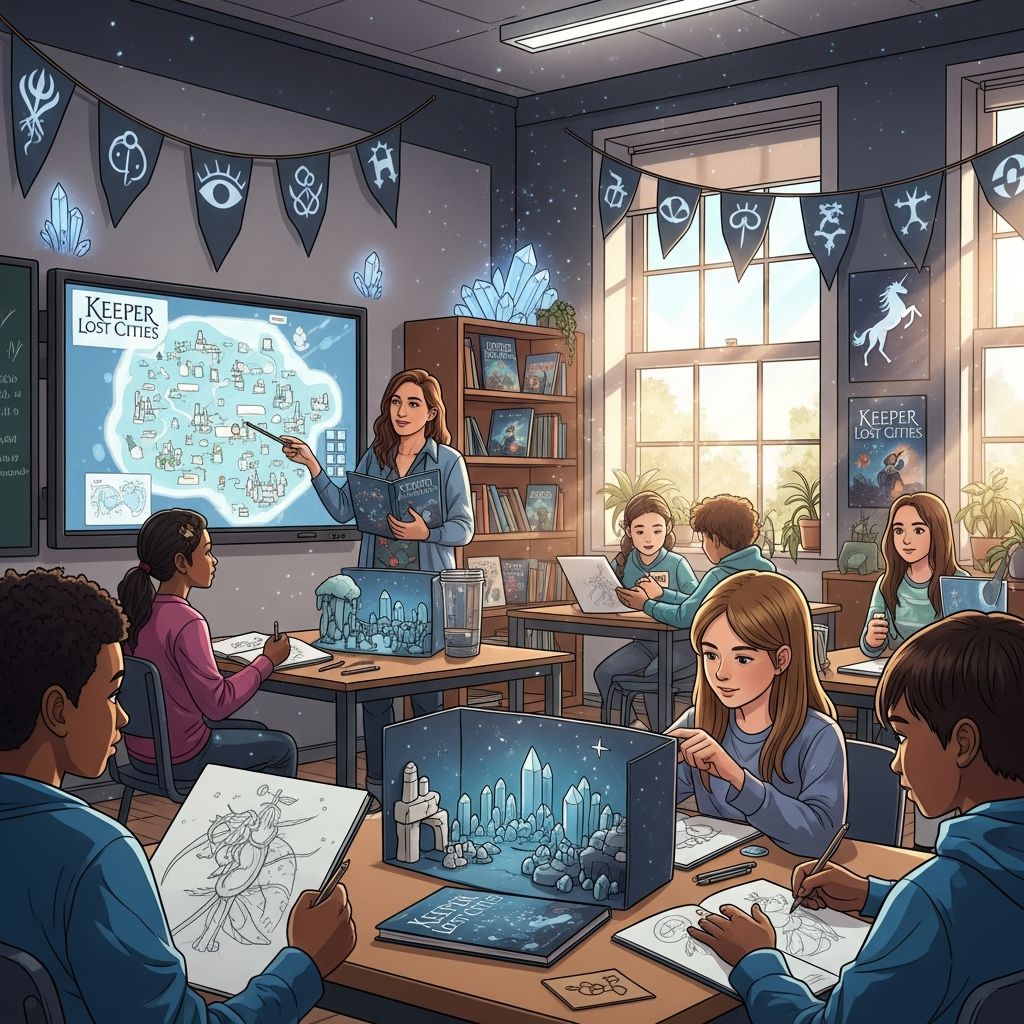
Shannon Messenger’s Keeper of the Lost Cities captivates young readers with its blend of adventure, magic, and mystery in a hidden elven world. This guide provides educators with fresh, engaging strategies to weave the novel into your curriculum, promoting deep reading, creative expression, and collaborative learning. From mapping fantastical realms to crafting character profiles, these activities build literacy skills while immersing students in Sophie’s extraordinary journey.
Building a Foundation: Pre-Reading and Introductory Discussions
Before diving into the chapters, set the stage with activities that prime students’ curiosity. Start with a world-building brainstorm: Ask students to imagine a secret society hidden from humans. What rules govern it? What powers do its inhabitants possess? This mirrors Sophie’s discovery of the Lost Cities and encourages predictive thinking.
- Project student ideas onto a shared digital board or poster for a class ‘Lost Cities Charter.’
- Discuss real-world parallels, like hidden ecosystems or undiscovered species, to ground the fantasy in science.
- Pair this with a quick journal prompt: ‘If you could have one magical ability, what would it be and why?’
Introduce key vocabulary from the book, such as ‘telepath,’ ‘prosthenics,’ and ‘gondola rides,’ using a word wall that evolves as reading progresses. These steps ensure students enter Sophie’s world prepared and excited.
Chapter-by-Chapter Engagement: Comprehension and Reflection
Structure your novel study around thematic chapter clusters rather than daily summaries to maintain momentum. For instance, group early chapters focusing on Sophie’s human life transitioning to elven discovery.
| Chapter Cluster | Focus Theme | Key Activity |
|---|---|---|
| 1-5 | Identity Discovery | Personal Talent Inventory: Students list their ‘hidden talents’ with evidence, akin to Sophie’s telepathy. |
| 6-10 | Friendships & Alliances | Alliance Web: Draw connections between characters, predicting betrayals. |
| 11-15 | Magical School Life | Class Schedule Design: Create a Foxfire timetable with invented elf subjects. |
End each cluster with reflective prompts: ‘How does Sophie’s new ability change her view of her old life?’ Encourage evidence-based responses with page citations to hone analytical skills.
Creative Mapping: Visualizing the Lost Cities Universe
One of the novel’s strengths is its richly detailed settings, from Havenfield’s animal preserve to the gleaming halls of Foxfire. Guide students in crafting interactive world maps that capture these locales.
- Collect descriptions of key locations like Lumenaria, Eternalia, and the Forbidden Cities.
- Have pairs sketch maps incorporating scale, legends, and fantastical creatures like goxlings or verminion.
- Incorporate tech: Use free tools like Google Drawings or Canva for digital versions, adding hyperlinks to character quotes.
Display maps classroom-wide for a ‘Lost Cities Tour’ where creators present their designs. This activity reinforces geography, descriptive writing, and artistic skills while reviewing plot points.
Character Deep Dives: Profiles and Social Media Simulations
Sophie, Fitz, Keefe, and others leap off the page with complex personalities. Engage students by having them develop digital character dossiers.
- Choose a character and compile traits, motivations, relationships, and growth arcs with textual evidence.
- Create ‘social media profiles’—think Fakebook pages with profile pics, friend lists, status updates, and posts reflecting key events.
- Host a class ‘scrolling feed’ gallery walk where students comment on peers’ profiles as if in-universe friends.
This fosters empathy, inference, and multimedia literacy. Extend by debating: ‘Who is the most reliable ally for Sophie and why?’.
Artistic Interpretations: From Imagery to Illustrations
Messenger’s vivid imagery—similes of shimmering light-paths or metallic-tasting fear—begs visual response. Launch an imagery gallery project.
Students select 3-5 quotes, illustrate them, and categorize sources (nature, technology, emotions). Categories might include:
- Nature-inspired: Glowing rivers, crystal forests.
- Magical tech: Leaping crystals, pathfinders.
- Emotional metaphors: Hearts pounding like thunder.
Culminate in a class discussion: ‘How does imagery shape our emotional connection to the story?’ Display as a ‘Wall of Wonders’ for ongoing inspiration.
Writing Extensions: Journals, Poems, and Travelogues
Transform passive reading into active creation with writing workshops.
Sophie’s Secret Journal
Students pen 5-7 entries from Sophie’s perspective on pivotal moments, emphasizing internal conflict. Include a post-climax ‘what if’ entry predicting book two events.
Poetic Remixes
Extract appealing phrases and remix into found poetry, focusing on rhythm and metaphor. Share via poetry slam.
Elven Travel Blogs
Write articles as if touring Lost Cities spots, blending book details with invented sensory experiences. Publish in a class anthology.
Group Challenges: Escape Rooms and Role-Play Scenarios
Boost collaboration with immersive challenges inspired by the book’s puzzles. Design a classroom escape room with locks requiring book knowledge: Decode runes for a word lock, match animal facts for numbers, or sequence plot events.
- Teams solve to ‘rescue Sophie’ from a locked box containing prizes.
- Adapt for virtual: Use Google Forms with branching clues.
Alternatively, stage role-plays of Foxfire classes or council meetings, with students embodying talents like conjurers or empaths.
Assessing Learning: Rubrics and Culminating Projects
Track progress with holistic rubrics emphasizing evidence use, creativity, and collaboration. Culminate in choice-board projects:
| Project Option | Skills Targeted | Product |
|---|---|---|
| Future Home Design | Descriptive Writing, Art | Illustrated blueprint of an adult character’s home. |
| Theme Debate | Argumentation, Research | Multimedia presentation on belonging or power. |
| Sequel Pitch | Plot Structure, Prediction | Storyboard for Book 2 opener. |
These ensure differentiated assessment while celebrating the book’s themes.
Frequently Asked Questions (FAQs)
What age group is ideal for these activities?
Best for grades 4-7, aligning with the book’s middle-grade appeal and reading level.
Can these be adapted for remote learning?
Yes—use platforms like Padlet for maps, Flipgrid for discussions, and Genially for interactive profiles.
How do I incorporate standards?
Activities align with CCSS for reading literature (inference, theme), writing (narrative, informative), and speaking/listening.
Are there extensions for advanced readers?
Add comparative essays with other fantasies or research on mythology inspiring elf lore.
What if students haven’t finished the book?
Scaffold with spoiler-free previews and flexible grouping.
Essential Objects Hunt: Symbolism and Discussion
Curate a class collection of five pivotal artifacts (e.g., Sophie’s home crystal, Keefe’s pin). In groups, debate their symbolic weight, then vote on the most essential for a whole-class share-out. This sharpens thematic analysis.
By integrating these activities, teachers not only cover the plot but cultivate lifelong readers who think critically about fantasy’s power to reflect real-world issues like identity and friendship.
References
- Curriculum Guide – Keeper of the Lost Cities (Stellarlune) — Simon & Schuster Publishing. 2023. https://simonandschusterpublishing.com/keeper-of-the-lost-cities/documents/91189_KOTLC_CurriculumGuide_Stellarlune.pdf
- Keeper of the Lost Cities Novel Study Resources — Teachers Pay Teachers. 2024. https://www.teacherspayteachers.com/browse?search=keeper+of+the+lost+cities
- A Curriculum Guide to Keeper of the Lost Cities — Shannon Messenger. 2017. https://shannonmessenger.com/wp-content/uploads/2017/11/keeper-of-the-lost-cities_cg.pdf
- Educators – Keeper of the Lost Cities — Shannon Messenger. 2024. https://shannonmessenger.com/teacherslibrarians.html
- Keeper of the Lost Cities Escape Room — The Overlake School. 2023. https://www.overlake.org/about/news/2661
- Your Lessons | Keeper of the Lost Cities — TeachingBooks. 2024. https://school.teachingbooks.net/clp.cgi?master_id=37410&lf_id=9

- Integrated M.A. in Applied Linguistics, University of Hyderabad
- 5+ years in editorial, instructional, SEO, and research-based writing
Sneha is a relationships and lifestyle writer with a strong foundation in applied linguistics and certified training in relationship coaching. She brings over five years of writing experience to theskillvault, crafting thoughtful, research-driven content that empowers readers to build healthier relationships, boost emotional well-being, and embrace holistic living. Her writing and insights reflect the belief that beauty, happiness, and wellness…