
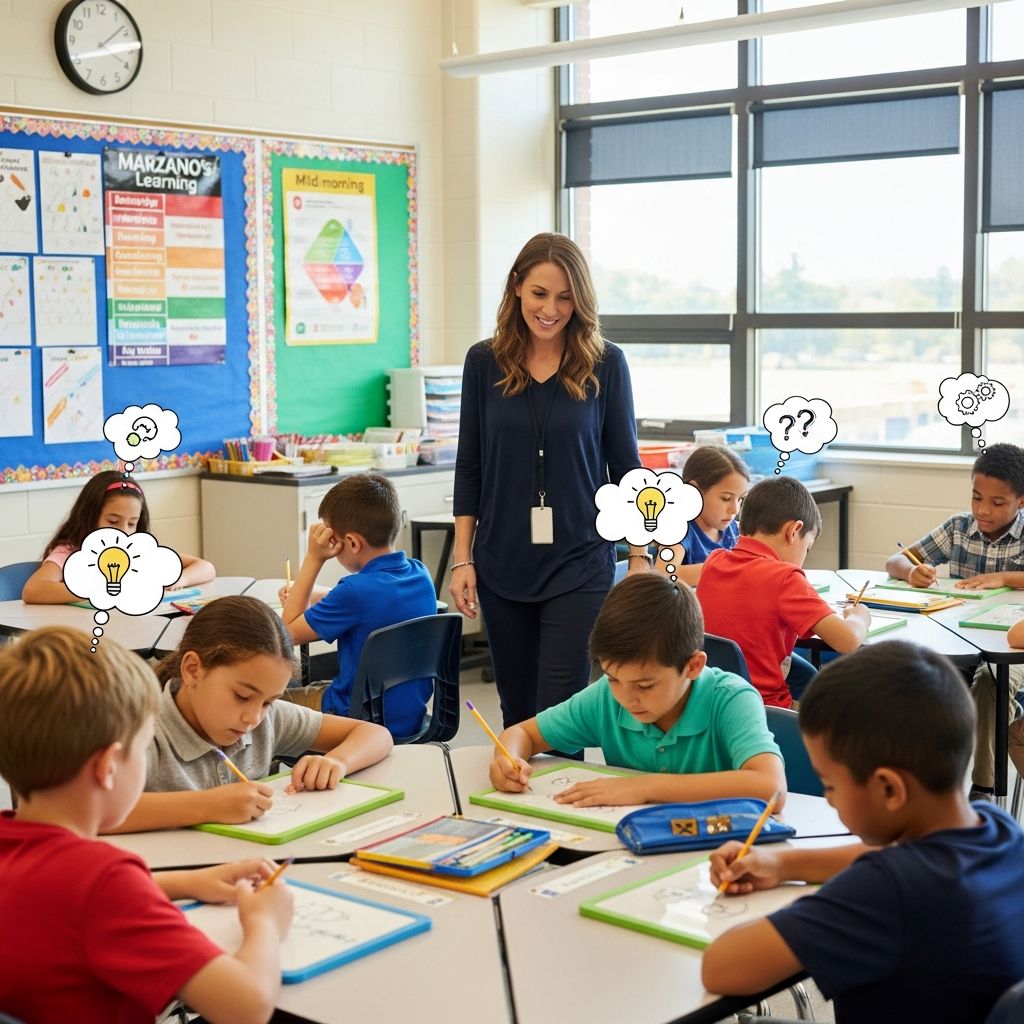
Robert Marzano’s research-backed instructional model offers educators powerful tools to transform everyday classroom moments into opportunities for profound learning. By weaving his high-yield strategies into morning announcements and end-of-day reflections, teachers can activate prior knowledge, reinforce key concepts, and cultivate metacognitive skills. This approach not only enhances student engagement but also builds a culture of continuous improvement across all grade levels.
Building a Foundation with Marzano’s Core Principles
At the heart of Marzano’s framework lies a structured path from teacher actions to student outcomes. His elements, organized into domains like lesson segments and professional responsibilities, emphasize previewing new content by linking it to what students already know. For instance, when teachers prompt students to recall relevant prior experiences, formative evidence shows stronger connections to upcoming material. This theory of action—focus statements leading to desired effects—provides a roadmap for intentional instruction.
In daily routines, such as morning announcements, these principles shine. Instead of rote recaps, announcements become dynamic previews that set the stage for the day’s learning. Marzano’s developmental scales allow teachers to self-assess and refine their practice, ensuring consistency and growth.
Activating Prior Knowledge Through Morning Briefings
Morning announcements offer a prime window to engage Marzano’s previewing element. Teachers can design brief activities where students access and share prior knowledge related to the day’s objectives. This might involve quick pair-shares: “Think of a time you solved a similar problem—what worked?” Such prompts create cognitive bridges, with evidence indicating students better link old and new information.
- Quick Recall Prompts: Pose 1-2 targeted questions tying yesterday’s lesson to today.
- Visual Anchors: Display a graphic organizer recapping key ideas from prior units.
- Student-Led Shares: Rotate student announcers to summarize connections, building ownership.
These tactics align with Marzano’s high-yield strategies, like identifying similarities and differences, which research shows boosts comprehension by simplifying complex ideas.
High-Yield Strategies for Reflective Announcements
Marzano identifies nine strategies proven to elevate achievement, several ideal for short morning segments. Comparing and contrasting fosters deep analysis—use announcements to highlight parallels between historical events or math concepts. Note-taking cues, such as shared digital boards, encourage concise summarization.
| Strategy | Morning Application | Expected Student Effect |
|---|---|---|
| Similarities & Differences | Venn diagram teaser for science topics | Enhanced problem-solving via pattern recognition |
| Setting Objectives | State daily goals with success criteria | Clear direction for focused effort |
| Feedback Loops | Quick poll on yesterday’s mastery | Corrective insights for adjustment |
| Effort Recognition | Shout-outs for homework completion | Increased motivation and persistence |
Implementing these in 5-10 minutes daily compounds benefits, as consistent practice reinforces neural pathways for retention.
Structuring End-of-Day Reflections for Mastery
Reflection segments draw from Marzano’s reviewing and revising knowledge elements. Students process what they’ve learned, identify gaps, and plan next steps. A simple three-question protocol—What stuck? What confused? How will I improve?—mirrors his emphasis on metacognition.
Organize interactions purposefully: think-pair-share or small-group huddles allow elaboration. Provide scales for self-rating progress against rubrics, communicating clear goals upfront. This feedback mechanism, central to Marzano’s model, ensures students internalize standards.
- Daily journals with prompts tied to objectives.
- Exit tickets rating confidence on a 0-4 scale.
- Peer feedback stations for constructive notes.
Domain-Specific Applications Across Subjects
Marzano’s framework spans content areas. In language arts, reflections might classify texts by genre similarities. Math classes use hypothesis testing: “Test your strategy on this problem—what changed?” Science leverages nonlinguistic representations, like sketched models revised daily.
Professional responsibilities domain underscores teacher growth: adhere to protocols, maintain pedagogy expertise, and foster collaboration. Morning meetings can include teacher modeling of reflections, inspiring student leaders.
Measuring Impact with Developmental Scales
Marzano’s scales track progress from novice to expert levels. For reflection, a scale might rate: 0 (no recall), 1 (basic facts), 2 (links to prior), 3 (applies independently), 4 (extends creatively). Aggregate data from announcements reveals trends, informing adjustments.
Research confirms effort recognition shifts student beliefs, linking hard work to success. Track via pre/post surveys: Do you see effort paying off?
Overcoming Common Challenges in Routine Integration
Time constraints? Start with 2-minute bursts, scaling up. Resistance from students? Gamify with points for insightful shares. Tech barriers? Low-tech options like whiteboards suffice. Marzano stresses consistency over perfection.
Professional development tip: Study groups dissect elements weekly, applying to recordings of announcements.
Frequently Asked Questions (FAQs)
What are the core Marzano elements for reflection?
Key elements include previewing prior knowledge, reviewing content, and providing scales/rubrics to guide self-assessment and growth.
How do morning announcements fit Marzano’s model?
They serve as previewing activities, activating prior knowledge to prime new learning, with evidence of linked comprehension gains.
Which high-yield strategies work best for daily routines?
Similarities/differences, objectives/feedback, and effort recognition yield quick, measurable boosts in engagement.
How to assess reflection effectiveness?
Use developmental scales and formative data like exit tickets to measure links from known to new content.
Can this work in large classes?
Yes—rotate roles, use digital polls, and pair-shares to scale interactions efficiently.
Advanced Techniques for Sustained Growth
For deeper impact, layer strategies: combine cues/questions with advance organizers in announcements. End days with purposeful homework previews, elaborating on reflections. Collaborate across grades for vertical alignment, ensuring progressive complexity.
Marzano’s domains build coherence—mental engagement strategies like chunking info prevent overload. Track long-term via portfolios of reflections, showcasing growth.
Incorporate nonlinguistic tools: symbols, gestures during shares enhance memory. Foster cooperative learning by having groups synthesize daily takeaways.
Teacher leadership thrives here—model vulnerability in your reflections, promoting a growth mindset community.
References
- Mastering the Marzano Elements: Building Blocks of Effective Teaching — Marzano Evaluation Center, Lorah Neville, M.Ed. and Martha Hightower, Ed.D. 2023. https://marzanoevaluationcenter.com/library/marzano-elements/
- Marzano’s High Yield Instructional Strategies — Teachings in Education (YouTube). 2015-01-15. https://www.youtube.com/watch?v=9lQFbu8h8k4
- Marzano’s Nine Instructional Strategies for Effective Teaching and Learning — Mid-continent Research for Education and Learning (McREL). 2001. https://www.cloud.edu/Assets/pdfs/assessment/marzanos%209%20strategies.pdf
- The New Art and Science of Teaching Evaluation Model — Oklahoma State Department of Education. 2017. https://oklahoma.gov/content/dam/ok/en/osde/documents/services/teacher-year/tle-qualitative-components/New-Art-and-Science-of-Teaching-Eval-Model.pdf

Medha Deb is an editor with a master's degree in Applied Linguistics from the University of Hyderabad. She believes that her qualification has helped her develop a deep understanding of language and its application in various contexts. Medha specializes in the areas of beauty, health, sports, and wellness and is committed to ensuring that the content on the website is…