
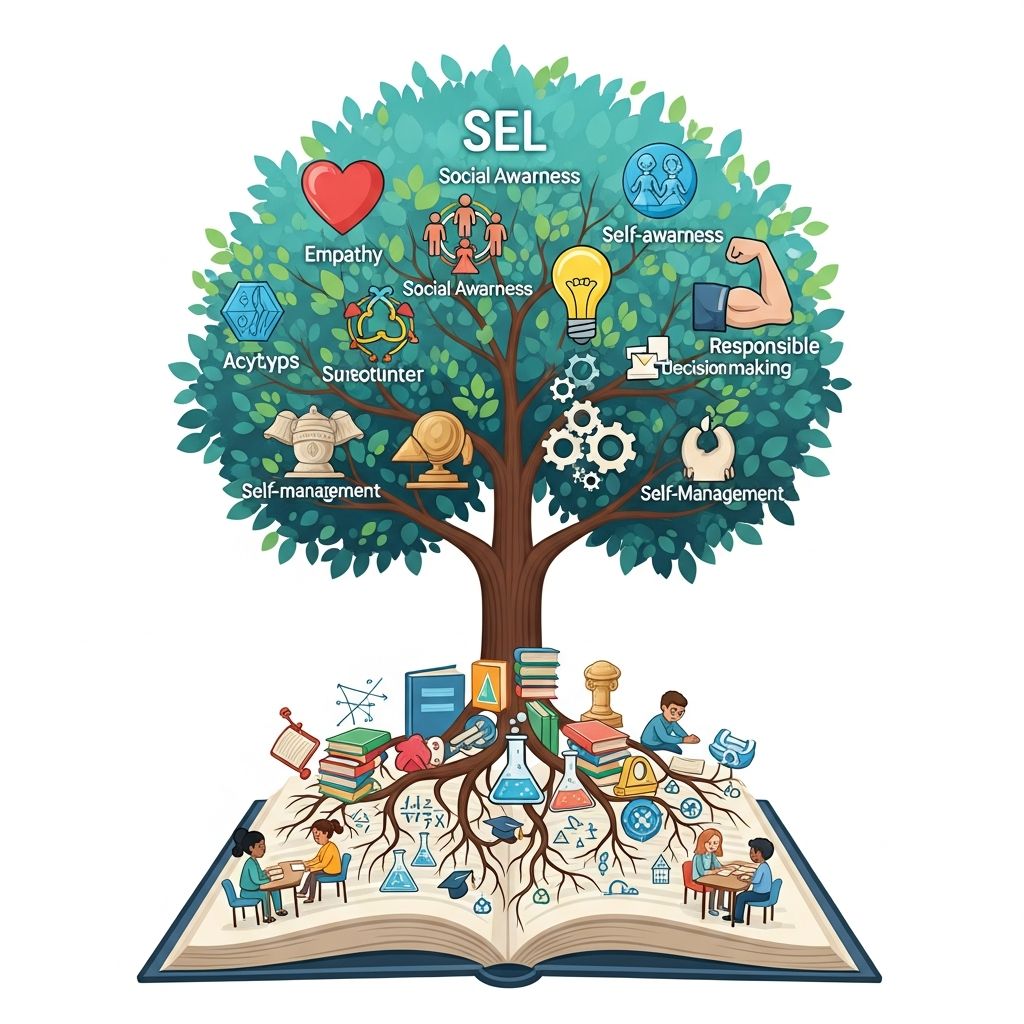
Social-emotional learning (SEL) equips students with essential skills for managing emotions, building relationships, and making responsible decisions. Integrating it into academic instruction transforms classrooms into holistic environments where emotional growth supports cognitive development.
Why Blend SEL with Academics?
Research shows that SEL integration improves academic outcomes, reduces behavioral issues, and promotes long-term success. Students who practice SEL competencies during lessons develop better focus, collaboration, and resilience, leading to higher achievement and fewer disruptions. Unlike standalone programs, embedding SEL makes it a natural part of the school day, aligning emotional skills with content standards for deeper learning.
Educators report that SEL-infused lessons increase student engagement and motivation. By addressing emotional needs alongside academics, teachers create supportive climates where students feel safe to take risks and persist through challenges. This approach also prepares students for real-world demands, fostering competencies like empathy and self-regulation that extend beyond the classroom.
Core SEL Competencies and Classroom Ties
CASEL outlines five key SEL competencies: self-awareness, self-management, social awareness, relationship skills, and responsible decision-making. Each can be woven into subjects through targeted activities.
- Self-Awareness: Helps students recognize emotions and strengths, aiding focus in tasks like reading comprehension.
- Self-Management: Builds impulse control and stress coping, crucial for math problem-solving under time pressure.
- Social Awareness: Encourages perspective-taking, enhancing group discussions in history or science.
- Relationship Skills: Promotes teamwork and communication, ideal for collaborative projects.
- Responsible Decision-Making: Teaches ethical choices, applicable in literature analysis or ethical science debates.
Aligning these with academic goals ensures SEL feels relevant, not additive.
Step-by-Step Guide to SEL Integration
Follow this structured process to embed SEL effectively, inspired by evidence-based frameworks.
- Identify Targets: Review standards and student needs to pair academic objectives with SEL skills. For a science unit on ecosystems, target relationship skills through group research.
- Pre-Assess: Gauge baseline knowledge in both areas via quick surveys or observations to tailor instruction.
- Plan Lessons: Design activities where SEL supports content, like using debates for social awareness in social studies.
- Deliver and Coach: Model skills, provide feedback, and notice SEL use in real-time.
- Reflect and Assess: End with discussions on what worked emotionally and academically.
This method ensures balanced growth, with teachers acting as coaches to scaffold skill application.
Subject-Specific SEL Strategies
Tailor integration to curriculum demands for maximum impact.
Mathematics: Building Persistence
In math, SEL fosters grit during complex problems. Use the Frame-Coach-Reflect model: Frame challenges by discussing needed self-management, coach during pair work, and reflect on strategies used. For standards like constructing arguments, students practice perspective-taking by critiquing peers’ reasoning, blending metacognition with social awareness.
| Math Objective | SEL Competency | Activity Example |
|---|---|---|
| Solve multi-step equations | Self-management | Timed challenges with positive self-talk prompts |
| Critique arguments | Social awareness | Peer review sessions with active listening |
| Group data analysis | Relationship skills | Collaborative graphing with role assignments |
English Language Arts: Enhancing Empathy
ELA naturally supports self-awareness through character analysis. Start lessons with emotion check-ins: “How does this character’s frustration mirror your own?” to build vocabulary and insight. Group reading circles promote relationship skills via active listening and respectful feedback.
Science and Social Studies: Collaborative Inquiry
These subjects thrive on teamwork. In science experiments, assign roles to practice decision-making and conflict resolution. Social studies debates build social awareness by exploring historical perspectives.
Daily Practices for Seamless SEL
Incorporate quick, consistent routines to reinforce SEL without disrupting flow.
- Daily affirmations for growth mindset.
- Kindness challenges, like peer compliments.
- Active listening drills before discussions.
- Stress management breaks with breathing exercises.
- Goal-setting reflections tied to lesson outcomes.
Class discussions and problem-solving are foundational: they provide authentic contexts for skill transfer, deepening understanding.
Creating Supportive Classroom Environments
A positive climate amplifies SEL. Foster belonging through community-building, like morning circles where students share wins and challenges. Use student-centered discipline focusing on restoration over punishment, teaching accountability. Intentional language explains SEL’s purpose: “This pairing builds teamwork for future careers”.
Overcoming Common Challenges
Time constraints worry many teachers, but micro-practices like 2-minute check-ins yield big results. Start small, track progress, and collaborate with colleagues via professional learning communities. Systemic support, like district initiatives, provides tools and training.
Measuring SEL Integration Success
Track via observations, student self-reports, and academic metrics. Rubrics assessing both content mastery and SEL use offer clear data. Improved engagement and reduced issues signal progress.
Frequently Asked Questions
What is the best way to start SEL integration?
Begin with one competency per week, aligning it to a familiar lesson, using the Frame-Coach-Reflect model for scaffolding.
How does SEL affect academic performance?
Studies show SEL boosts achievement by 11 percentile points and reduces conduct problems by 9%.
Can SEL fit into packed schedules?
Yes, embed it via existing activities like group work, avoiding separate lessons.
What resources support SEL planning?
CASEL’s tools, including lesson plans and playbooks, offer grade-specific examples.
How to engage reluctant students?
Share the ‘why’ explicitly and use relatable contexts to build buy-in.
Advanced Tools and Programs
Select evidence-based programs via CASEL’s guide, filtering for academic integration. Sample plans for K-12 subjects demonstrate strategy. Professional development on pedagogies like interactive learning ensures fidelity.
By prioritizing SEL, educators nurture resilient, empathetic learners ready for life’s complexities. Consistent practice yields transformative results across academics and personal growth.
References
- Integration of SEL and Academics — CASEL Schoolguide. 2023. https://schoolguide.casel.org/focus-area-3/classroom/integration-of-sel-and-instruction/
- Incorporating SEL into Everyday Academic Instruction — Student Behavior Blog. 2022-10-15. https://studentbehaviorblog.org/incorporating-social-emotional-learning-sel-into-everyday-academic-instruction-how-do-i-do-it/
- SEL in the Classroom — CASEL. 2024. https://casel.org/systemic-implementation/sel-in-the-classroom/
- How to Embed SEL Into Your Instruction — Edutopia. 2023-05-12. https://www.edutopia.org/article/how-embed-sel-your-instruction/
- How to Incorporate SEL in the Classroom — PBIS Rewards. 2024. https://www.pbisrewards.com/blog/how-to-incorporate-sel-in-the-classroom/
- Integrate Social Emotional Learning Skills into Content Areas — WebTeaching. 2023. https://www.webteaching.com/articles/integrateSELcontent.html

Medha Deb is an editor with a master's degree in Applied Linguistics from the University of Hyderabad. She believes that her qualification has helped her develop a deep understanding of language and its application in various contexts. Medha specializes in the areas of beauty, health, sports, and wellness and is committed to ensuring that the content on the website is…