
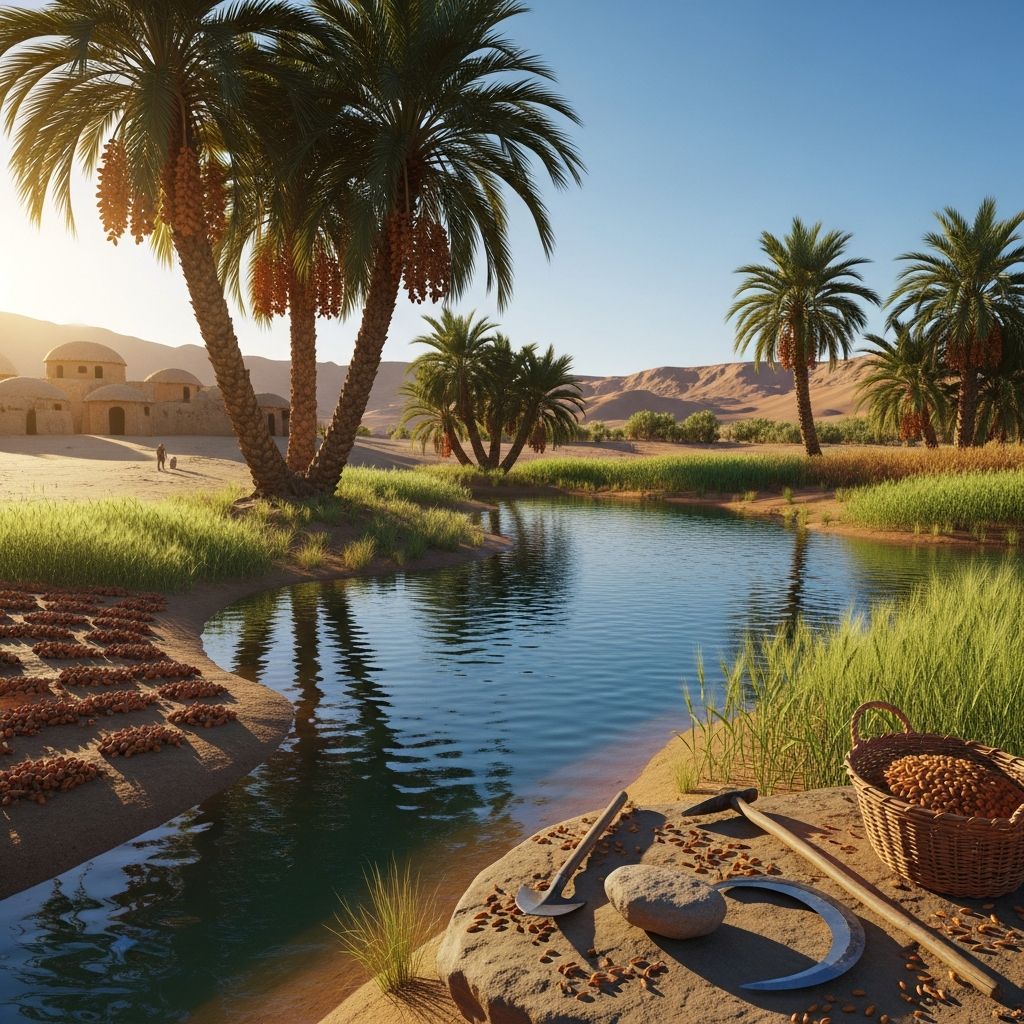
The Oasis Theory stands as a foundational idea in understanding how humanity transitioned from wandering hunter-gatherers to settled farmers. Proposed amid early 20th-century archaeological debates, it posits that environmental pressures, particularly post-Ice Age climate shifts, drove communities to water-rich oases in arid landscapes. There, close proximity to wild plants and animals fostered domestication, laying the groundwork for agriculture and complex societies.
Environmental Catalysts Behind Human Adaptation
At the core of the Oasis Theory is the notion that dramatic climate changes at the end of the Pleistocene epoch compelled human groups to cluster around scarce water sources. As vast ice sheets retreated around 10,000 BCE, many regions experienced increased aridity. This desiccation reduced available vegetation and game, pushing populations into refugia like oases—fertile pockets amid deserts sustained by underground aquifers or springs.
In these lush micro-environments, early humans encountered abundant wild cereals, legumes, and herd animals. The theory argues that survival necessitated intensified resource management: protecting seed caches from birds and beasts led to planting, while defending water holes from predators encouraged animal herding. Over generations, selective breeding emerged, transforming wild species into domesticates.
- Key Climate Shift: Post-glacial drying concentrated humans and resources.
- Oasis Role: Provided reliable water independent of rainfall, ideal for experimentation.
- Domestication Trigger: Forced cohabitation accelerated plant cultivation and animal taming.
Key Figures Who Shaped the Theory
Raphael Pumpelly, an American archaeologist, first articulated the Oasis Theory in 1908 during excavations at Anau in Central Asia. Observing stratified settlements near water sources, he suggested aridification funneled humans and fauna together, sparking symbiosis.
V. Gordon Childe, the influential Australian archaeologist, popularized the concept in his 1928 work The Most Ancient Near East and later texts. Childe framed it within his broader “Neolithic Revolution” paradigm, likening agriculture’s impact to the Industrial Revolution. He envisioned retreating monsoons and Atlantic depressions shifting north, squeezing communities into oases where domestication flourished.
Kathleen Kenyon bolstered the idea through 1950s digs at Jericho, revealing pre-pottery Neolithic settlements (c. 9000 BCE) with evidence of early farming near a perennial spring. Her findings aligned with Childe’s model, though debates with rivals like Robert Braidwood ensued.
Archaeological Evidence Supporting Oasis Scenarios
Sites across the Near East and beyond offer tantalizing clues. Jericho’s massive stone tower and domesticated emmer wheat (c. 8300 BCE) suggest settled life near a spring oasis. Similarly, the Ghassulian culture in the Jordan Valley (c. 3800 BCE) thrived around oases, yielding copper tools and irrigation traces.
In Turkmenistan, Pumpelly’s Anau layers show sequential occupation with grinding stones and animal bones, hinting at progressive domestication. Egyptian Fayum sites (c. 5000 BCE) reveal oasis-based fishing-farming communities transitioning to Nile Valley agriculture.
| Site | Date (BCE) | Key Finds | Oasis Link |
|---|---|---|---|
| Jericho | 9000 | Emmer wheat, tower | Spring-fed settlement |
| Anau | 5000 | Grinding stones, bones | Arid zone oasis |
| Fayum | 5000 | Barley, sheep | Lake oasis precursor |
| Beidha | 7000 | Goats, lentils | Highland spring |
These locales demonstrate how oases buffered climate stress, enabling surplus production and population booms.
Critiques and Modern Reassessments
Despite initial appeal, the Oasis Theory faced scrutiny. Paleoclimate data from pollen cores and lake sediments indicate the Near East grew wetter, not drier, post-10,000 BCE—contradicting Childe’s desiccation driver. Braidwood’s “Nuclear Zone Hypothesis” countered that domestication occurred in upland zones (Zagros, Anatolia) where wild progenitors thrived, not marginal oases.
Recent studies revive nuanced versions. A 2023 analysis tests the “oasis hypothesis of agricultural intensification,” arguing low-biodiversity, water-secure oases favored intensive farming over foraging. Cross-cultural data from the Ethnographic Atlas supports this, showing intense agriculture in such niches even after Neolithic spreads.
Demographic pressures and feasting models also compete, suggesting population growth or elite displays spurred cultivation independently of climate.
Global Parallels: Oases Beyond the Near East
While focused on the Fertile Crescent, oasis dynamics echo worldwide. In China’s Taklamakan Desert, the Xiaohe cemetery (2000 BCE) reveals Bronze Age oasis farmers growing wheat amid dunes. Mexico’s Tehuacán Valley oases hosted squash domestication (c. 7000 BCE). African Sahel oases sustained pearl millet cultivators.
These cases affirm geography’s role: water refugia as innovation hubs amid adversity.
Implications for Understanding Civilization’s Dawn
The Oasis Theory illuminates how environment shapes culture. It underscores adaptation’s ingenuity—turning scarcity into abundance. Though refined, it reminds us that agriculture’s roots lie in ecological opportunism, paving paths to cities, writing, and states.
Today, amid climate crises, its lessons resonate: resilient water management remains key to human thriving.
Frequently Asked Questions
What is the Oasis Theory in simple terms?
It proposes that drying climates post-Ice Age forced early humans to oases, where they domesticated plants and animals, inventing agriculture.
Who first proposed the Oasis Theory?
Raphael Pumpelly in 1908, later championed by V. Gordon Childe.
Is the Oasis Theory still accepted?
Largely critiqued for climate inaccuracies, but updated versions on intensification hold traction.
How did oases enable domestication?
Concentrated resources and humans/animals, fostering protection, planting, and herding.
What evidence supports it?
Sites like Jericho show early farming near springs amid arid surrounds.
References
- Oasis Theory: Early World Civilizations Study Guide — Fiveable. 2023. https://fiveable.me/early-world-civilizations/key-terms/oasis-theory
- Definition of Oasis Theory — Boundless World History. N/A. http://library.snls.org.sz/boundless/boundless/definition/oasis-theory/
- An Overview of the Oasis Theory History Essay — UKEssays. 2023. https://www.ukessays.com/essays/history/an-overview-of-the-oasis-theory-history-essay.php
- The Neolithic Revolution — Lumen Learning. 2023. https://courses.lumenlearning.com/atd-herkimer-worldcivilization/chapter/the-neolithic-revolution/
- Why did foraging, horticulture and pastoralism persist after the Neolithic transition? — PubMed (Philos Trans R Soc Lond B Biol Sci). 2023-06-26. https://pubmed.ncbi.nlm.nih.gov/37381847/
- Why did foraging, horticulture and pastoralism persist after the Neolithic transition? — Royal Society Publishing. 2023-08-14. https://royalsocietypublishing.org/rstb/article/378/1883/20220300/42677/Why-did-foraging-horticulture-and-pastoralism
- Theories of Middle East Sedentism — University of New Mexico. N/A. http://www.unm.edu/~gbawden/328-theory/328-theory.htm

Medha Deb is an editor with a master's degree in Applied Linguistics from the University of Hyderabad. She believes that her qualification has helped her develop a deep understanding of language and its application in various contexts. Medha specializes in the areas of beauty, health, sports, and wellness and is committed to ensuring that the content on the website is…