
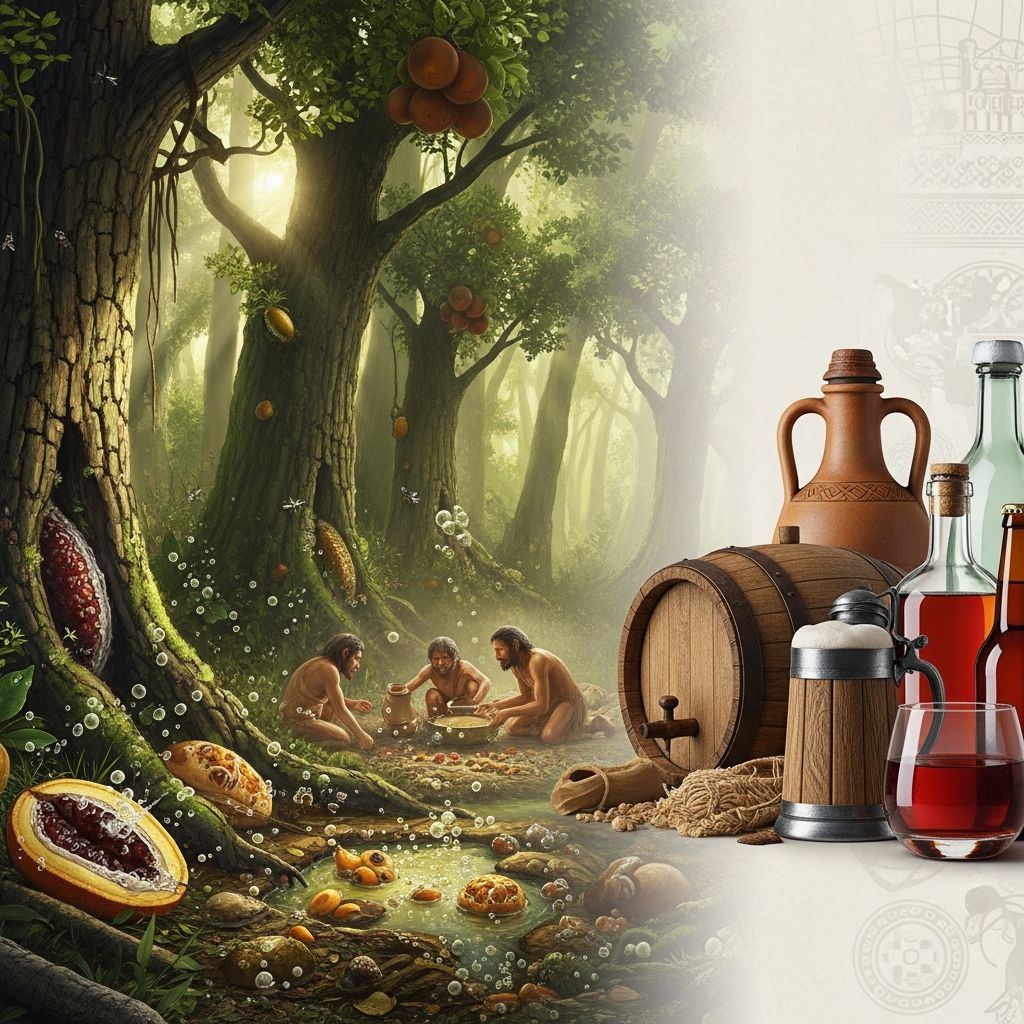
Alcohol’s journey begins with a simple natural process: fermentation, where yeasts convert sugars into ethanol and carbon dioxide. This phenomenon likely first caught human attention through accidental discoveries with fruits, grains, and honey, evolving into intentional production around 7000 BCE in ancient China.
The Natural Spark: Accidental Fermentation in Prehistory
Long before recorded history, alcohol emerged from nature’s own laboratory. Wild yeasts, present in the air and on fruit skins, would ferment sugars in overripe or damaged produce left unattended. Primates, including early human ancestors, consumed these naturally intoxicating fruits, gaining a metabolic adaptation to process ethanol that predates modern humans.
Archaeological evidence points to controlled fermentation emerging in the Neolithic period, around 10,000 BCE. Stone Age jugs containing residues suggest purposeful brewing, possibly tied to rituals. In a cave near Haifa, Israel, researchers uncovered a 13,000-year-old brewery site with stone mortars holding traces of wheat-and-barley-based alcohol, likely used in funerary feasts. This challenges the idea that agriculture preceded alcohol; some theorize the quest for reliable intoxication drove early farming.
- Key early evidence: Residues in Jiahu village pots, China (7000–6650 BCE), showing a mix of rice, grapes, hawthorn berries, and honey.
- Middle East parallels: Barley beer and grape wine around the same era in Iran (5400–5000 BCE) and Georgia (6000 BCE).
Ancient China’s Pioneering Brews: The Jiahu Discovery
The earliest verifiable alcoholic beverage hails from Jiahu, a Neolithic settlement in China’s Henan province. Chemical analysis of pottery residues, published in the Proceedings of the National Academy of Sciences, confirms a fermented mix from rice, honey, fruits, and millet dating to 7000 BCE. This beverage wasn’t just sustenance; it held ritual importance, blending nutrition with mild euphoria in early communal life.
As agriculture advanced with domesticated rice and millet, fermentation became systematic. These drinks nourished workers and featured in spiritual rites, laying groundwork for alcohol’s dual role as daily staple and sacred elixir.
Mesopotamia and Egypt: Beer as the Staff of Life
In the Fertile Crescent, around 4000–3000 BCE, beer emerged from barley and emmer wheat. Mesopotamians brewed ‘sikaru,’ a thick, nutrient-rich porridge-like beer essential for diet, wages, and religion. Workers received beer rations, and temples produced it on massive scales.
Ancient Egyptians refined this into ‘heqet,’ depicted in tomb art and texts. Beer was safer than water, its alcohol killing pathogens, and was given to children and laborers alike. The Ebers Papyrus (c. 1550 BCE) prescribes beer-based remedies, highlighting its medicinal value. Sumerian texts from 2100 BCE similarly note alcohol’s healing properties.
| Region | Main Ingredient | Cultural Role |
|---|---|---|
| Mesopotamia | Barley | Daily wage, ritual offering |
| Egypt | Emmer wheat | Food staple, medicine |
| China (Jiahu) | Rice, honey | Ritual beverage |
The Rise of Wine: Grapes and Mediterranean Civilizations
Where grapes thrived, wine followed. Georgia’s 6000 BCE evidence marks the oldest firm wine production, with residues in kvevri jars. By 3150 BCE, Egyptian vineyards yielded shedeh, a fermented pomegranate-grape mix for pharaohs.
In Greece and Rome, wine symbolized sophistication. Homer’s epics praise it, and Romans spread viticulture across Europe. Dionysus/Bacchus cults elevated wine to divine status, blending pleasure with mysticism. Celtic peoples brewed cider from apples as early as 3000 BCE, noted by Romans in 55 BCE Britain.
Beyond the Old World: Indigenous Ferments in the Americas
Alcohol wasn’t confined to Eurasia. Pre-Columbian Americas boasted diverse brews. In Mesoamerica, pulque—from maguey sap—dates to 200 CE carvings, revered in Aztec lore as a godly gift. Chicha, corn-based and sometimes spiced with hallucinogens, fueled Andean societies from grains, grapes, or apples.
Iroquois tapped sugar maple sap for mild beer, while Chiricahua made corn beer. These drinks integrated into rituals, trade, and survival, adapting to local flora.
- Pulque: Fructose-rich, milky ferment from agave.
- Chicha: Corn-mashed, communal staple.
- Maple sap beer: Sweet, seasonal Iroquois brew.
Distillation’s Revolution: From Ale to Spirits
Fermentation yielded low-alcohol drinks (3–15% ABV), but distillation concentrated spirits. Likely Arab-invented in the 8th century for alchemy, it reached Europe via trade. By the Middle Ages, monks distilled wine into brandy.
Whisky origins trace to Ireland (1405 record) and Scotland (1494), from malted barley. Nordic brewers influenced lager styles in colder climates, emphasizing controlled fermentation. Emil Christian Hansen’s 19th-century yeast isolation revolutionized brewing purity.
Alcohol’s Cultural and Social Tapestry
Across eras, alcohol wove into identity. Babylonians worshipped Ninkasi, beer goddess (2700 BCE). Greeks warned of excess in literature, yet mead thrived. In India, sura from rice (3000–2000 BCE) fueled rituals.
It drove exploration—rum fueled navies, wine trade built empires—and innovation, from safer drinks to global economies. Yet, overindulgence prompted regulations, from Greek symposia rules to modern laws.
Modern Legacy and Scientific Insights
Today, beer, wine, and spirits reflect 10,000-year refinement. Yeast genetics, per Hansen and Koch, enables pure strains. Fermentation remains vital; in antiquity, it purified water.
Global varieties—sake, tequila, vodka—echo ancient adaptations. Alcohol’s story is humanity’s: discovery, mastery, celebration, caution.
Frequently Asked Questions (FAQs)
What is the oldest evidence of alcohol production?
The earliest confirmed is from Jiahu, China, around 7000 BCE, with residues of rice, honey, and fruit ferment.
Did alcohol precede agriculture?
Possibly; 13,000-year-old Israeli brewery suggests ritual use before widespread farming, potentially incentivizing it.
Why was beer vital in ancient Egypt?
It was nutritious, safer than water, and used medicinally, rationed to workers and children.
What are some Native American alcohols?
Pulque (maguey), chicha (corn), and maple sap beer, integral to rituals and daily life.
When did distillation begin?
8th century Arab alchemy, spreading to Europe for spirits like whisky by the 15th century.
References
- Spirits Through the Ages: Unveiling the History of Alcohol — Eight Oaks Distillery. 2023. https://eightoaksdistillery.com/blog/spirits-through-the-ages-unveiling-the-history-of-alcohol/
- How Was Alcohol Discovered? — Britannica. 2023. https://www.britannica.com/technology/How-Was-Alcohol-Discovered
- A brief history of alcohol – Rod Phillips — TED-Ed (YouTube). 2013-10-23. https://www.youtube.com/watch?v=y5XEwTDlriE
- History of alcoholic beverages — Wikipedia (citing PNAS study). 2024. https://en.wikipedia.org/wiki/History_of_alcoholic_beverages
- A short history of beer brewing: Alcoholic fermentation and yeast — PMC (NCBI). 2022-12-13. https://pmc.ncbi.nlm.nih.gov/articles/PMC9724654/
- A Brief History of Alcohol & Alcoholic Beverages — Foundation for a Drug-Free World. 2023. https://www.drugfreeworld.org/drugfacts/alcohol/a-short-history.html

- Integrated M.A. in Applied Linguistics, University of Hyderabad
- 5+ years in editorial, instructional, SEO, and research-based writing
Sneha is a relationships and lifestyle writer with a strong foundation in applied linguistics and certified training in relationship coaching. She brings over five years of writing experience to theskillvault, crafting thoughtful, research-driven content that empowers readers to build healthier relationships, boost emotional well-being, and embrace holistic living. Her writing and insights reflect the belief that beauty, happiness, and wellness…